































































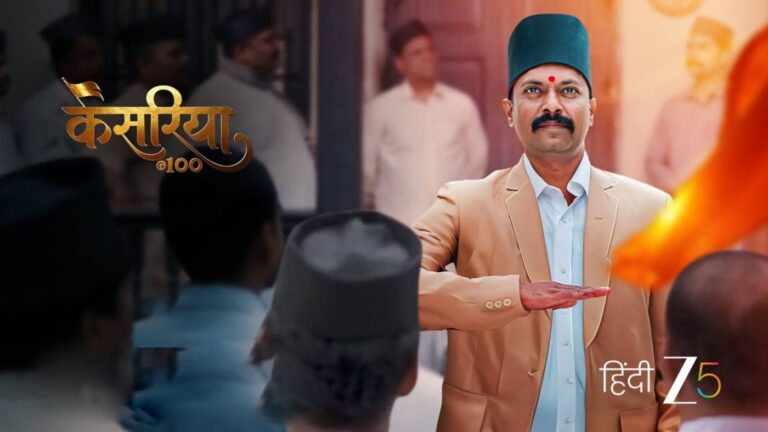
ZEE5 has dropped the official trailer of its upcoming docuseries, Kesariya@100, hosted by actor Nitish Bharadwaj (known for his role as Lord Krishna), and set for a 12 December release. Focused on the Rashtriya Swayamsevak Sangh (RSS) as it nears its centenary (100 years), the series is framed by its promoters as a look into the organisation’s role in nation-building.
However, given the RSS’s long-standing, often controversial position in Indian politics and society, the question arises: will it be an effective historical analysis, or lean towards propagandistic narrative control?
The promotional material for Kesariya@100 suggests a focus on the RSS as a “nationalist organisation”, exploring how it “inspired patriotic minds and paved the way for nation-building.” This aligns with the RSS’s self-perception as a cultural and social movement dedicated to promoting Hindutva.
The choice of Nitish Bharadwaj, who is also noted to have previously been involved in directing a documentary on former RSS chief M.S. Golwalkar to clear ‘wrong’ notions against the Sangh, suggests the documentary’s perspective may be one of affirmation and clarification of the RSS narrative.
The RSS believes that it stands for instilling national spirit and cultural pride. However, RSS leaders such as founder K.B. Hedgewar and later chief M.S. Golwalkar largely kept the group separate from movements against British rule led by the Indian National Congress, such as the Quit India Movement.
They did not want to fight the British government. Instead, their main focus was on defending religion and culture, not fighting for independence. Critics often highlight the RSS’s absence from the freedom struggle.
In addition, the RSS has been banned three times by the Indian government: in 1948, following the assassination of Mahatma Gandhi by Nathuram Godse, a former RSS member; in 1975, during the Emergency; and in 1992, following the demolition of the Babri Masjid. ZEE5, therefore, needs to deliver a critical documentary that addresses these bans and the underlying communal and political tensions that led to them.
Furthermore, the RSS is the ideological parent and crucial support base for the ruling Bharatiya Janata Party (BJP). Most key BJP leaders, including the current Prime Minister, have a long association with the RSS. Any series produced in the current media environment is inherently subject to scrutiny regarding its political neutrality, especially one that promotes a powerful organisation closely allied with the ruling government.
This is why, in order to emerge as a truly effective documentary, Kesariya@100 must offer a balanced, critical, and evidence-based historical account. It should acknowledge the RSS’s grassroots work in social service, discipline, and disaster relief.
It should also critically analyse its core ideology of Hindutva, including the criticisms regarding its stance on minority groups, its historical role during the independence struggle, and its influence on contemporary Indian politics.
Ultimately, while the forthcoming ZEE5 series may serve as an effective vehicle for the RSS to present its preferred self-image to a large digital audience, its value as an objective historical documentary remains questionable until the final content is released and subjected to independent academic review. Stay tuned for more updates.
Check out the latest trailer for Kesariya@100!
We’re hiring!
We are hiring two full-time junior to mid-level writers with the option to work remotely. You need to work a 5-hour shift and be available to write. Interested candidates should email their sample articles to [email protected]. Applications without a sample article will not be considered.
