































































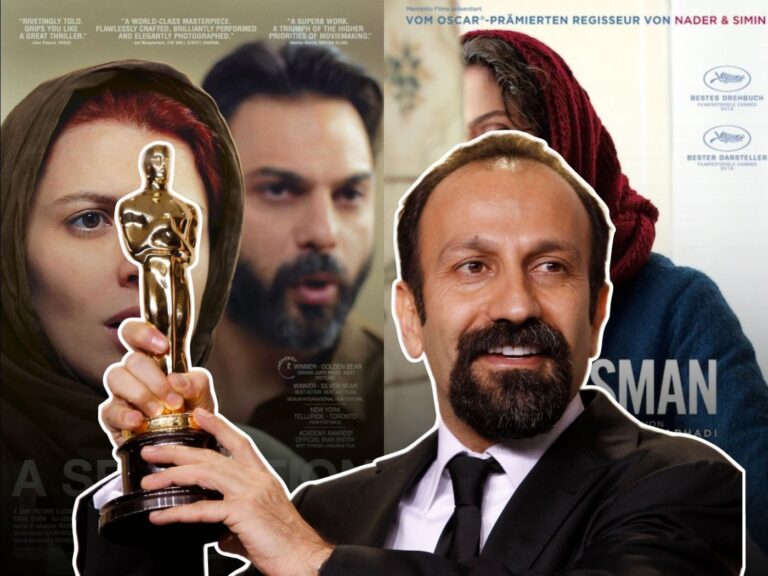
Asghar Farhadi is not just a director; he’s a storyteller who turns the mundane into moments of deep emotional complexity. In a cinematic world full of grand narratives and epic spectacles, Farhadi’s films stand out for their intimate focus on human relationships and moral dilemmas. His direction brings a subtlety that resonates long after the credits roll, making him one of the most compelling filmmakers in contemporary cinema.
Farhadi’s films often revolve around simple, everyday situations, yet these situations are crafted with such precision that they unfold into multi-layered dramas. His ability to transform a seemingly trivial incident into a profound examination of human nature is what makes his work exceptional.
Take A Separation for instance. The film opens with a couple, Nader and Simin, arguing over their divorce. At first glance, it seems like a straightforward domestic dispute. However, as the story progresses, this small conflict branches out into a web of moral, ethical, and social questions. Farhadi doesn’t provide easy answers. Instead, he lets the audience grapple with the complexities of each character’s perspective.
In The Salesman, another one of his masterpieces, Farhadi explores the fallout of a traumatic event in a couple’s life. Emad and Rana are actors rehearsing for a production of Death of a Salesman when an assault in their apartment disrupts their lives.
The film delicately balances the personal and the public, the psychological and the physical. What sets Farhadi apart is how he handles these delicate subjects without ever turning them into melodrama. He lets the tension simmer beneath the surface, allowing small gestures and quiet moments to speak volumes.
One of Farhadi’s key strengths is his use of ambiguity. In his films, there is no clear villain or hero—everyone is flawed, everyone is human. In A Separation, both Nader and Simin have valid reasons for their actions, and yet both are complicit in the escalation of the conflict. Farhadi leaves the moral judgment to the audience, making his films not only stories to watch but ethical dilemmas to ponder. This moral ambiguity gives his films a richness and depth that keeps viewers engaged, even after the story ends.
Another hallmark of Farhadi’s direction is his focus on dialogue. His films are rich in conversations that reveal the inner workings of his characters’ minds. In The Past, the dialogue between Ahmad, Marie, and Samir slowly unravels the tangled relationships that have built up over the years.
The film doesn’t rely on dramatic outbursts to convey the characters’ emotions; instead, it uses quiet conversations that are loaded with meaning. Farhadi’s dialogue feels natural and unforced, yet every word carries weight, drawing viewers deeper into the narrative.
Farhadi’s attention to detail is another aspect that elevates his work. The settings of his films are often ordinary—a family apartment, a courtroom, a school—but within these mundane spaces, he builds intricate emotional landscapes. In The Salesman, the apartment where Emad and Rana live becomes a character in itself, a place where trauma, fear, and trust are constantly at play. Farhadi uses these spaces to heighten the tension and underscore the emotional stakes of his stories.
His ability to draw powerful performances from his actors is another reason why Farhadi’s films resonate so deeply. In A Separation, the performances of Leila Hatami and Peyman Moaadi are a testament to how Farhadi’s direction allows actors to explore the full emotional range of their characters.
The subtle nuances in their performances—Hatami’s quiet resolve and Moaadi’s simmering frustration—add layers to the story that go beyond the dialogue. Farhadi trusts his actors to communicate the complexities of their characters, and this trust results in some of the most compelling performances in contemporary cinema.
Farhadi also excels in crafting narratives that are deeply rooted in their cultural context while remaining universally relatable. His films often reflect the tensions of Iranian society, where tradition and modernity collide, yet the emotions at play are ones anyone can understand—love, guilt, shame, and responsibility. In The Past, although the film is set in France, the themes of memory, forgiveness, and the burden of the past are universal. This ability to tap into both the local and the global makes Farhadi’s work resonate with audiences around the world.
One of Farhadi’s most remarkable traits is his empathy for his characters. Even when they make questionable decisions, he never condemns them. Instead, he presents them as real, flawed people doing their best in difficult situations. In The Salesman, Emad’s quest for justice becomes increasingly obsessive, yet Farhadi never portrays him as a villain. He is simply a man trying to reclaim his dignity in a situation that feels beyond his control. This empathy allows viewers to see themselves in Farhadi’s characters, to recognize their own fears, desires, and insecurities.
What ultimately sets Farhadi apart is his deep understanding of the human condition. His films are not about what happens to his characters, but about how they react to what happens. They are studies in emotion, in the complexity of relationships, in the fine line between right and wrong.
Farhadi doesn’t give us easy answers because there are none. Life is complicated, and so are the people in it. Through his direction, Farhadi invites us to sit with that complexity, to feel the discomfort of not knowing, and to empathize with the difficult choices his characters must make.
In a world where films often rush to provide neat conclusions, Asghar Farhadi stands out as a filmmaker who embraces ambiguity and complexity. His films are not just stories; they are emotional and ethical experiences that challenge us to think deeply about our own lives and the choices we make. Farhadi’s direction reminds us that the most powerful dramas often come from the simplest of human interactions, and in his hands, those interactions become unforgettable cinematic experiences.
We’re hiring!
We are hiring two full-time junior to mid-level writers with the option to work remotely. You need to work a 5-hour shift and be available to write. Interested candidates should email their sample articles to [email protected]. Applications without a sample article will not be considered.
