































































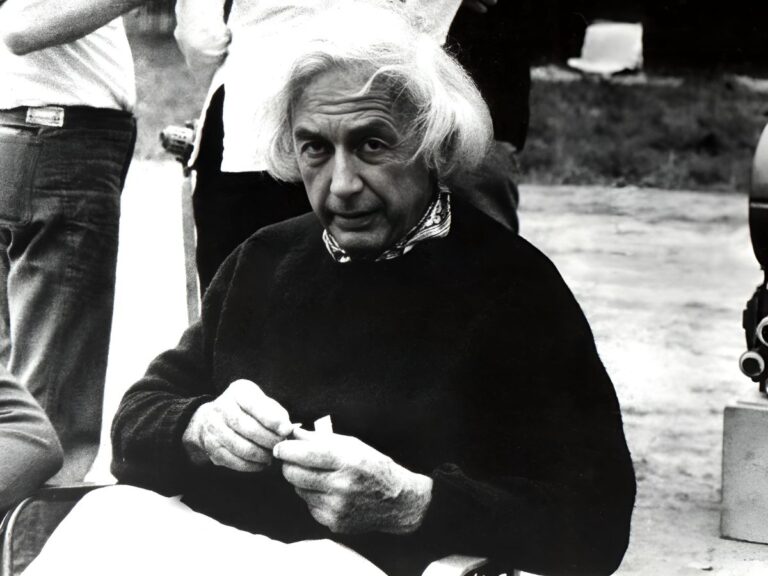
What is it about Robert Bresson’s films that lingers so profoundly, even when they seem almost devoid of emotion? How does he pull us into the world of his characters while deliberately stripping away traditional elements of cinematic storytelling?
To understand Bresson’s genius, we must delve into his unique approach to directing, one that redefined the language of cinema and set him apart as a true auteur.
Bresson’s films are an exercise in restraint—he avoids grand gestures, theatricality, and even overt emotion, preferring a minimalist style that distills each moment to its essence. In a film industry driven by spectacle, Bresson’s work asks a fundamental question: Can simplicity be as powerful, or even more so, than excess? For Bresson, the answer is a resolute “yes.” His approach is rooted in his belief that “true cinema” lies in the subtle, in the unspoken, in the things left unsaid.
One of Bresson’s most distinctive techniques was his refusal to work with trained actors. Instead, he used what he called “models”—non-actors whom he would rigorously train to deliver their lines without expressiveness. This might seem counterintuitive in a medium that thrives on emotional connection, but Bresson was less interested in showing feelings than in invoking them within the audience.
Consider Pickpocket, where Bresson’s protagonist, Michel, seems detached, his face nearly blank even in moments of intense inner conflict. Yet this restraint draws us into Michel’s world, making us fill in the gaps ourselves. Isn’t it remarkable how Bresson’s minimalism forces us to empathize more deeply? By stripping down his models’ performances, Bresson placed the emotional burden on the audience.
In Au Hasard Balthazar, we follow a donkey, Balthazar, as it changes hands among various owners who treat it with different degrees of kindness and cruelty. Balthazar does not “act” or respond as a human character might, yet through its silence and resilience, we come to understand the harshness of the world around it. Bresson knew that sometimes, silence can speak louder than words.
Bresson’s use of cinematography is another key aspect of his distinctive direction. Each frame in a Bresson film feels meticulously crafted, not to dazzle, but to convey meaning with simplicity and precision. He often avoided establishing shots or wide-angle views, preferring close-ups and tight framing.
In A Man Escaped, a film about a prisoner planning his escape, Bresson’s camera work draws us into the protagonist’s claustrophobic environment. We don’t see the entire prison, only small sections, like a hand chiseling away at the wall or a face reacting to footsteps in the corridor. By narrowing our view, Bresson amplifies our sense of confinement. Do we need more than this focused detail to feel the tension?
Similarly, in Diary of a Country Priest, Bresson uses close-ups and limited spaces to convey the isolation and inner turmoil of the protagonist. The priest’s existential struggles and physical suffering are depicted not through overt drama but through restrained visuals, allowing us to feel his pain without embellishment. Bresson’s technique here is like a meditation—he doesn’t show us everything, only what we need to feel the weight of the priest’s crisis.
Bresson’s use of sound is equally deliberate and sparse. He once said, “When a sound can replace an image, cut the image or neutralize it. The ear goes more towards the within, the eye towards the outer.” In Lancelot du Lac, Bresson gives us a medieval world that sounds more like a monastery than a battlefield. We don’t hear the usual clanging swords or shouts of warriors.
Instead, Bresson removes sound or uses it minimally, focusing on the clinking of armor or the footsteps of knights in empty corridors. This auditory minimalism feels almost monastic, as if we are listening to an ancient ritual rather than a battle. Doesn’t this approach make us question our need for noise in storytelling?
Even in Au Hasard Balthazar, the sounds are sparse and often diegetic—the clip-clop of hooves, distant church bells, the murmurs of villagers. Bresson allows silence to permeate his scenes, letting us feel the weight of each moment. Where most directors would use music to amplify emotions, Bresson believes in quiet. This absence of embellishment forces us to confront the rawness of his stories.
Bresson’s films grapple with deep themes, often focusing on spiritual redemption, moral struggle, and human frailty. But unlike other directors who might approach these themes with overt religiosity, Bresson’s spirituality is grounded, almost secular. His characters are not saints; they are flawed, broken individuals seeking meaning in an indifferent world. Take Mouchette (1967), where a young girl endures relentless suffering.
There is no “redemption” for her in the traditional sense, no climactic moment of salvation. Yet Bresson treats her story with such dignity that it transcends her pain, allowing the audience to glimpse a quiet, unspoken grace. In his restrained direction, Bresson seems to ask, “Can there be beauty in suffering?” For him, grace does not come through miracles but through resilience and endurance.
In A Man Escaped, the theme of redemption is intertwined with the protagonist’s meticulous escape plan, a testament to Bresson’s belief in persistence as a form of grace. The prisoner’s escape isn’t driven by defiance but by a quiet determination to reclaim his freedom. Is Bresson suggesting that grace lies in this silent strength, in the will to survive despite overwhelming odds?
While Bresson’s films might feel stark, almost ascetic, they invite us to experience cinema in its purest form. His work forces us to see, to hear, and ultimately, to feel in ways that we might not be accustomed to. In a world of excess, Bresson’s restraint was, and remains, revolutionary. His approach asks a bold question: What happens when a director removes everything that’s “extra” in film? The answer, as Bresson proved time and again, is that simplicity can reveal the profound.
Bresson’s influence can be seen in filmmakers who value subtlety and introspection, such as Andrei Tarkovsky and Terrence Malick. They, too, draw us into worlds where silence speaks volumes, where inner conflict matters more than outer action. But Bresson’s style remains unique in its unyielding purity—an approach that, even decades later, challenges us to rethink what cinema can be.
Robert Bresson’s direction stands as a testament to the raw, unfiltered power of cinema. By stripping his films of conventional embellishments, he draws us into a world where silence, stillness, and restraint reveal a profound depth of feeling. Bresson doesn’t spoon-feed emotions or manipulate with spectacle; instead, he challenges us to search for meaning within his austere frames, to listen to the unsaid, to see beauty in restraint.
This approach, so uncompromising and meditative, elevates his films to something more than just stories—they become experiences that linger, urging us to question our own need for noise and visual excess. Bresson’s legacy reminds us that true cinematic impact isn’t achieved by more but by less, and through that subtraction, he has redefined what it means to truly see and feel a film. In this simplicity, Bresson’s work transcends time, forever reshaping our expectations of what cinema can reveal.
We’re hiring!
We are hiring two full-time junior to mid-level writers with the option to work remotely. You need to work a 5-hour shift and be available to write. Interested candidates should email their sample articles to [email protected]. Applications without a sample article will not be considered.
