































































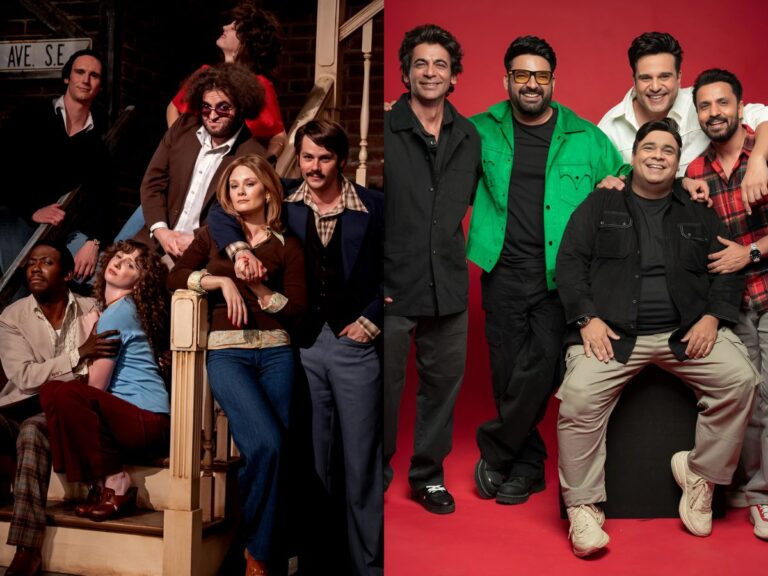
Late-night talk shows in the US and primetime shows in India have always been cornerstones of entertainment, but the direction they’re headed tells two very different stories. Let’s break it down.
Take The Great Indian Kapil Show as an example. In its third week of the latest season, an episode featuring Rohit Sharma and the World Cup champions could only pull in 1.3 million views.
In contrast, Season 1 had a much better run. When Rohit Sharma appeared back then, that week scored the highest viewership of the season at 2.6 million views—beating even Ranbir Kapoor’s debut week of 2.5 million views. So, what’s changed?
Over the first three weeks of this season, Kapil’s show amassed a total of 4.3 million views, but if we look back at the same period last season, it garnered a whopping 6.8 million—58% more than the current one. In fact, this season has been left behind by competitors. It couldn’t surpass Jr. NTR’s episode, which drew 1.8 million views, but it did manage to beat Alia Bhatt’s week, which had 1.2 million.
While this paints a worrying picture for Kapil Sharma, Saturday Night Live (SNL) tells a very different story. Despite its longstanding history, SNL has continued to stay relevant and maintain solid viewership numbers.
For instance, the season premiere featuring Ryan Gosling saw a 3% increase in viewership compared to last season’s premiere, with 8.9 million total viewers across both linear TV and digital platforms.
SNL thrives on change. It adapts to what’s trending, always bringing in fresh faces, humor, and satire that resonates with its audience. This ability to reinvent itself with every season is crucial to its success, something that Kapil’s show seems to struggle with. While SNL is embraced by the younger generation, Kapil Sharma’s show is stuck with the same formula, jokes, and structure that worked in the past but are now wearing thin.
SNL has also mastered the art of extending its reach beyond just live TV. Its sketches regularly go viral on platforms like YouTube and TikTok, broadening its audience far beyond the traditional viewer. Kapil Sharma’s show, meanwhile, hasn’t adapted in the same way, losing out to global competitors like Culinary Class Wars, which topped the global chart with 4 million views in the same week Kapil’s show sat at sixth place.
Ultimately, Saturday Night Live is surviving—and thriving—because it knows how to evolve. The Great Indian Kapil Show has all the talent and potential but without innovation, it risks further decline in a competitive landscape.
We’re hiring!
We are hiring two full-time junior to mid-level writers with the option to work remotely. You need to work a 5-hour shift and be available to write. Interested candidates should email their sample articles to [email protected]. Applications without a sample article will not be considered.
