































































Films, back in the day, used to be a 25 or 50 week-run affair (some even more!) and time would decide its fate. Then came a time when a film would be declared a hit/flop based on its performance in the first couple of weeks. However, today, this scene has changed entirely with the entry of the digital space, where the film’s success is more or less certain by the time its trailer is out! Much earlier from the 70s to the 90s, film promotions were only about one announcement, a few events and an interview or two, so a film had to completely rely on stars, their image or good music for its success. More often than not, it had to cater to the mood of the audience and would be a repetition of what was in trend at the time. One has to remember that this was a time when people didn’t have easy access to interviews, since there were hardly a few film magazines with a monthly or quarterly issue at best.
Since then, we have seen a shift in dynamics and nearing 2005, films were promoted heavily with unique campaigns, music launches and the lead cast doing a bunch of city tours, hitting popular colleges and malls to engage with larger audiences. It also helped that interviews were more frequent, popular and accessible due to the arrival of the internet. Though, all this still didn’t guarantee a film’s success because the engage-rate wasn’t really as high to work the box office numbers. Public visits in metro cities would see gatherings of a few hundreds to thousands, with smaller cities accounting for much less. Although these strategies were new at the time and helped increase the star’s stardom, it was extremely tiring and proving to be quite expensive. Then nearing 2010, new marketing strategies evolved and actors started appearing on every fictional or reality show on TV to promote their films. Up until a couple of years back, these tactics really worked since Television in India still reaches a much larger audience than any other medium.
More recently, with the digital space taking over, the need to be visible through TV shows and occasional public visits has considerably reduced. While we do see some traditional promotional activities, launches and interviews from time to time, other forms of public engagement have taken a back seat. This can be attributed to the fact that stars now interact directly with their fans through social media platforms. The need to be real and accessible to fans has really helped enhance an actor’s stardom and with time, this has ensured a worldwide reach for each promotional activity, which was a major problem earlier. The target audience with social media is clear (roughly 15 – 40 yrs), resulting in a number of digitalized campaigns and personalised strategy moves to promote a film.
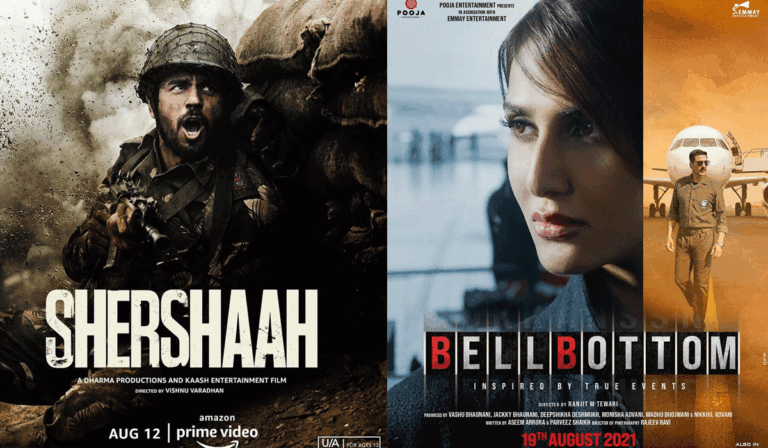
So we have finally arrived at a time now, when a film’s promotion comprises of a first announcement, a ‘First Look’- generally released as a poster or a small video clip, a Teaser Clip- like a mini trailer, the Main Trailer Launch, followed by individual Song Launches that now involve each song releasing on a separate day. Mind you, these are only the formal strategies. Apart from these, regular filming updates are also a thing now, where the actors or makers take to social media to share announcements about a schedule completion or a change of shooting location. Actors now also go to the extent of sharing daily or weekly updates from the film sets, thus engaging with fans and giving them the necessary daily dose to be in the news. Let’s take the example of upcoming film ‘Shershaah’ and its social media approach. In the last 10 days, alongside song launches, they have been posting some Behind-the-Scene clips as well as romantic reels of the lead actors to showcase their chemistry. These reels are short videos and get millions of likes and views immediately and help keep them and the film in the public eye. These extremely well planned tactics dont take up much time and still reach millions of eyeballs simultaneously across the globe.
These marketing strategies have not only proved to be successful but also quite cost-effective, spanning over a year or more, from the initial announcement to the film’s release date. Fans are also thrilled and feel involved in the making process, since they’re a part of the entire journey, right from a film’s inception to its release. These timely updates and developments help to create the necessary buzz and keep fans intrigued to know more. With many films releasing digitally too, this shift in strategy is of extreme importance since now a film’s fate is decided by the initial teaser or trailer. So of course, one wrong move can heavily impact a film’s success. Though at a time when actors are constantly busy, juggling shoots and over booked for dates, these strategies work well since not much of their time after shoot completion is needed for extensive promotional activities.
We have reached a new cinematic era where ‘Content is King’ and rightly so, since the target audience for these promotions is the youth, resulting in all kinds of films doing well. Where once only repetitive films were a success (we saw a whole decade of only one kind of action movies in the 70s), we have come to a time where repetition is a guaranteed failure. Our attention spans are lowering and we have become very picky in the content we watch, hence only the new and the catchy are making its way to seeing the light of day.
We’re hiring!
We are hiring two full-time junior to mid-level writers with the option to work remotely. You need to work a 5-hour shift and be available to write. Interested candidates should email their sample articles to [email protected]. Applications without a sample article will not be considered.
