































































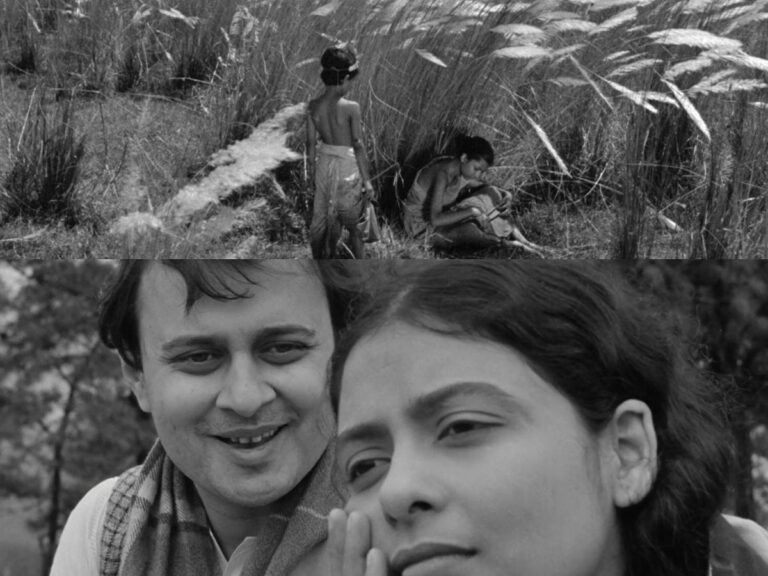
In terms of art, Bengal has definitely been one of the most important pillars in India. From revolutionary filmmakers such as Satyajit Ray, Mrinal Sen, and Ritwik Ghatak to composers such as R. D. Burman and S. D. Burman, they have contributed not only to Bengali cinema but to Indian and global cinema too.
But now, things have changed. How?
The golden era of Bengali cinema gave us iconic films like Pather Panchali and Meghe Dhaka Tara—movies that not only showcased Bengal’s rich cultural ethos but also held up a mirror to society’s complex issues.
Filmmakers during that period were unafraid to explore bold themes like class struggles, existential dilemmas, and the human condition. It was cinema driven by deep-rooted ambition, passion, and a desire to break conventional barriers.
Today, however, the Bengali film industry seems to be standing at a crossroads. While regional industries like Telugu and Malayalam cinema are making waves nationally and internationally, pushing boundaries with content like RRR and Jallikattu, Bengali cinema has been relatively quieter on the global front.
Take Autograph (2010) by Srijit Mukherji, for instance—this film was a breath of fresh air, reigniting a sense of hope that Bengali cinema was ready to evolve again. The narrative was smart, and the execution was sharp.
But fast forward to the last few years, and the output appears more complacent. Commercial ventures like Challenger (2023) and Aparajito (2022) may find local success but fail to leave a lasting impact outside of Bengal. It’s not about the lack of talent, but the ambition to push beyond the comfort zone that seems missing.
Even in terms of content, there’s been a shift towards formulaic storytelling—comedies, family dramas, and romance-heavy films. While these genres are popular, they rarely challenge audiences the way early films did.
The complexity and risk-taking spirit, once synonymous with Bengali cinema, seem subdued in favor of safer choices. Unlike the Tamil industry’s daring ventures like Super Deluxe or Kannada cinema’s KGF, we aren’t seeing films that generate national or global discussions.
At the same time, it’s important to acknowledge that there are filmmakers like Kaushik Ganguly (Bishorjan) and Anik Dutta (Bhobishyoter Bhoot), who still aim to create meaningful cinema. However, their work remains limited to niche audiences without the broader appeal or ambition to resonate on a pan-Indian or global scale.
So, is Bengali cinema truly suffering from a lack of ambition?
It’s more complex than a simple yes or no. The industry is filled with talented individuals, but the hunger to innovate, take risks, and tell stories that transcend local boundaries seems to be dwindling.
For Bengali cinema to regain its former glory, it needs to think bigger, push creative limits, and move beyond its safe formulas—just like its golden era did. Otherwise, it risks being overshadowed in a rapidly evolving Indian film landscape.
We’re hiring!
We are hiring two full-time junior to mid-level writers with the option to work remotely. You need to work a 5-hour shift and be available to write. Interested candidates should email their sample articles to [email protected]. Applications without a sample article will not be considered.
