































































For years, and even generations, Bollywood’s ultimate holy grail has been the formula for making the “four-quadrant” masala movie. This procedure was simple to implement and bestowed lucrative results for filmmakers until 2019, or what some of us like to call the “pre-COVID” period.
What are the ingredients of this formula? Make a movie that appeals to children, their parents, their elder siblings, and their grandparents, and you secure a blockbuster. Throw in a 50-something megastar, 3–4 dance tracks, a dash of strong emotions (usually patriotism, love, anger, sacrifice, etc.), and some gravity-defying action, and the box office takes care of itself. But that’s no longer the case.
The data disclosed by the latest Ormax reports tells a different story. The “universal family audience” is effectively dead, replaced by a demographic shift that Bollywood is actively struggling to decode.
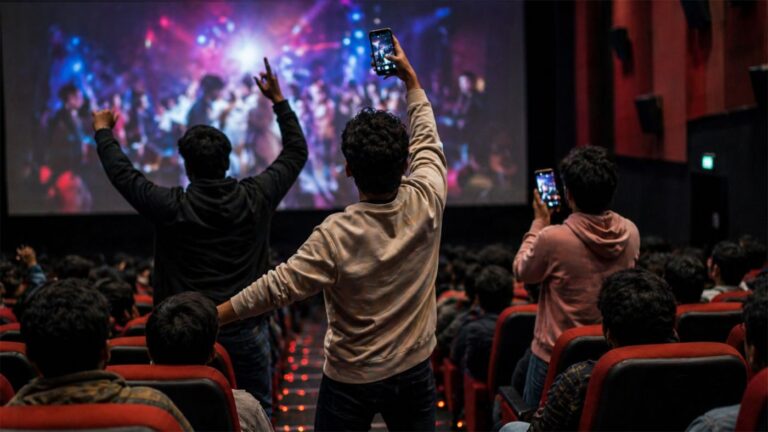
According to one of the latest reports unveiled by Ormax, a staggering 57% of the Hindi box office is now driven by audiences under the age of 30. Gen Z and younger Millennials are officially the primary financial gatekeepers of Hindi cinema.
We know that Hindi movies have a much stronger hold in the northern and central regions of India, so this scenario emerges as a much bigger factor in the aforementioned regions than in the country’s southern regions.
At first glance, this looks like a golden ticket for studios. A young, digitally native audience should mean easy marketing and consistent weekends, right?
Not quite.
When you cross-reference this youth explosion with Ormax Media’s TOBAR report, which maps out the five distinct behavioural segments of India’s regular theatregoers, a massive structural fault line appears.
The under-30 crowd isn’t blindly loyal to ageing icons. They have also completely fragmented the traditional theatre experience. The last 12 months of box-office data of Bollywood movies will help you understand this situation better.
It’s about time that the industry’s so-called older “gatekeepers” started taking younger audiences more seriously and stopped dismissing them as consumers with “short attention spans” who only care about viral trends, memes, or reels. The Ormax data paints a vastly more complex picture.
There is no denying that OTT platforms and the content they provide to users in the comfort of their homes have completely changed the dynamics of the industry. The biggest impact they have had on the minds of viewers (particularly the SSSs – Spectacle and Story Seekers) is that they now focus on attending theatrical screenings only for big-budget, event-level movies or films that are generating serious buzz through their unique or intriguing content, regardless of budget. These are the audiences who love visiting theatres to enjoy the immersion, scale, and compelling storytelling that come with these projects.
We saw this in full force with the massive, culture-shifting success of Aditya Dhar’s blockbuster spy thrillers, Dhurandhar and Dhurandhar: The Revenge, which became viral events that young audiences raced to witness first-hand.
But this has also significantly reduced theatre footfalls, as audiences prefer watching small-scale or generic masala template flicks on OTT platforms instead of spending their time and money in theatres. High prices associated with F&B (food and beverages) at theatre chains have also become a major issue.
Then, we have the Masala Men, a slightly older, heavily male-skewed, and star-driven segment that treasures action and mainstream theatrical entertainment.
Border 2’s success seems like a perfect fit for this category. This sequel not only strengthened Sunny Deol’s filmography but also attracted a noticeable number of loyal older fans of the original 1997 cult classic, Border. In addition, the film’s strong emotional and nationalistic tone heavily appealed to middle-aged and older citizens, veterans, and military enthusiasts.
We also have the Gen Z gang, which comprises young people deeply connected to modern cultural nuances and trends. This section of the audience relates to movies as a shared social experience and has a strong liking for accessible, mood-led genres. We all know how much this demographic contributed to Saiyaara’s massive success.
Apart from these categories, we should not sideline the High-Concept Cinematic Purists. Raised on international streaming platforms, this segment of Gen Z views the theatre as a sacred space for visual spectacle and airtight writing. They are hyper-critical, immune to cheap gimmicks, and deeply loyal to visionary directors or breakout concepts over face-value stars.
Just look at how this section is going absolutely bonkers for Christopher Nolan’s The Odyssey. IMAX ticket prices for this upcoming big-budget fantasy have crossed INR 3,000, yet this segment’s advance bookings continue to justify the price.
Then, there’s the section of Gen Z that treats the multiplex simply as an air-conditioned weekend hangout spot with friends, where the movie itself is almost secondary to the social experience.
By treating “the youth” as a single target demographic, Bollywood is failing to realise that even the Gen Z audience has multiple layers.
This fragmentation exposes Bollywood’s most uncomfortable reality: the industry’s top box-office draws and prominent filmmakers are rapidly ageing out of touch with the people actually buying the tickets.
The industry still leans heavily on a collection of stars who entered the business before many of their current ticket buyers were even born. While nostalgia can still power massive opening weekends for legacy icons, the under-30 crowd is fundamentally agnostic towards the old-school “star system”.
Younger audiences do not possess the unconditional, multi-decade emotional loyalty that their parents had. If a movie’s concept is stale, its VFX are subpar, or its storytelling feels dated, the under-30 audience will abandon it by Friday evening. They worship the experience and the narrative hook, not the name on the marquee.
Look no further than the colossal underperformance of Salman Khan’s Sikandar. Despite a massive INR 200 crore budget and an A-list superstar at the helm, the film cratered under poor reviews and failed to spark any real fire at the domestic box office. Similarly, the high-budget actioner War 2, despite crossing certain benchmarks, severely struggled to recover its massive INR 300–400 crore production cost due to negative word of mouth.
Because the under-30 demographic is split so intensely across different behavioural archetypes, the traditional strategy of making a film with “a little bit of everything” is backfiring.
When a director tries to inject every possible element into a project just to appease all demographics, they eventually end up alienating the very youth who bought 57% of the tickets.
Last year, the horror-comedy Thamma opened with massive promise but rapidly lost steam after its first week as younger audiences rejected its uneven execution and, messy and overstuffed storyline. Audiences also rejected Tiger Shroff’s Baaghi 4, proving that empty, repetitive action templates wrapped around fresh leading ladies can no longer save a movie with zero conceptual depth.
To survive this demographic shift, Bollywood must abandon the pursuit of the universal four-quadrant hit. The future belongs to hyper-targeted filmmaking. Studios must learn to build movies engineered specifically for the distinct psychographics of modern Indian youth.
If nearly 60% of your audience is under 30, you no longer need to make movies for everyone. You just need to understand the complex, fragmented, and demanding generation that is actually showing up at theatres. Stay tuned for more updates.
We’re hiring!
We are hiring two full-time junior to mid-level writers with the option to work remotely. You need to work a 5-hour shift and be available to write. Interested candidates should email their sample articles to [email protected]. Applications without a sample article will not be considered.
