































































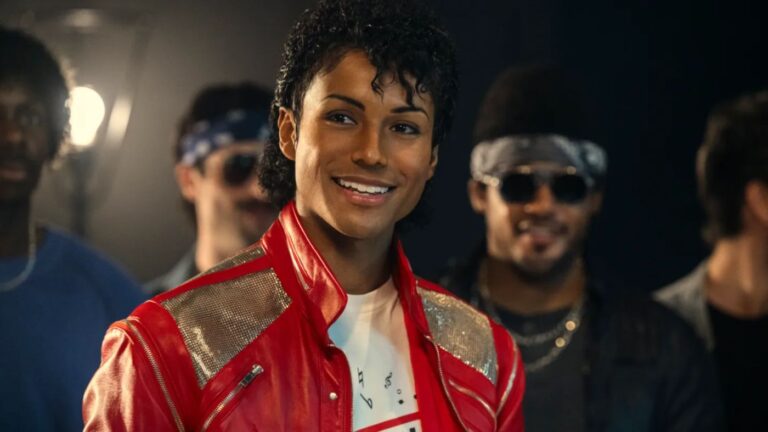
In the world of cinema, we often see a significant gap between what critics want to see and what the public wants. This gap is quite visible in the case of Antoine Fuqua’s Michael, the highly anticipated biopic of the King of Pop, Michael Jackson.
The divide between the public and the press regarding Michael has reached a fever pitch, highlighting a fundamental disagreement over what a biopic’s “duty” actually is. While critics are looking for a journalistic exposé, the majority of the global audience seems to be seeking a celebration of a once-in-a-generation talent.
Currently, the movie stands at a 35% “Rotten” score on Rotten Tomatoes, based on 101 reviews, as many critics believe the narrative looks heavily sanitised and stays miles away from the serious allegations that trailed Jackson for decades.
The core of the criticism lies in the belief that you cannot understand the man without fully confronting the shadows.
Reviewers have pointed out that the film often positions Jackson as a perpetual victim of a predatory media landscape, which, while true in many respects, leads to a one-dimensional portrayal. To these critics, the film isn’t a biography, it’s a high-budget defense brief that prioritises legacy protection over objective truth.
On the other side, a massive and vocal majority of the public is showing fierce support for the film. For many fans, the “controversy” has been the only story told about Michael Jackson for the last thirty years. To them, the film isn’t “hollow”. It is a long-overdue restoration of his humanity and his unmatched artistic contributions.
There is a prevailing sense among supporters that Jackson was “hunted” by the press during his life. Seeing the film skip over what many consider to be debunked or sensationalised tabloid stories is viewed as a victory for the artist’s memory rather than a narrative flaw.
According to Deadline, the film is now expected to earn around $150 million worldwide in its debut weekend.
In the U.S., estimates have risen to $65–70 million, up from earlier forecasts of $50–60 million, while international earnings are projected at $75–80 million. As recently as early April, expectations were closer to a $60 million domestic opening.
If these figures hold, Michael will surpass the domestic openings of Straight Outta Compton and Bohemian Rhapsody, which debuted at $60.2 million and $51 million, respectively, setting a new benchmark for music biopics.
Bohemian Rhapsody is another case of this scenario, where the critics’ score stands at 60% on Rotten Tomatoes, whereas the audience score is 85%. Despite the highly polarised response from critics, the Queen biopic ended up minting over $910 million globally.
As per reports, Michael covers Jackson’s life from the early 1960s to his phenomenal rise in the 1980s. The makers are also looking to produce sequels if the first chapter emerges as a huge success. So, this criticism of Michael from critics doesn’t make much sense, as the sequels would likely cover the artist’s life after the 1980s and the controversies that followed him.
Michael arrives in theatres on April 24. Stay tuned for more updates.
We’re hiring!
We are hiring two full-time junior to mid-level writers with the option to work remotely. You need to work a 5-hour shift and be available to write. Interested candidates should email their sample articles to [email protected]. Applications without a sample article will not be considered.
