































































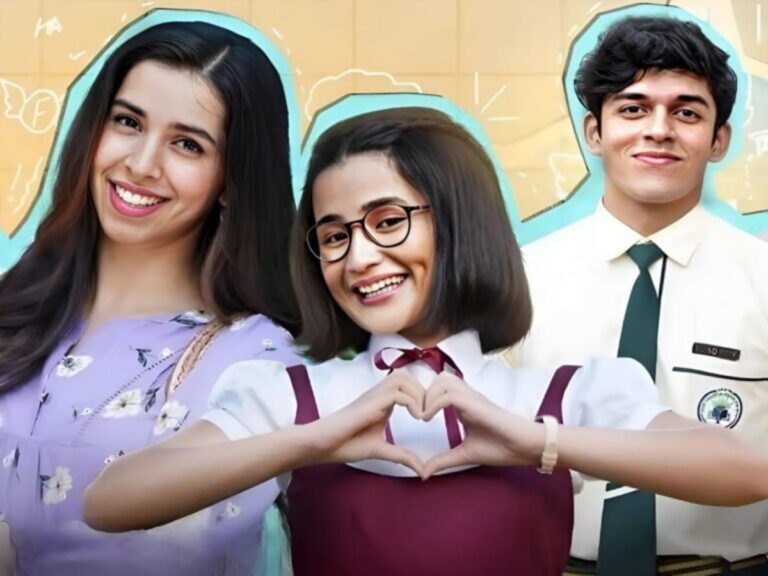

What Is the Story About?
Ojas is determined in her pursuit of becoming the school’s new head girl but a few missteps undo her progress. She finds love soon and stands up for her sister Tejas when the latter faces an unexpected personal setback. Their parents – Sugandha, Ashok – confront several obstacles in their relationship. Through family, friends and a new love interest, Ojas is on the path of self-discovery.
Performances?
Celesti Bairagey has a natural charisma on the screen through which she reflects the rebellious spirit of her character with ease. As someone navigating the innocence of childhood and the hypocrisy of adulthood, she continues to put up a good show as Ojas. Kajol Chugh is impressive in conveying Tejas’s never-say-die approach to life, portraying both her strengths and inner resilience.
While Shruti Ulfat slips into the shoes of Sugandha with a natural flair, thanks to her well-fleshed-out character, Harsh Khurana’s Ashok is rather under-wrought and the show doesn’t give him a fair chance to share his side of the story. Other actors – from Ishika Gagneja to Adrija Sinha to Aadi Bharadwaj, and Manveer, perform well within the scope of the roles.
Analysis
‘One is not born, but rather becomes a woman,’ Simone De Beauvoir famously quoted in ‘The Second Sex’, the widely celebrated feminist text. Regardless of its cinematic merit, the presence of Amber Girls School in the digital space is justified, for it is a rare show digging into the shoes of an opinionated teenage girl, making an honest effort to understand her worldview holistically.
Ojas, who was coming to terms with the contradictions in the world around her in the first season, is gradually decoding what she wants and doesn’t from life. On the cusp of adulthood, she has a reasonably supportive mother, a feisty sister and a rather absent father going through the motions. The season offers a ringside view of her friendships, newfound love and conflicts at school and home.
One of the most significant takeaways from Amber Girls School in its second instalment is the attempt to underline the conditioning that girls/women are subjected to, right from their younger years, forced to suppress their true identities and having to subscribe to so-called societal norms. Through Ojas, the show challenges and exposes such dubious standards for women.
Meanwhile, the lives of Ojas and her family are on the verge of falling apart. Ojas has already been outed at school for her secret transactions, Tejas nearly escapes pregnancy, finds a part-time job and the mother, who believed that she was parenting her daughters well, gets a rude shock. The father, fearing irrelevance in the job market, has sudden emotional outbursts.
Amber Girls School is refreshing for it neither romanticises childhood nor despises it, it offers a pragmatic outlook of the world through a girl and portrays her evolution effectively. There’s more to the school ambience beyond the classes, friendships and tiffs – it exposes several biases within the system and calls out the educators and the power hierarchy within schools when necessary.
The show gradually emphasises that adulthood is far from rosy and suggests the grown-ups are as messed up as the younger lot but do a better job at concealing it. There’s a mother who judges her daughter’s friend on the basis of his father’s position at work. A sports coach turns out to be a virtual predator preying on a girl at school. A teacher looks down upon a student for her social status.
Set in 2009-10, Amber Girls School throws a hint of the internet and the mobile invading our lives. Ojas communicates with her crush Angad on social media while on the other front, a girl realises the dangers of faceless predators over virtual chats. Unlike today, there’s still a childlike glee in the faces of the protagonists as they find themselves at the dawn of a new digital era.
In addition, the show does a fine job at normalising pre-marriage pregnancy and it’s a pleasant choice by the creators to not use it as a conflict to blow up the drama, instead focusing on Ojas and Tejas’s sisterhood. Back at school, the emphasis is on equality, throwing light on moral policing and peer pressure with dressing choices and social status.
Amber Girls School raises its voice on several issues and anomalies within society across all age groups, though the character development and the hotchpotch narration remain an aspect of concern. The exaggeration and the rebellion, at times, appear unwarranted and the black-and-white outlook towards characters doesn’t help its cause.
The foundation of conflicts isn’t built quite organically and the writers get carried away by the intent of a scene, more often than not. The innocence in the performances helps us overlook the storytelling issues to an extent. The ending is, however, memorable – showcasing the psychological evolution of Ojas convincingly, where she is clear about whom she doesn’t want to be.
The second season of Amber Girls School is a paper tiger, where the sum of its parts is not greater than the whole. It qualifies as a one-time watch with a fair share of silver linings but doesn’t fully utilise the potential of its premise.
Music and Other Departments?
Avijeet Satapathy’s background score does a fine job of providing a larger context to the ambiguities in the life of the protagonists through his music. The cinematography – Himanshu Dubey, the costume designer and the production designer use their creative license to employ a flashy colour palette that’s easy on the eye, enhancing the aesthetic appeal, without overriding the story’s intent. The crisp 15-20-minute episodes make for easy viewing on a lazy weekend evening.
Highlights?
How it calls out anomalies within the education system
The lens through which it addresses teenage concerns
The innocence in the performances
Drawbacks?
Patchy narration
Gets carried away by its intent
Is in a hurry to address too many issues
Did I Enjoy It?
Only in parts
Will You Recommend It?
Provided you’re in the mood for some teen drama
Amber Girls School Season 2 Review by Binged Bureau
We’re hiring!
We are hiring two full-time junior to mid-level writers with the option to work remotely. You need to work a 5-hour shift and be available to write. Interested candidates should email their sample articles to [email protected]. Applications without a sample article will not be considered.
