
































































What Is the Story About?
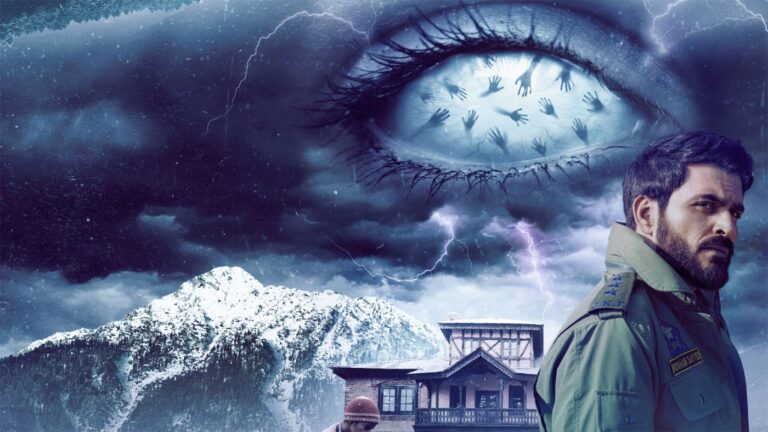
Baramulla is set in the cold, snow-covered valley of Kashmir and it follows DSP Ridwaan Sayyed, a police officer who believes every mystery has a logical explanation. When a few children suddenly go missing from a small town, he’s sent to investigate. At first, it looks like a case of militancy, but as Ridwaan digs deeper, strange things begin to happen around him. His new home feels unsettling. His wife grows distant, his daughter stops talking to him, and his little son starts behaving oddly.
Things begin as a police investigation but slowly turn into something far more personal. The sounds in the house, the symbols that appear, and the old stories people whisper about begin to chip away at Ridwaan’s certainty. He starts to wonder whether the real ghosts are outside or within him.
But Baramulla isn’t really a horror film in the traditional sense. It’s about the kind of haunting that comes from being uprooted from one’s own land. Through Ridwaan’s journey, we see a Kashmir that is beautiful but burdened by grief. The missing children become a metaphor for what the valley itself has lost.
By the time the truth comes out, it’s no longer just about finding who took the children. It’s about facing what the land has become and what its people carry inside them. The story slowly turns into a reflection on pain, guilt, and belonging.
Performances?
The performances in Baramulla are easily its strongest pillar. Manav Kaul carries the film with an intensity that feels both raw and real. As DSP Ridwaan Sayyed, he doesn’t play a hero; he plays a man weighed down by duty, guilt, and grief. There’s something magnetic about the way Kaul uses silence. His eyes tell you more than most dialogues in the film. Whether he’s staring at an old photograph, interrogating a suspect, or holding his trembling child, he never breaks the rhythm of his character. It’s a performance that earns your attention.
Bhasha Sumbli, as Ridwaan’s wife, is excellent in moments where her presence matters. You can feel the exhaustion of someone trying to hold her family together while battling her own fears. She doesn’t have many lines, but the ones she gets are delivered with remarkable restraint. After The Kashmir Files, this role allows her to explore a more human, tender side, and she handles it beautifully.
Arista Mehta, as Ridwaan’s teenage daughter, has a slightly inconsistent arc. Her emotional outbursts feel forced at times, especially in the earlier half, but she grows into the role as the story progresses. By the end, she holds her own against Kaul in some of the film’s most difficult scenes.
The supporting cast, including Neelofar Hamid and Shahid Latief are nice.
However, one can’t ignore that the film’s writing occasionally limits the performers. Some dialogues sound too polished for such a raw story, pulling you out of the realism the actors work hard to create.
Despite these flaws, the performances stay with you. Kaul’s presence alone makes Baramulla worth watching.
Analysis
Baramulla is one of those rare Hindi films that wants to be more than what it appears on the surface. At first glance, it’s a supernatural thriller about missing children and a haunted house in Kashmir. But as the story moves ahead, it reveals an emotional meditation on grief, identity, and memory. The film tries to weave personal pain with historical trauma, and while it occasionally stumbles, its ambition deserves recognition.
Aditya Suhas Jambhale’s direction is thoughtful, if slightly heavy-handed at times. His earlier work, Article 370, was more direct in tone as it was rooted in politics and ideology. Here, he takes a quieter, more layered approach. Through Baramulla, he explores not only the ghosts that haunt Kashmir’s history but also the ghosts that live within its people. The film doesn’t rely on traditional horror elements like sudden scares or loud sound cues. Instead, it builds an unsettling mood through silence, stillness, and an atmosphere of constant unease. You’re not scared of what you see but what you feel.
Where Baramulla truly succeeds is in its emotional core. The story of DSP Ridwaan Sayyed is not just a police investigation; it’s a man’s journey through doubt, guilt, and faith. Manav Kaul’s restrained performance helps anchor this balance. Through him, the film makes you confront uncomfortable questions about what it means to belong, to lose, and to carry the weight of history you didn’t create but still suffer from.
The film also deserves credit for how it treats the exodus of Kashmiri Pandits. It doesn’t sensationalize or politicize their pain, at least not overtly. The tragedy is presented as something that seeps through generations by shaping the lives of those who remain. The supernatural element, instead of being just a gimmick, becomes a symbol for that lingering pain. The ghosts are not monsters but memories that never found peace.
However, Baramulla isn’t without flaws. The first half is sluggish, which is often meandering without clear purpose. It takes too long to build momentum, and the editing could have been sharper. The dialogues, while poetic at times, occasionally sound overly polished and it takes away the rawness from the viewer. There’s also a certain ideological undertone that feels unnecessary. The film, in its final act, starts to lean towards a familiar “us versus them” narrative that something Hindi cinema has been guilty of repeating. It doesn’t dominate the film, but it does linger enough to make you wish Jambhale had trusted the emotional power of his story instead of nudging it toward a political reading.
By the time the film reaches its climax, Baramulla transforms from an enigma into a lament. The ending is heartbreaking because it represents a collective sorrow that refuses to fade. It’s a film that asks you to sit with discomfort, to listen to the echoes of a land that has lost too much.
If you look closely, this film will leave a greater impact than The Kashmir Files. Unlike the Agnihotri film, it is not at all loud and obvious. But if you think about it, it is way more dangerous.
In the end, Baramulla is not a perfect film, but it is an honest one. It’s flawed, ambitious, and deeply human. It dares to look at history but through stories of loss. For that reason alone, it deserves to be seen.
Music and Other Departments?
The background score by Ketan Sodha is minimal. It doesn’t overwhelm the scenes but lingers like a faint echo which is a reflection of Kashmir’s melancholy.
Visually, the film is stunning. The Kashmir of Baramulla is neither a tourist postcard nor a war-torn wasteland; it’s a haunting middle ground. The cinematography captures the fog, snow, and silence of the valley with immense sensitivity. Each frame feels cold. The background score complements this perfectly without overpowering the scene but subtly amplifying the melancholy that runs through the story.
Highlights?
Manav Kaul
Concept
Direction
Drawbacks?
First half
Screenplay
Did I Enjoy It?
In parts
Will You Recommend It?
Only if you are okay with the dark story of Kashmir.
Baramulla Netflix Movie Review by Binged Bureau
We’re hiring!
We are hiring two full-time junior to mid-level writers with the option to work remotely. You need to work a 5-hour shift and be available to write. Interested candidates should email their sample articles to [email protected]. Applications without a sample article will not be considered.
