































































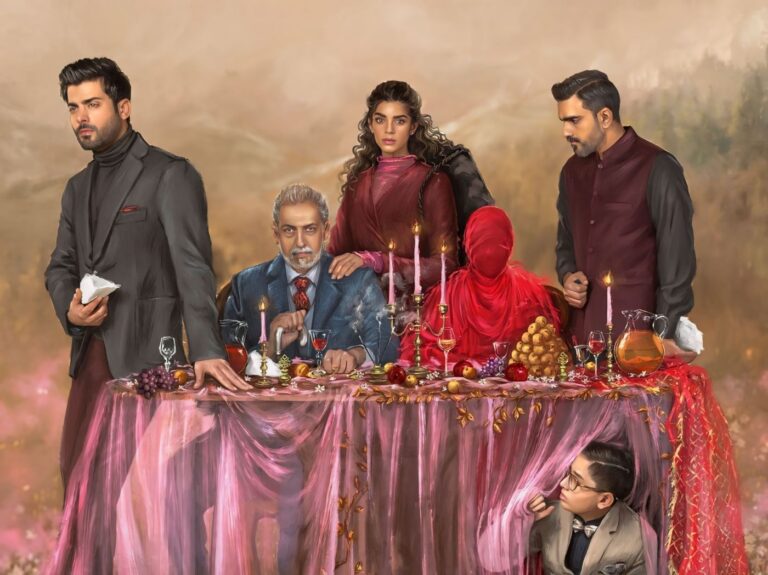

What Is the Story About?
An ageing Jafar Khanzada calls on his estranged sons from both marriages – Shehryar and his brother – to visit him after expressing interest in uniting with his long-dead first love – Mahtab, whom he believes is on the other side of the world, waiting for him. While a son is still grieving the loss of his wife, his half-brother is coming to terms with his identity and the ‘sins’ of his past.
Performances?
The distinct, well-established characters give all the pivotal actors to discover their latent depths as performers and still not be academic about it. While Fawad Khan is excellent in a more upfront role in expressing himself, Khusshal Khan finds solace in his character’s silences and unspoken trauma. Syed Arham, cast as Shehryar’s son, is a fantastic child actor with a maturity belying his age.
Sanam Saeed’s guarded performance, where she’s careful not to reveal her character’s true colours, is another asset to the show. Salman Shahid is a natural as the stubborn father who’s hardened by the vagaries of life. The supporting cast firmly complements its co-actors – be it Anika Zulfikar or Franco Giusti or Sajad Hasan, Nighat Chaudhry and others.
Analysis
Barzakh, Asim Abbasi’s second web series after the highly acclaimed Churails, is a renewed attempt by the filmmaker to uncover the trauma of a dysfunctional family after his debut Cake. This time, he pushes the bar further, dealing with the thin line that separates the real from the surreal, tackling questions of life, death and a world beyond the obvious.
Death is a burden that haunts most of Barzakh’s pivotal characters. In pursuit of livelihood and materialistic desires, Jafar and Mahtab part ways, promising to reunite, until it gets too late to find a middle-ground. Before my first love, I was just a boy, Jafar says, recollecting the ‘woman’ that made him a ‘man’. In his final years, he pursues Mahtab again, believing she’s still waiting for him.
Meanwhile, Jafar’s second son Shehryar is now the father of a curious pre-teenage boy Harris. While Harris couldn’t even meet his mother, a supposedly pragmatic Shehryar is silently mourning the loss of his wife Leena. Shehryar’s half-brother (whom Jafar calls a ‘wimp’), after taking care of an ailing mother until her last breath and suppressing his desires, is experiencing a strange sense of emptiness.
There’s adequate drama around the place that Jafar has made his home. The cafe, next to his residence, is built on the mortal remains of the ancestors of the locals (who protest Jafar’s ways). The locals are seeking ways to reunite with the parted souls who’ve become fairies now. Jafar’s caretaker – Scheherezade – is also guarding a mystery about which she’s unwilling to disclose much.
The show is essentially about the conflict between two parallel worlds (lines of thought) and a protagonist’s hope to find love again. It’s a fight between pragmatism and love that transcends barriers. The story is about fathers and sons and their gloom around the missing links (women) in their lives. The storytelling has an interpretative quality that offers enough fodder for the viewer to chew on.
The best part of Barzakh isn’t merely its characters and the family drama, but how the director conveys his abstract ideas, using visual imagery and poetry with a Sufi touch. Asim doesn’t settle for easy answers and tells the story with sensitivity.
Often, dialogues in mainstream films don’t leave anything to your imagination. Barzakh has a free-flowing quality, permitting a transparent exchange of conflicting ideas and belief systems. Shehryar’s son Harris, for instance, is innocent but treated no less than an adult by his father. They share a warm camaraderie and even bond over jokes about the dead.
Within a genre that has a wider reach, Asim Abbasi chases an alien territory with Barzakh. At times, the show has a problem of excess – it’s bursting with too many details, ideas, metaphors and references that it becomes difficult to lose yourself in the moment. Even with its minor niggles, it’s still delectably original and moving. The hyper-local show has the appeal of a European magnum opus.
Music and Other Departments?
Sarmad Ghafoor’s music embodies the same spirit and the meditative, spiritual quality in the setting, adding value to a situation and providing room for introspection. Cinematographer Mo Azmi’s third collaboration with the director Asim Abbasi is as fruitful as the others if not better, ably supported by the superb production design (by Aarij Hashimi).
The colour grading is another dimension of the show that merits praise and provides character to the visuals. At the same time, the dialogues, shifting between chaste Urdu to conversational English, are music to the ears. The fluid editing, not rushing for closures and resolutions, lets the director find his rhythm with the story and transport his viewers to a different world.
Highlights?
Superb visualisation
Excellent performances
Different take on a dysfunctional family drama
Drawbacks?
Gets too abstract at times
Philosophises indulgently
Did I Enjoy It?
Yes
Will You Recommend It?
Yes
Barzakh Series Review by Binged Bureau
We’re hiring!
We are hiring two full-time junior to mid-level writers with the option to work remotely. You need to work a 5-hour shift and be available to write. Interested candidates should email their sample articles to [email protected]. Applications without a sample article will not be considered.

