































































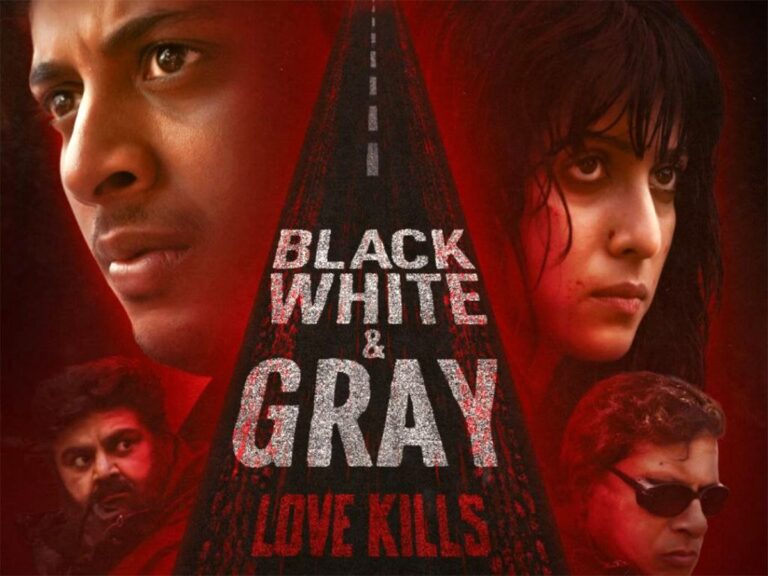

What Is the Story About?
Black, White and Gray: Love Kills is a crime drama that unfolds through the investigation of a series of murders. While it begins as a classic whodunnit, the show evolves into an exploration of complex emotional and societal issues. The central plot focuses on the love story between the two protagonists, played by Mayur More and Palak Jaiswal, whose romance faces opposition from class differences and societal expectations.
The series takes a unique approach, blending a murder mystery with deep social commentary. It critiques patriarchy, power structures, and the societal pressures that shape human behavior, all while keeping viewers on edge with suspenseful twists. The investigation, led by Kamlesh Sawant’s character, uncovers more than just the truth behind the murders; it delves into how love, societal biases, and personal struggles intertwine to create the perfect storm of tragedy.
The story shifts between various locations, heightening the stakes as the characters’ relationships and personal lives become as complicated as the case itself. The show ultimately blurs the lines between right and wrong, making viewers question the nature of truth and justice.
Performances?
The performances in Black, White and Gray: Love Kills carry the weight of the story with a quiet but lasting impact. Mayur More, as the unnamed protagonist, is a revelation. He doesn’t play the character, he becomes him. There’s an urgency in his eyes, a tenderness in his silences, and a kind of lived-in chaos that makes him impossible to look away from. Palak Jaiswal matches that intensity with a performance that’s both raw and restrained. Together, they build a relationship that feels heartbreakingly real.
Sanjay Kumar Sahu, playing the ‘real’ version of the boy, adds an almost documentary-like depth to the narrative. His expressions do more talking than the dialogue ever could.
Tigmanshu Dhulia, as a fading ex-cop, reminds us how powerful subtlety can be. His weariness isn’t performed, it’s embodied. Kamlesh Sawant brings the same intensity that made him memorable in Drishyam, and Deven Bhojani is refreshingly unpredictable in a role that’s far removed from his comic past.
This is a rare show where even the smallest parts feel lived-in. No one overacts. No one underplays. The cast leans into the story with honesty, and that honesty is what stays with you long after the series ends.
Analysis
There’s something quietly haunting about Black, White and Gray: Love Kills. At first glance, it feels like your usual murder mystery: four deaths, one accused, and a lot of noise in between. But give it a few minutes, and the show starts to shift. What looks like a whodunnit slowly turns into a much deeper, much messier reflection of the world we live in.
The series follows a unique structure. A foreign filmmaker comes to India to document a murder case, and the narrative unfolds as a mix of interviews with people involved and dramatized flashbacks. It’s a tricky format, almost mockumentary-like, but surprisingly seamless here. You’re constantly toggling between what people claim to have happened and how it might have actually played out. That back-and-forth keeps you alert, suspicious, and oddly emotional.
At its core, this isn’t just a story about a crime. It’s a story about the quiet violence of society, how love becomes a crime when caste, class, and patriarchy stand in the way. The series doesn’t spell things out, but it drops enough hints: an upper-caste boy, a girl from a different background, a pair on the run, hunted not just by the law but by their own pasts.
The performances are a real highlight. Mayur More carries the story on his shoulders with remarkable ease, slipping between tenderness and tension. Palak Jaiswal brings both strength and vulnerability. And then there’s the ‘real’ boy, Sanjay Kumar Sahu, whose silence speaks volumes. Every time the camera lingers on him, you feel something shift inside.
Of course, it’s not perfect. Some side plots, like the TV anchor and the investigative journalist, feel like they belong to another show. A few dialogues are a bit too on-the-nose. But none of that takes away from the emotional weight this story holds.
What stands out is how rooted the series feels. It doesn’t try to glamorize the chase or over-explain the politics. It just shows things the way they are, complicated, painful, unresolved. By the time it ends, you’re not thinking about who killed whom. You’re thinking about how easy it is to lose your life when you don’t fit the mold society sets for you.
Black, White and Gray: Love Kills isn’t here to comfort you. It’s here to remind you that truth often hides in the blur. And sometimes, that blur says more than anything black or white ever could.
Music and Other Departments?
The music and other technical departments in Black, White and Gray: Love Kills play a crucial role in enhancing the series’ atmosphere. The music, with its subtle yet evocative score, heightens the emotional depth and tension, perfectly complementing the dark and suspenseful tone of the show. Sound design is also thoughtfully crafted, adding to the immersive experience by capturing the nuances of each scene. Cinematography is another standout, with the series using a documentary-style approach that blends archival footage, police interviews, and close-up shots to create a gripping, raw aesthetic that pulls viewers deeper into its world.
Highlights?
The innovative style of direction
Specific performances, especially Mayur More
Blends fiction and reality flawlessly
Drawbacks?
Certain subplots distract
Extremely mediocre writing
Though the concept is good, it feels overdone at times
Did I Enjoy It?
At times, yes
Will You Recommend It?
This week, there aren’t many releases anyway. Plus, you might love the experimental nature of the show
Black White and Gray Love Kills Series Review by Binged Bureau
We’re hiring!
We are hiring two full-time junior to mid-level writers with the option to work remotely. You need to work a 5-hour shift and be available to write. Interested candidates should email their sample articles to [email protected]. Applications without a sample article will not be considered.
