
































































What Is the Story About?
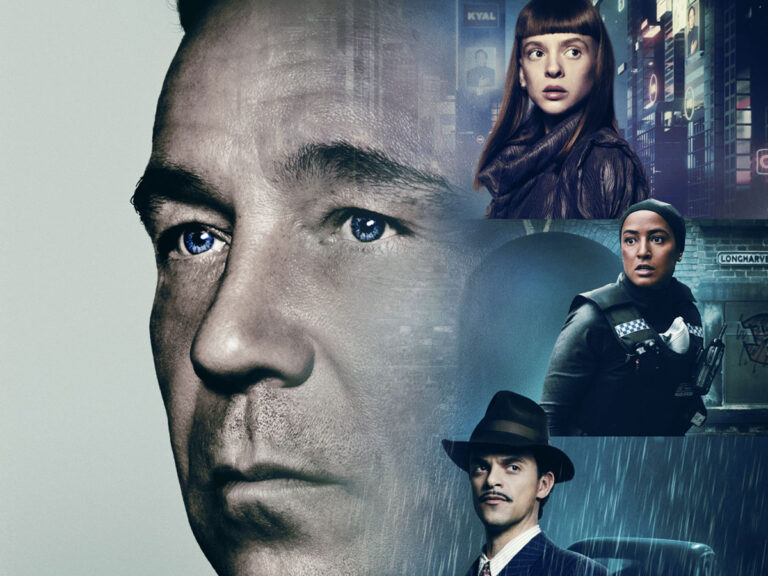
Netflix’s new limited series ‘Bodies’ is created by Paul Tomalin, from the late Si Spencer’s 2015 graphic novel, published by DC Comics. A police detective comes across an unidentified dead body in London’s Longharvest Lane in 2023. The same dead body is found by three other detectives, in exactly the same way and in the same London locality; but in different eras.
The four cops, each in their own respective eras, must investigate the same murder, and its cause and effect — Detective Sergeant Shahara Hasan (Amaka Okafor) in 2023; Detective Charles Whiteman (Jacob Fortune-Lloyd) in 1941; Detective Alfred Hillinghead (Kyle Soller) in 1890; and Detective Iris Maplewood (Shira Haas) in 2053. Can the four get to the bottom of the sinister conspiracy spanning 163 years, which seems to center around the powerful Julian Harker (Stephen Graham)?
Performances?
The performances in Bodies are brilliant across the board. Stephen Graham is superb as Julian Harker. Creepy and sinister, he makes you want to keep watching, just to find out what makes him tick. Amaka Okafor is excellent as Detective Sergeant Shahara Hasan, as is Jacob Fortune-Lloyd as DS Charles Whiteman.
Shira Haas and Kyle Soller are superb as well. All four keep the viewer invested and glued to their screens, as they navigate the tricky, convoluted drama with considerable skill. Lastly, Tom Mothersdale as ‘the body/ies’ is brilliantly effective and impactful. The rest of the cast is equally good.
Analysis
Bodies is a clever, intelligently-written drama, which hooks you from the get-go, and keeps you invested in the proceedings on screen. Yet, after a while, the eight, hour-long episodes begin to seem too long and contrived. A couple of episodes in, the story also starts to get repetitive, and too fantastical for its own good.
However, the narrative gets back on track around the midpoint of the series. As things start to fall into place for the viewer, we’re swiftly and surely yanked back into the story. The story juggles back and fourth between timelines and eras, capturing the impact that the stark naked dead body makes in each particular timeline, triggering events that alter the course of history in each.
Apart from the four detectives investigating the murder, the dead body also impacts the lives of those around the detectives in interesting ways. A gay romance unfolds in homophobic Victorian times; a morally ambiguous man discovers his inner good; a teenaged boy shoots himself in the mouth; a young Jewish girl finds a kindred spirit; and a quantum physicist turns instigator of the whole sordid conspiracy.
The narrative brilliantly unspools the personal lives of the four detectives, meshing them into the larger story, along with their quirks, strengths and weaknesses. Time travel is deftly woven into the plot, while all the events taking place around it integrate seamlessly into a satisfying whole. All confusion in the mind regarding the bodies and their significance to the story is further removed when you watch the actual murder taking place. It also dawns on you why the stakeholders go to great lengths to scuttle the investigation into the body.
The most impressive part of Bodies is the way the makers not only tie every loose thread towards the end, but go beyond, to link tiny happenings with their larger repercussions – much like the proverbial ‘butterfly effect’. Bodies may not be as mind-bending as Netflix’s own German blockbuster series ‘Dark’. But it is compelling and eminently watchable.
A very interesting part of Bodies is how the writers address multiple social issues through the four timelines, their characters and precipitating events. Homophobia, anti-semitism, racism, the rich-poor divide – the narrative addresses all of them. And it does it not in an aggressive, in-your-face manner, but through subtle, understated storytelling.
The stand-out element of the series is its excellent production design and colour pallette to brilliantly differentiate between the four eras. As the story toggles between the past, present and dystopian future, the delicately-coloured frames follow suit to perfectly depict each era.
The series is not without its flaws. Syed’s (Chaneil Kular) part in the whole drama goes unexplained and seems needless. The contrivances in the plot are galling – for instance, the ease and swiftness with which Detective Hasan is able to find crucial evidence and clues in the identical cases, even though they are more than a hundred years apart. The quantum physics part of the plot is irritating too. It is silly and amateurish, and seems like it’s been written by a 16-year-old.
The most unlikeable aspect of the series is the resolution of the problem – it happens far too easily, and far too unsatisfyingly. A stunning twist or two towards the end would have left a far greater impact on the viewer than it does now.
All said and done, Netflix’s Bodies is an engaging watch, and certainly well worth your time, despite the flaws.
Music and Other Departments?
Jon Opstad’s background score is suitable spooky and unsettling. It sets the tone of the storytelling perfectly. Joel Devlin’s camerawork is excellent. Johannes Hubrich’s editing is efficient. Richard Bullock’s production design is terrific.
Highlights?
Inventive plot
Terrific attention to detail
Superb performances and casting
Drawbacks?
Glaring contrivances
Unsatisfying resolution
Tame end
Did I Enjoy It?
Yes
Will You Recommend It?
Yes
Bodies Series Review by Binged Bureau
We’re hiring!
We are hiring two full-time junior to mid-level writers with the option to work remotely. You need to work a 5-hour shift and be available to write. Interested candidates should email their sample articles to [email protected]. Applications without a sample article will not be considered.
