
































































What Is the Story About?
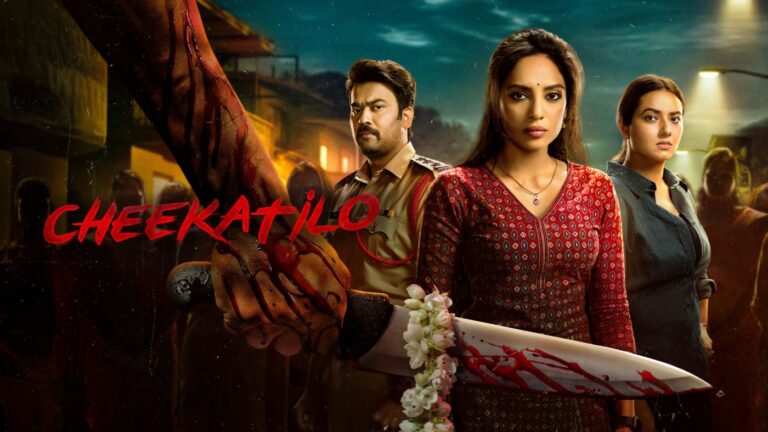
Cheekatilo follows Sandhya Nelluri, a young woman who hosts a popular crime show on television. Over time, Sandhya grows deeply uncomfortable with how the channel turns violence into spectacle to boost ratings. Basically how a typical Indian news channel works. The loud graphics and lack of empathy for victims push her to quit. Encouraged by her friend Bobby, she decides to start an independent crime podcast that focuses on facts and unheard voices. At the same time, her personal life seems settled, with her wedding to longtime boyfriend Amar approaching.
Just as Sandhya prepares to launch her podcast, tragedy strikes. Bobby is brutally murdered, and the crime appears to be part of a larger pattern of killings targeting women. Naturally, Sandhya takes it upon herself to investigate the case, using her background in criminology and information gathered through informal police sources. As she digs deeper, she begins to uncover links between the recent murders and older, buried cases from rural districts, where victims were silenced.
The investigation forces Sandhya to confront her own childhood trauma, which had been dismissed and suppressed by her family, particularly her mother. As her podcast gains attention, more survivors begin to speak up, revealing how abuse was ignored or enabled by society. Sandhya’s pursuit of the truth puts her in danger, strains her relationships, and repeatedly brings her into conflict with the police, who warn her against crossing boundaries.
The case takes several turns, including the arrest of a false suspect, before the real killer’s backstory is revealed. While Sandhya does not achieve complete justice for every victim, the journey allows her to reclaim her voice and confront the darkness she has lived with for years. Cheekatilo ends with Sandhya finding a sense of closure, even as it acknowledges that many wounds remain unresolved.
Performances?
Cheekatilo rests almost entirely on Sobhita Dhulipala’s shoulders, and her performance is a study in stoicism that works only in parts. As Sandhya Nelluri, Sobhita chooses a muted, inward approach, playing the character as emotionally guarded and observant rather than expressive. This makes sense given Sandhya’s past trauma, but the performance often stays locked in the same register. In moments that demand volatility, grief, or moral urgency, Sobhita rarely lets the mask slip. While her physical presence and styling are solid, the character’s inner conflict never fully surfaces.
Vishwadev Rachakonda, as Amar, provides warmth and grounding. His performance feels natural and unforced, especially in quieter scenes where he plays the supportive partner without turning sentimental. He brings a lived-in ease to the relationship, and although the role is underwritten, Vishwadev ensures Amar feels like a real person rather than a narrative convenience.
Analysis
Cheekatilo positions itself as a crime thriller but is far more interested in being a social statement. This imbalance ultimately defines both its ambition and its failure. Director Sharan Koppishetty clearly wants to move away from exploitative crime narratives and instead question how crimes, especially those involving sexual violence, are consumed, sensationalised, or silenced. The intent is sincere, but the execution struggles to translate that intent into a compelling dramatic structure.
At its core, Cheekatilo is less about solving a crime and more about reclaiming voice and agency. This reminds us of Prime Video’s very own Khauf which was more of a commentary on social issues than merely being a horror series. But in that series, this concern was brilliantly raised. In this film, however, that is missing. Sandhya’s frustration with television journalism sets up a promising conflict between truth and spectacle. The decision to make her a podcaster rather than a cop is a smart modern update, allowing the film to explore new media as both a tool for justice and a site of ethical tension. However, once the murder occurs and the investigation begins, the film slips into familiar territory. Patterns, clues, false suspects, and procedural shortcuts take over, but none of them are developed with enough rigor to generate suspense. The investigation progresses because the script demands it, not because Sandhya earns each breakthrough through logic or consequence.
One of the film’s central weaknesses is its inconsistent treatment of realism. Sandhya frequently operates like a trained investigator, gaining access to crime scenes, police information, and suspects with minimal resistance. Law enforcement figures exist largely to validate her instincts or step aside when convenient. This not only reduces narrative tension but also undermines the film’s own critique of systems of power. If institutions are meant to be complicit or negligent, the screenplay never explores that conflict deeply enough. Instead, authority figures oscillate between obstruction and blind support, depending on what the scene requires.
The thematic exploration of trauma and silence is where Cheekatilo is at its strongest. The film draws a clear link between Sandhya’s childhood experience and her present-day choices, showing how unresolved trauma shapes both professional ethics and personal relationships. The portrayal of familial suppression, particularly through the mother’s insistence on silence, reflects a social reality that the film understands well. Several scenes, especially conversations between women, carry more emotional truth than the larger investigative arcs. These moments suggest a more intimate film struggling to exist within a genre framework.
However, the screenplay repeatedly undercuts its own sensitivity through careless writing choices. Certain dialogues and plot turns unintentionally reinforce the very attitudes the film claims to critique. Casual remarks about victims, the treatment of male trauma, and the reliance on symbolic shortcuts dilute the moral clarity of the narrative. The inclusion of familiar mythological or devotional imagery during key moments feels performative rather than earned, turning complex emotional pain into broad symbolism.
The antagonist, while conceptually disturbing, is underdeveloped as a dramatic presence. His motivations are revealed late and rely heavily on backstory rather than sustained psychological tension. The final reveal feels rushed because the groundwork was never laid with enough care. The false suspect track further weakens the climax, making the resolution feel mechanical rather than inevitable.
Structurally, the film is stretched thin. At over two hours, Cheekatilo does not have enough narrative material to justify its length. Several sequences repeat the same emotional beats without progression, slowing the pacing and reducing urgency. A tighter structure or even a limited series format might have allowed the themes to breathe without forcing them into a conventional thriller arc.
In the end, Cheekatilo visibly struggles between intention and execution. It wants to be a socially responsible crime narrative but relies too heavily on genre convenience to reach its destination. While its empathy is genuine and its questions relevant, the film lacks the narrative discipline to turn those ideas into a gripping or coherent whole.
Music and Other Departments?
The technical craft of Cheekatilo often works harder than the screenplay, sometimes to its benefit and sometimes to its detriment. The background score by Sri Charan Pakala is one of the film’s more assertive elements. It constantly pushes tension to the foreground, especially during investigative and emotional scenes. At times this urgency helps compensate for the lack of narrative momentum, but it also becomes intrusive, underlining emotions that the writing hasn’t fully earned.
The editing keeps the film moving, but it relies heavily on quick transitions and familiar thriller rhythms. This creates pace, but not pressure. The frequent cutting during key revelations and confrontations prevents the film from building sustained dread or psychological weight.
Overall, Cheekatilo is technically competent and often polished, but the craft feels like an attempt to elevate material that needed stronger writing support.
Other Artists?
Jhansi delivers one of the film’s more effective performances as Sandhya’s mother. She embodies a mindset shaped by fear, social conditioning, and misplaced concern for reputation. Her insistence on silence and adjustment carries emotional weight, and she convincingly represents the generational complicity the film wants to critique.
Aamani makes a brief but memorable impression, bringing empathy and sadness to a character who reflects on lost agency and emotional isolation after marriage. Her scenes add texture to the film’s thematic core. Ravindra Vijay and Chaitanya Krishna are dependable but restricted by thinly sketched roles that serve the plot more than the drama.
The weakest link among the performances is the police ensemble. Eesha Chawla’s portrayal lacks authority, often undercutting the seriousness of the investigation. Overall, Cheekatilo features committed actors, but uneven writing prevents most of them from fully realising their potential.
Highlights?
Sobhita Dhulipala
Technicalities
Intent
Drawbacks?
Screenplay
Overall writing
Did I Enjoy It?
No
Will You Recommend It?
Not really
Cheekatilo Movie Review by Binged Bureau
We’re hiring!
We are hiring two full-time junior to mid-level writers with the option to work remotely. You need to work a 5-hour shift and be available to write. Interested candidates should email their sample articles to [email protected]. Applications without a sample article will not be considered.
