
































































What Is the Story About?
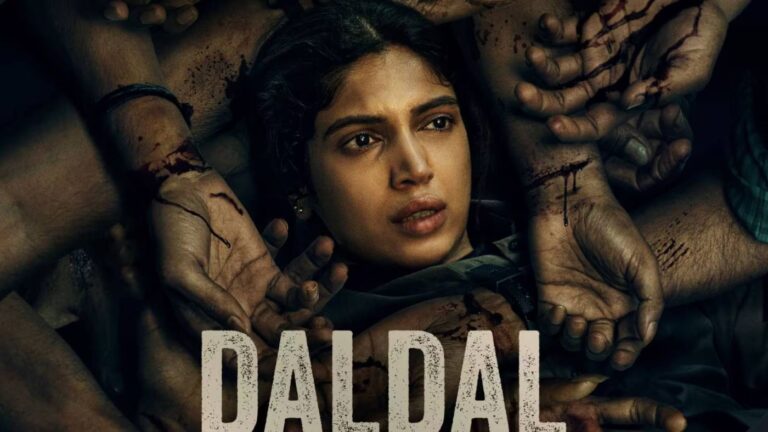
Daldal follows Mumbai Crime Branch officer Rita Ferreira as she steps into a role that tests both her authority and her past.
Rita is promoted to Deputy Commissioner of Police after successfully cracking a sensitive case involving child trafficking. The promotion makes headlines, but it also places her under a microscope. Within the department, some colleagues resent her rise as they view it as a symbolic move rather than a deserved one. Outside, the city is unsettled by a string of brutal murders that soon land on her desk.
The victims are middle-aged men who appear respectable on the surface. Each is found with slit wrists and a disturbing pattern to the crime.
As the investigation moves forward, Rita realises the killings are connected to long-buried abuse and exploitation. The case forces her to revisit her own childhood trauma, caused by her own mother and a constant pressure to suppress anger and fear.
Parallel to Rita’s pursuit runs the story of the killer, whose identity is revealed early. The series focuses on motive, tracing how institutional neglect, failed shelter systems, and untreated psychological wounds can turn victims into perpetrators. A journalist closely following the case, and a drug-addicted man with ties to the underworld.
As Rita digs deeper, she battles a sexist work culture, political pressure, and her own sense of impostor syndrome. Each breakthrough brings her closer to the truth, but also closer to confronting her unresolved guilt and rage.
Daldal ultimately positions the investigation as both a criminal case and a personal reckoning, asking whether justice can truly exist in a system that repeatedly fails the vulnerable and then punishes them for surviving.
Performances?
Performances are the most consistently engaging aspect of Daldal, even when the writing struggles to support them fully.
Bhumi Pednekar carries the series as DCP Rita Ferreira, a character written as emotionally guarded and perpetually burdened. Bhumi commits completely to this internalised portrayal. Her stillness, controlled body language, and clipped dialogue delivery convey a woman constantly holding herself together in hostile spaces. However, the performance also suffers because the writing limits Rita to a narrow emotional register. Bhumi is rarely allowed moments of vulnerability or contradiction, making her portrayal feel monotonous despite her evident effort. When the script finally gives her space to crack, you glimpse what the character could have been.
Samara Tijori emerges as the most striking presence in the series. Playing a journalist with a deeply fractured inner life, she brings an unsettling menace. Her performance carries emotional residue that lingers beyond individual scenes. Even when the character arc begins to flatten in later episodes, Samara maintains a sense of lived-in pain that keeps the role compelling. She is easily the show’s most memorable performer.
Aditya Rawal delivers a quietly effective turn as a drug-addicted man trapped by past trauma. He relies on vacant stares and physical exhaustion to express despair. His performance adds texture to an otherwise familiar character type.
Analysis
A psychological crime thriller that wants to interrogate trauma, power, and gendered violence, Daldal positions itself as a whydunit rather than a whodunit. From the outset, the series makes sure that it is less interested in suspense mechanics and more focused on emotional damage. This ambition is admirable, but the execution rarely lives up to the promise.
At its core, Daldal draws parallels between its protagonist, DCP Rita Ferreira, and the serial killer she is chasing. Both are presented as products of neglect, control, and unresolved childhood wounds. The idea is sound, but the writing treats this mirroring too literally. Instead of allowing the similarities to emerge organically through behaviour and choice, the series repeatedly underlines them through flashbacks and explicit narrative cues. This constant emphasis drains the tension from what could have been a more unsettling psychological relationship.
The show’s biggest weakness lies in how it handles complexity. It gestures toward themes of imposter syndrome, institutional sexism, mental health, and abuse, but rarely digs beneath the surface. Rita’s struggles within the police force are framed almost entirely through overt hostility from male colleagues who are written as one-note obstacles. Their sexism feels schematic rather than systemic, reducing workplace patriarchy to easily identifiable villains instead of something embedded in everyday structures and compromises.
Similarly, the investigation itself often feels secondary. Although the series is structured like a crime thriller, the case unfolds in predictable beats. Clues arrive, suspects behave exactly as required by the plot, and procedural logic bends frequently to accommodate emotional revelations. The show wants Rita’s inner turmoil to feel as important as the murders, but the lack of rigour in the investigation weakens both threads. When the mechanics of the case feel flimsy, the psychological weight attached to solving it also loses credibility.
The portrayal of violence is another area where intention and impact diverge. Daldal clearly wants to critique society’s voyeuristic consumption of brutality, yet it repeatedly returns to disturbing imagery as a narrative crutch. The killer’s ritualistic methods are shown with such insistence that they begin to feel like a gimmick rather than a meaningful commentary on trauma or rage. Shock replaces insight, and repetition dulls whatever unease the early episodes manage to create.
The series also struggles with tone. It oscillates between pulp thriller and serious psychological drama without fully committing to either. At times, it hints at moral ambiguity and moral collapse, only to retreat into familiar genre comforts. Rita’s journey, for instance, is clearly designed as one of healing through confrontation, but this arc feels preordained. Her breakdowns and recoveries occur because the narrative requires them, not because they emerge naturally from accumulated pressure.
Another missed opportunity lies in the setting. Mumbai is treated more as an dark aesthetic backdrop. The underbelly exists in abstract terms, without specificity. As a result, the crimes feel detached from the city’s social realities, weakening the show’s claim to be examining systemic decay rather than isolated pathology.
What ultimately holds Daldal back is its fear of ambiguity. Despite dealing with damaged people and moral grey zones, the series is uncomfortable letting its characters remain unresolved or contradictory. Psychological pain is explained too neatly, motivations are clarified too directly, and outcomes lean toward closure rather than discomfort. In a story about wounds that never truly heal, this insistence on narrative tidiness feels misplaced.
Daldal is not without merit. Its intent is sincere, and its focus on emotional consequences over clever plotting sets it apart from routine procedurals. But sincerity alone cannot substitute for depth. It wants to pull you into a swamp, but never quite allows you to sink.
Music and Other Departments?
On a technical level, Daldal is far more assured than its writing. The craft consistently signals seriousness, even when the narrative struggles to sustain it.
The background score does much of the emotional heavy lifting. It leans into brooding, low-frequency motifs that underline Rita’s mental state and the moral rot surrounding the case. At times, the music is more expressive than the scenes themselves, especially during psychological tension scenes.
The cinematography embraces darkness as both atmosphere and metaphor. Interiors are dim, faces are frequently half-lit, and shadows dominate frames. While this fits the show’s themes of repression and decay, it occasionally turns monotonous.
Editing keeps the episodes brisk but uneven. Early episodes are packed with sharp transitions and cross-cutting, creating momentum. As the series progresses, the rhythm falters.
Overall, the technical departments strive to compensate for narrative shortcomings. They succeed in creating an oppressive mood, but they cannot fully mask the lack of psychological depth beneath the surface.
Other Artists?
Geeta Agrawal Sharma provides warmth and grounding as Rita’s junior officer. Her sincerity and restraint make the professional bond feel genuine. Chinmay Mandlekar and Sandesh Kulkarni are serviceable as hostile authority figures, though their characters are written too broadly to leave a strong impression.
Overall, the actors often do more work than the material allows, elevating scenes that might otherwise feel flat or schematic.
Highlights?
Performances
Vision
Drawbacks?
Writing
Direction
Did I Enjoy It?
No
Will You Recommend It?
No
Daldal Series Review by Binged Bureau
We’re hiring!
We are hiring two full-time junior to mid-level writers with the option to work remotely. You need to work a 5-hour shift and be available to write. Interested candidates should email their sample articles to [email protected]. Applications without a sample article will not be considered.
