
































































What Is the Story About?
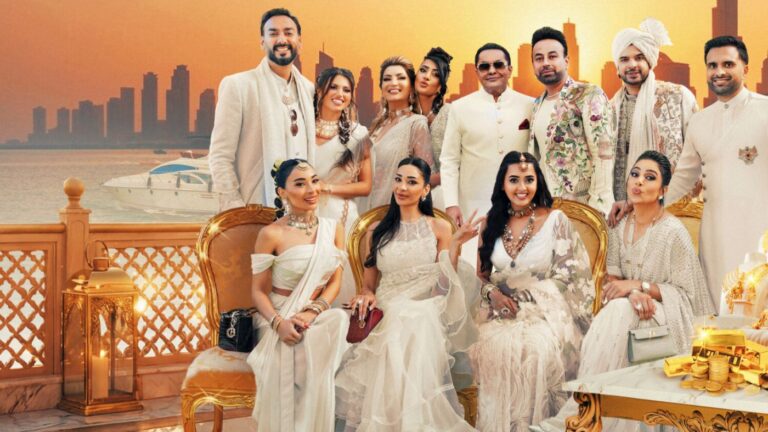
Desi Bling takes viewers inside the extravagant world of Dubai’s ultra-rich Indian social circle, where luxury is not just a lifestyle but almost a personality trait. Inspired by shows like Dubai Bling and The Kardashians, the reality series follows a group of wealthy entrepreneurs, socialites, influencers, and celebrity couples as they navigate friendships, relationships, business ambitions, and endless personal drama against the backdrop of extreme wealth and glamour.
At the centre of the show are television couple Karan Kundrra and Tejasswi Prakash, whose relationship becomes one of the major attractions of the series. The show follows their life in Dubai as they interact with some of the city’s wealthiest Indian families and personalities. Their journey eventually builds toward a grand proposal sequence, but along the way, the couple constantly finds themselves surrounded by misunderstandings, emotional confrontations, jealousy, gossip, and dramatic social situations.
The series also introduces viewers to billionaire couple Satish and Tabinda Sanpal, whose luxurious lifestyle almost feels unreal. From gifting their daughter a pink Rolls-Royce to owning kilos of gold and hosting over-the-top parties, the show repeatedly highlights the excesses of Dubai’s elite culture. Other personalities in the series include socialites, business owners, influencers, and celebrity friends who frequently clash over petty things and personal insecurities.
While the show presents itself as a glamorous reality drama, much of it is heavily staged and exaggerated, almost functioning like a scripted soap opera disguised as reality television. Arguments escalate dramatically, emotional moments feel camera-conscious, and every interaction seems designed for spectacle.
Beneath all the designer labels, luxury cars, and extravagant lifestyles, Desi Bling also reveals the emotional emptiness, toxic relationships, and social performance that often exist behind curated images of wealth and perfection.
Analysis
Desi Bling is one of those reality shows that know that even if they cover petty entertainment with luxury, then people would watch it. It wants to be aspirational, glamorous, emotional, scandalous, and self-aware all at once, but somewhere between luxury handbags, staged confrontations, and painfully rehearsed emotional breakdowns, the show collapses into an exhausting social media performance stretched across multiple episodes.
The biggest problem with Desi Bling is that absolutely nothing feels organic. Reality television has always involved manipulation and staging, but successful reality shows at least create the illusion of spontaneity. Here, every single interaction feels pre-planned down to the camera angles. The arguments do not erupt naturally. They arrive exactly when the episode needs drama. The emotional scenes are framed like influencer content. Even the proposal sequences feel less like life moments and more like brand collaborations.
The show constantly wants viewers to envy these people, but ironically exposes how emotionally hollow most of their lives appear. The wealth itself quickly stops feeling impressive because the series keeps weaponising luxury like dialogue. Gold. Rolls-Royce. Chanel. Richard Mille. Birkin. Lamborghini. Every conversation sounds like an unpaid luxury brand sponsorship. After a point, the endless name-dropping becomes unintentionally funny because the people themselves begin disappearing behind the products they own.
What makes the show even more bizarre is the clash between hyper-modern wealth and deeply regressive thinking. Beneath the Botox, designer styling, and Dubai skyscrapers lies a disturbingly outdated social environment. Women are still expected to tolerate emotionally immature men, preserve relationships at all costs, and adjust themselves around male ego. Several conversations casually expose patriarchal attitudes that the show itself never properly interrogates. Instead, it packages them as relationship drama.
Karan Kundrra and Tejasswi Prakash become the clearest example of this artificiality. Their relationship is presented like a fandom fantasy constantly aware of its own publicity value. Every romantic scene feels performed for social media clips rather than lived emotionally. The constant bickering, exaggerated reactions, and dramatic mood swings eventually become exhausting because the show confuses toxicity with chemistry. Tejasswi’s repeated mannerisms and overperformed reactions quickly turn repetitive, while Karan’s “cool and composed” persona frequently slips into passive-aggressive masculinity.
The larger cast does not fare much better because nobody is allowed to exist beyond archetypes. There is the glamorous billionaire couple. The gossip queen. The emotionally damaged socialite. The loud alpha male. The “strong independent woman.” Everyone feels flattened into reality-show templates designed to generate confrontation rather than authenticity.
The series also suffers from a complete lack of emotional rhythm. Every episode follows the same exhausting cycle: luxury montage, gossip session, misunderstanding, screaming confrontation, emotional reconciliation, repeat. There is no evolution in the conflicts because the show is terrified of falling out of a dramatic structure. When someone discusses illness, marriage troubles, or loneliness, the emotional impact is immediately undercut by the show’s obsession with maintaining aesthetic perfection.
Visually, the show is polished to the point of artificiality. Every frame looks aggressively curated for Instagram. The mansions, designer outfits, luxury parties, and dramatic entrances are shot with glossy excess, but eventually create emotional numbness because the series has no grounded reality to balance the spectacle. It becomes visual noise.
What Desi Bling accidentally reveals, however, is far more interesting than what it intentionally tries to sell. Beneath all the glamour lies a deeply insecure world built entirely on performance. These people are constantly curating themselves for social approval, social climbing, and public validation. Nobody seems emotionally comfortable enough to simply exist without spectacle.
That is why the show becomes strangely addictive despite being deeply shallow. Watching Desi Bling feels less like entering a glamorous fantasy and more like doom-scrolling through an expensive nervous breakdown.
Highlights?
Wealth
Drawbacks?
Everything other than wealth
Did I Enjoy It?
Hell no
Will You Recommend It?
Hell no
Desi Bling Netflix Reality Show Review by Binged Bureau
We’re hiring!
We are hiring two full-time junior to mid-level writers with the option to work remotely. You need to work a 5-hour shift and be available to write. Interested candidates should email their sample articles to [email protected]. Applications without a sample article will not be considered.
