
































































What Is the Story About?
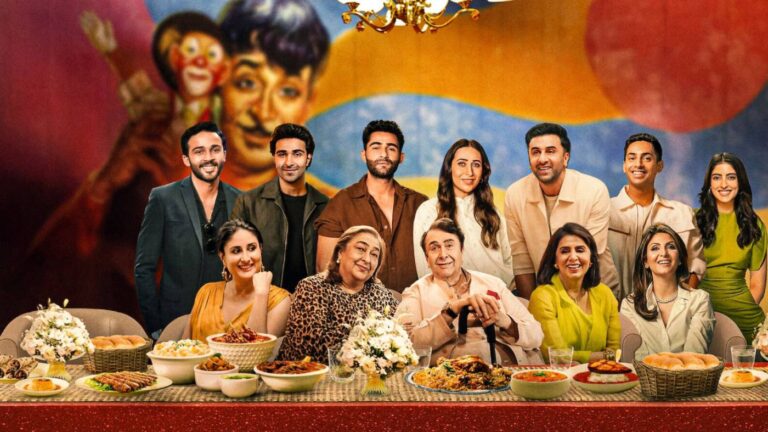
Dining with the Kapoors is a one-hour documentary built around a simple premise: gather Raj Kapoor’s sprawling family under one roof, share a home-cooked meal, and revisit a century of memories connected to the Showman. Directed by Smriti Mundhra and created by Armaan Jain, the film unfolds as the Kapoors, across generations, sit together to celebrate Raj Kapoor’s 100th birth anniversary.
There is no investigative angle, no dramatic arc, and no attempt to dig beneath the family’s public image. Instead, the documentary plays like a warm, loosely structured afternoon where Kareena, Karisma, Ranbir, Saif, Rima Jain, and several younger members swap stories, laugh over childhood anecdotes, and reflect on the legacy they inherited.
Much of the narrative drifts between cooking, casual conversations, and rare home videos and photographs of Raj Kapoor. Armaan Jain anchors the gathering through the family’s food traditions, connecting old recipes to older memories. The documentary doesn’t search for revelations, it simply invites viewers to sit at the table and witness a family remembering a man who shaped their lives, their identities, and Indian cinema itself.
Performances?
Because Dining with the Kapoors is a documentary, the “performances” aren’t crafted, they’re lived. Yet what stands out most is how the film quietly reveals sides of the Kapoor family we rarely get to see on camera.
Rima Jain emerges as the emotional anchor, her animated storytelling and music-led recollections giving the documentary much of its heartbeat. Kareena and Karisma strike a natural balance between nostalgia and humour, slipping effortlessly into the role of custodians of family memory. Ranbir appears more subdued and reflective than his usual public persona, especially in moments where old home videos of his childhood surface. Saif Ali Khan, though featured briefly, adds a grounded, observational presence that offsets the family’s more chaotic energy.
Analysis
Dining with the Kapoors is a documentary that knows it has extraordinary access, but doesn’t always know what to do with it. Smriti Mundhra chooses a hands-off, almost invisible style of filmmaking, letting the family talk, tease, cook, and reminisce without much direct intervention. That decision gives the film its warmth, but it also becomes its biggest limitation. The documentary wants to feel intimate, but intimacy without direction can easily slip into indulgence, and it often does.
The strongest passages come when the film accidentally stumbles into genuine emotion. Rima Jain’s animated storytelling, her piano tribute, Randhir Kapoor’s fleeting moment of remembering his late brothers, these scenes crack open the glossy façade and show that behind the glamour is a family still shaped by loss, legacy, and the weight of a surname that has defined Hindi cinema for generations. But these moments appear and vanish without exploration, as though the film is afraid to disrupt the comfort of the dining table.
This hesitation becomes more obvious when the documentary brushes against compelling themes and then retreats. Armaan Jain admitting his failure as an actor could have been a powerful entry point into the pressures of being a Kapoor in an evolving industry. Similarly, the younger generation, Agastya, Zahan, Navya, hover around the edges, visibly curious, but the film never asks them what being a Kapoor today actually means. That absence feels like a missed opportunity, especially in a documentary framed around legacy.
Mundhra’s fascination with nostalgia is understandable, the Kapoors practically invented Bollywood nostalgia, but the film often chooses sentiment over substance. The archival footage and rare home videos are lovely, but they’re treated as decorative elements rather than narrative anchors. Even the food sequences, though warm and rooted in family history, start feeling repetitive because they’re never tied to anything larger than “we grew up with this.”
And yet, despite all this, the documentary is undeniably watchable. The chemistry between Ranbir, Kareena, Karisma, and Saif is effortless, the affection among generations is real, and the casual chaos of a Kapoor gathering has its own magnetism. The film’s charm is genuine; its shortcomings are simply the result of playing too safe. Dining with the Kapoors doesn’t probe, question, or challenge the family’s mythology, it simply sits with them. Whether that’s enough depends on what you seek: a deeper portrait of an iconic cinematic dynasty, or the comfort of being a fly on the wall as a legendary family shares a meal.
Music and Other Departments?
Since Dining with the Kapoors isn’t built around a musical backbone, the score stays minimal and functional, letting conversations and kitchen sounds carry most of the emotional weight. The real craft shows up in the camera and direction.v
Smriti Mundhra’s direction aims for an unforced, observational style, almost like she wants to disappear into the room. Sometimes this works beautifully, especially when the camera catches small, unguarded moments: Kareena teasing Ranbir, Rima drifting into a childhood memory, or the younger generation quietly watching the elders. These are the fragments where the documentary feels alive.
But the same approach also creates problems. The camera often feels too polite, too distant, reluctant to move in when a moment is begging for closer scrutiny. Important faces drift in and out of frame, conversations overlap without structure, and the visual rhythm feels more like a casual home video than a crafted documentary. The lighting and framing are warm and inviting, but the lack of intentional shot design reveals how loosely the film is held together.
It’s cozy, yes, but sometimes a little too cozy for its own good.
Other Artists?
Younger members like Zahan Kapoor, Agastya Nanda, and Aadar Jain appear only in flashes, but even in their short moments, there’s a sense of them negotiating what it means to inherit a legacy so large it precedes them. None of this registers as “acting”, it is simply the Kapoor family letting their guard down just enough for the camera to catch something genuine, something unpolished, and often something unexpectedly tender.
Highlights?
Unfiltered peak at the Kapoors
Solid storytelling
The food (we have to mention this)
Drawbacks?
The documentary feels too safe.
Not much exposure to the younger Kapoors.
Could have done better in the emotional aspects.
Did I Enjoy It?
It’s Kapoor, gossip and good food on screen… It was a cozy watch.
Will You Recommend It?
A week where Family Man 3 is streaming, we won’t say that you’ll miss out if you don’t watch it. But, you can keep it in your wishlist.
Dining With The Kapoors Documentary Review by Binged Bureau
We’re hiring!
We are hiring two full-time junior to mid-level writers with the option to work remotely. You need to work a 5-hour shift and be available to write. Interested candidates should email their sample articles to [email protected]. Applications without a sample article will not be considered.
