
































































What Is the Story About?
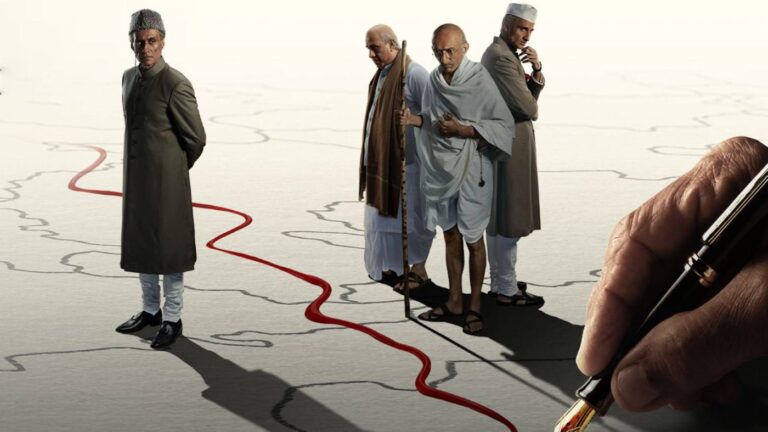
Freedom At Midnight Season 2 begins in the uneasy months after India’s independence. The country is free, but peace is far from settled. The wounds of Partition are still fresh, and the leaders who fought together for freedom now struggle to hold the nation together.
Jawaharlal Nehru tries to shape a modern, secular India, but his decisions often clash with Sardar Vallabhbhai Patel’s practical approach to unity and order. Their disagreements are not personal, but they reveal how difficult it is to govern a nation born out of chaos. Mahatma Gandhi continues to preach peace and harmony, even as violence spreads across Punjab, Bengal, and other regions. His faith in non-violence is tested every day.
Across the border, Mohammed Ali Jinnah leads the newly formed Pakistan while battling failing health. His dream of a separate nation comes with heavy costs, both political and emotional. Lord Mountbatten, now India’s Governor General, tries to manage the fragile balance between diplomacy and damage control, knowing that every choice affects millions of lives.
The series explores the painful process of dividing land, people, and resources. Trains filled with refugees move across borders. Communities are torn apart. Old friendships turn into rivalries. The question of Kashmir’s future becomes a major point of conflict, adding further strain to India and Pakistan’s already tense relationship.
At the heart of the season is the struggle to define what freedom truly means. For some, it is political power. For others, it is safety, dignity, and the right to live without fear. As leaders argue in closed rooms, ordinary people pay the highest price on the streets.
The season builds toward Gandhi’s assassination, a moment that shakes the nation and forces Nehru and Patel to reflect on the path India has taken. Freedom At Midnight Season 2 shows that independence was not an ending, but the beginning of a difficult and uncertain journey for a divided land.
Performances?
Freedom At Midnight Season 2 stands firmly on the strength of its performances, with the cast bringing emotional depth to one of the most complex periods in Indian history. Sidhant Gupta, as Jawaharlal Nehru, carries much of the narrative weight. His portrayal avoids grandstanding and instead focuses on Nehru’s inner conflicts. He captures the leader’s idealism, self-doubt, and political pressure with incredible intensity. While his physical resemblance may not be perfect (because he looks very young), his emotional commitment makes the character feel human rather than heroic.
Chirag Vohra’s Mahatma Gandhi is one of the season’s biggest achievements. Instead of presenting Gandhi as a distant icon, Vohra plays him as a weary, determined man burdened by responsibility. His soft voice, fragile body language, and emotional conflicts bring dignity to the role without turning it into a performance of reverence. Gandhi feels vulnerable, not mythic.
Rajendra Chawla shines as Sardar Vallabhbhai Patel. His grounded, no-nonsense presence balances Nehru’s idealism. The scenes between Chawla and Gupta feel lived-in, driven by ideological differences rather than ego clashes. Chawla brings warmth, authority, and strength to Patel’s character.
Arif Zakaria’s Mohammed Ali Jinnah is portrayed with sharp intelligence and emotional distance. He avoids villainy, instead presenting Jinnah as a man shaped by pride and political urgency. Rajesh Kumar, as Liaquat Ali Khan, offers solid support, though his character is more restrained in scope.
Luke McGibney’s Lord Mountbatten brings subtlety to a role that could easily slip into caricature. He plays the British official as conflicted, aware of the human cost of political decisions.
The female characters, including those played by Ira Dubey and Cordelia Bugeja, remain underwritten, limiting their impact. Still, the ensemble as a whole delivers sincere, controlled performances that elevate the series and keep its heavy historical material emotionally engaging.
Analysis
Freedom At Midnight Season 2 moves away from the anticipation of independence and steps into the emotional and political wreckage left behind by Partition. If the first season was about negotiations and looming decisions, this one is about consequences. Borders have been drawn, but nothing feels settled. The country is free, yet deeply fractured. Violence, displacement, and distrust dominate the atmosphere, and the leaders who once fought together now struggle to agree on how to shape the future.
What works most in this season is its refusal to romanticise history. Independence is not treated as a triumphant ending, but as the beginning of a far more complicated chapter. The show focuses on how quickly unity turns into suspicion, how political ideals collide with harsh realities, and how personal relationships suffer under national pressure. The story never simplifies these shifts. Instead, it shows how every decision carries emotional and moral weight.
The relationship between Nehru and Patel forms the backbone of the season. Their disagreements are not framed as petty power struggles but as clashes of belief. Nehru is driven by vision and global ideals, while Patel is rooted in practical governance and national stability. The show allows both perspectives to exist without pushing the viewer to pick sides. Their bond feels strained yet respectful.
Gandhi’s presence adds another layer of complexity. He is not portrayed as a flawless saint, but as a man who continues to believe in peace even when the country seems to be tearing itself apart. His hunger strikes, his appeals for unity, and his moral insistence often feel out of step with the growing anger around him. The series captures this tension well, showing how Gandhi’s ideals, while noble, also isolate him from those who feel that peace has already failed them.
On the other side of the border, Jinnah and Liaquat Ali Khan are shown navigating their own political uncertainties. Jinnah is not reduced to a villain. He comes across as a leader driven by pride, insecurity, and the pressure of shaping a new nation. His moments of firmness are mixed with quiet loneliness, especially as he leaves behind a life he once knew in India. The show avoids turning him into a symbol and instead presents him as a complicated individual.
One of the season’s strengths is its attention to the human cost of political decisions. Refugees, riots, and broken families are not treated as background noise. They are central to the story. Scenes of displacement and communal violence are handled with sincerity, making them more impactful. The suffering feels personal rather than distant, reminding viewers that history is not just about leaders and policies, but about ordinary people trying to survive chaos.
The show also explores how power operates behind closed doors. Negotiations, compromises, and political calculations often take precedence over public sentiment. Mountbatten’s role reflects this. He is neither glorified nor demonised. Instead, he is portrayed as a man trapped between responsibility and consequence, aware that the lines drawn on paper will reshape millions of lives.
While the writing is ambitious, the series sometimes tries to cover too much ground. Certain events and conflicts move quickly, leaving little time to absorb their emotional impact. At times, the dialogue becomes heavy with explanation, as if the show is eager to teach rather than let moments speak for themselves. This can make the viewing experience feel dense, especially for those not deeply familiar with the historical context.
The female characters, though present, are not given enough space to leave a strong impression. But yet again, it reflects the patriarchal structure of the times we are talking about.
Still, what the series achieves is rare. It turns a well-known chapter of history into something that feels alive, uncertain, and deeply human. It does not offer easy answers or clear heroes. Instead, it presents a nation struggling to define itself amid grief, pride, fear, and hope.
Freedom At Midnight Season 2 is not just about how India became independent. It is about how difficult it was to stay united afterward. It reminds us that freedom is not a single moment but an ongoing process shaped by choices and conflicts.
Music and Other Departments?
The music, cinematography, and editing in Freedom At Midnight Season 2 work together to shape the emotional weight of the story without overpowering it. The background score is used in a manner that allows silence and dialogue to carry much of the tension. When the music does rise, it supports the gravity of key moments rather than telling the audience how to feel. It avoids melodrama which is a relief.
Visually, the series maintains a muted and grounded look that suits its historical setting. The colour palette leans towards earthy and subdued tones, giving the world a worn, unsettled feel. Large political moments are often framed in intimate ways, focusing on faces, gestures, and reactions rather than spectacle. This keeps the attention on the people behind the decisions, not just the events themselves.
The editing keeps the narrative moving at a steady pace, especially considering the density of the subject matter. Scenes transition smoothly between political meetings, personal conflicts, and public unrest. While some moments feel information-heavy, the overall flow remains controlled.
Other Artists?
Luke McGibney’s Lord Mountbatten brings subtlety to a role that could easily slip into caricature. He plays the British official as conflicted, aware of the human cost of political decisions.
The female characters, including those played by Ira Dubey and Cordelia Bugeja, remain underwritten, limiting their impact. Still, the ensemble as a whole delivers sincere, controlled performances that elevate the series and keep its heavy historical material emotionally engaging.
Highlights?
Casting and Performance
Sincerity with the subject
Drawbacks?
Not really a fault but doesn’t have the mass appeal.
Did I Enjoy It?
Absolutely
Will You Recommend It?
Absolutely
Freedom At Midnight Season 2 Series Review by Binged Bureau
We’re hiring!
We are hiring two full-time junior to mid-level writers with the option to work remotely. You need to work a 5-hour shift and be available to write. Interested candidates should email their sample articles to [email protected]. Applications without a sample article will not be considered.
