
































































What Is the Story About?
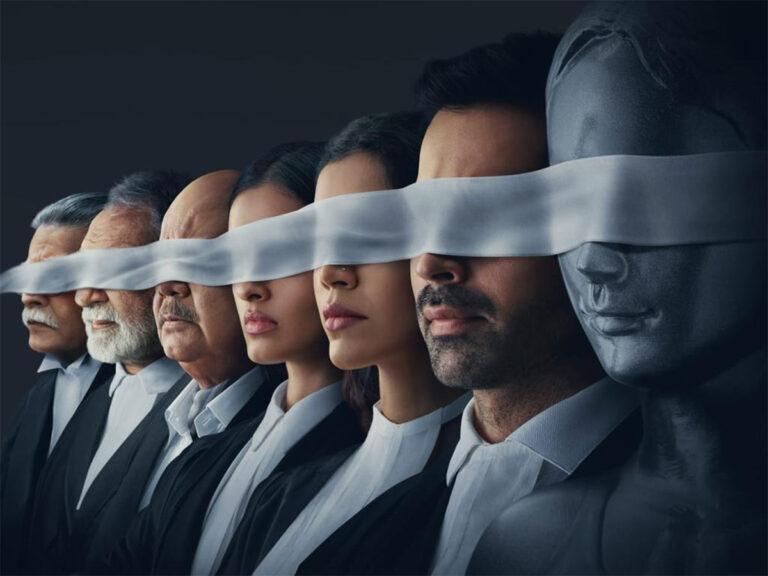
Prime Video’s new Indian original Show, Guilty Minds, is a legal drama that addresses myriad legal concerns and cases in ten 50-55-minute-long episodes. Kashaf (Shriya Pilgaonkar) and Vandana (Sugandha Garg) are two idealistic lawyers who run their own small legal concern. They take up meaningful cases that allow them to fight for the underdogs of society – those who’ve been wronged by the oppressive caste, class, gender and social systems in place in our country. Deepak Rana (Varun Mitra) is a flamboyant legal prodigy who is a partner in top law firm KKA, and has no qualms in taking up controversy-ridden cases for his ultra-rich clients. Each episode features a new case, on vastly diverse topics. Two long-running controversial cases are the common thread that binds the ten episodes together.
Performances?
Shriya Pilgaonkar and Varun Mitra are well cast as Kashaf Quaze and Deepak Rana. Both pull off their characters with panache and pizzazz. Besides the two leads, Guilty Minds is chock-full with powerhouse performers and noteworthy performances. Kulbhushan Kharbanda is a treat to watch as the head of Khanna Khanna And Associates (KKA). Sugandha Garg as Vandana is easily the pick of the lot. She’s simply terrific. Namrata Sheth, Pranay Pachauri and Diksha Juneja, as Shubhangi, Shubrat and Riya respectively, are excellent. Benjamin Gilani as Justice Munawar Quaze is classy and competent.
Satish Kaushik is very good as Tejinder Bhalla. Shakti Kapoor‘s cameo as a traditionally-inclined music director is eminently watchable. Karishma Tanna lends dignity to her #MeToo victim character. Girish Kulkarni and Suchitra Krishnamoorthi are cast well as the opposing counsel in a couple of cases. The rest of the cast is equally good.
The most entertaining member of the humongous cast of Guilty Minds, however, is a character called Parvathy, played by Sukitha Aiyar. Parvathy snoops around for a living and can dig up the most elusive information with precise ability. In short, Parvathy is the ‘Chellam Sir’ of Guilty Minds.
Analysis
The first couple of episodes of Guilty Minds seem a bit simplistic and amateurish. The #MeToo case template of Episode 1 has been done to death in films and shows. Though not particularly compelling, the episode does help to establish the characters quickly and efficiently. In that sense, Guilty Minds picks up slowly. But once it picks up, the narrative moves at a quick canter, getting more engaging and entertaining by the minute.
The courtroom drama feels realistic and authentic, quite unlike what we’re used to watching in our films. There’s no over-the-top posturing, melodramatic dialogue-baazi or profusion of difficult-to-understand judicial jargon. It’s just plain old legal arguments in refreshingly simplified language. Come to think of it, at several instances in Guilty Minds, the presiding judges themselves tick off witnesses or lawyers for using complicated language. “Say what you want in simple language”, is their constant refrain—a good thing for the show too. That, of course, is a given, considering its creator Shefali Bhushan’s pedigree. Her father is former India law minister, Shanti Bhushan; and her brother is legal luminary, Prashant Bhushan.
The chemistry between the two leads, Kashaf and Deepak, is quite enthralling to watch. The friends from college often find themselves poised on opposite ends of the law spectrum, but their hearts beat for each other.
The best part about Guilty Minds is the intriguing gamut of topics that the ten episodes of the series address. Writers Shefali Bhushan, Manav Bhushan, Deeksha Gujral and Jayant Digambar Somalkar have chosen the subjects with careful consideration and thoughtful insight.
Video game addiction; the importance of consent in a physical relationship; wrongful termination; a canny sex determination racket; self-driving cars and how safe they really are; the horrifying truth behind killing dacoits in the Chambal Valley; dating apps and their manipulative algorithms; creative copyrights; a cola plant monopolising the scarce water in parched rural lands, are the myriad subjects that Guilty Minds touches upon.
Yes, the resolutions are too quick and simplistic for comfort, but the ‘two Indias’ they depict are done with finesse and humour. A fatal accident by his self-driving car, and its connection with the Indian penchant for superstitious practices, leaves the CEO of the company baffled with the inanity of it all. The cola plant owner mutters how difficult it is to conduct business in India. Paani addresses the confounding quandary of development and jobs creation at the cost of the environment.
A music app that scrutinises thousands of songs in mere seconds, takes 2-3-second bits from each, and stitches together a completely different song within minutes is embroiled in a copyright battle with the creator of one of the original bits. The app creator laments that his app is the future of music but is undervalued and misunderstood in his own country. ‘Paani’, ‘Ehno’, ‘Spermaa’, ‘Aalap’ and ‘Deep Waters’ episodes are easily the best in the series.
The writing of Guilty Minds sparkles. The dialogue is candid, refreshing, and thought-provoking. The dialogue in ‘Deep Water’ is particularly stirring. Or take Deepak and Shubhangi’s chat about hiking, for instance. We’ll admit we’ve never considered the in-trend sport from Deepak’s point of view before.
To sum it up, ‘Guilty Minds‘ is a show that some might find too simplistic. The gay relationship part could have been done away with entirely. Also, a shorter and crisper runtime is way preferable than the tediously long runtime of now. However, the show is engaging and entertaining by dint of its rooted-in-Indian-ethos premise, well-crafted narrative and high production values.
Music and Other Departments?
Sagar Desai’s musical score for Guilty Minds is excellent. The title track is a delight to listen to. Take a few minutes to listen to the entire number that plays at the end of the show when the credits roll. It is superb. The ‘Paani’ song is another gem. It is haunting and stays with you for long after. The other songs are good too. The background score enhances the narrative subtly but surely. Navnita Sen’s editing is flawless. Siddarth Srinivasan’s camerawork is fluid.
Highlights?
Engaging narrative
Well-written screenplay
Interesting musical score
Excellent performances
Drawbacks?
Too long
A tad simplistic
A few redundant sub-plots
Did I Enjoy It?
Yes, mostly
Will You Recommend It?
Yes, watch it for the entertaining ‘Indianised’ takes on interesting subjects
Guilty Minds Series Review by Binged Bureau
We’re hiring!
We are hiring two full-time junior to mid-level writers with the option to work remotely. You need to work a 5-hour shift and be available to write. Interested candidates should email their sample articles to [email protected]. Applications without a sample article will not be considered.
