































































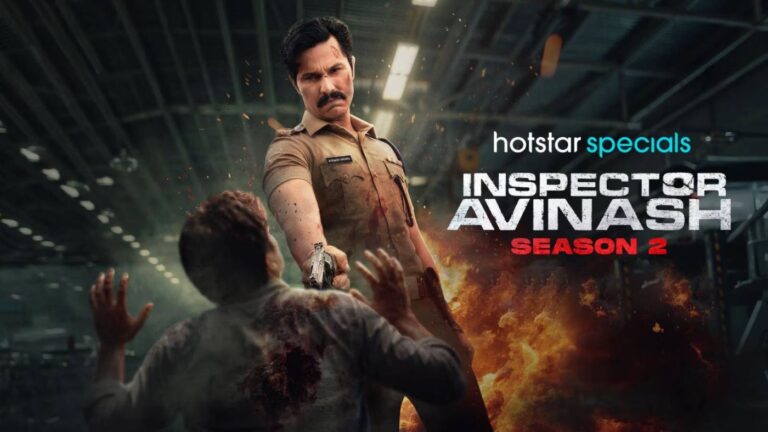

What Is the Story About?
Inspector Avinash Season 2 continues the story of Avinash Mishra, a fearless STF officer working in the violent and politically charged landscape of 1990s Uttar Pradesh. Known for his encounter operations and aggressive policing methods, Avinash once again finds himself caught between dangerous criminals, corrupt politicians, and growing pressure from within the system itself.
This season revolves around a large illegal weapons network connected to gangsters and political figures. Avinash and his team begin tracking the operation, which eventually takes them from Uttar Pradesh to Nepal. During the investigation, they come across dangerous criminals like Sheikh and Devi, both deeply involved in arms smuggling and organised crime.
At the same time, Avinash’s personal life begins to collapse. His son gets accused of murdering a classmate, throwing the family into emotional turmoil. His wife Poonam starts questioning the violent and dangerous life Avinash has built around himself and eventually distances herself from him. The pressure of balancing his duty as a police officer and his responsibilities as a father slowly starts affecting him emotionally.
Alongside the main investigation, the series also follows multiple STF operations involving gang encounters, corruption cases, and political conspiracies. New officers enter the system, and Avinash slowly realises that the threat is not only outside the force but also within it.
While the show uses action to maintain momentum, the story is equally focused on the emotional cost of living inside a violent system. Beneath all the gang wars and encounter drama, Inspector Avinash Season 2 is really about a man trying to hold together his family and job.
Performances?
The performances in Inspector Avinash Season 2 operate in a deliberately heightened space. Almost every actor seems aware that the show is aiming for old-school massy cop drama rather than grounded realism, and the acting style reflects that. Characters speak in punchlines, villains stretch their pauses for effect, and there is too much drama for maximum intensity. For a while, this exaggerated tone actually works because it matches the loud and chaotic world the series creates. But as the episodes progress, the same energy starts becoming repetitive and exhausting.
Randeep Hooda still manages to rise above the excesses more often than others. He understands the theatricality of the role but adds enough emotional control to stop Avinash from turning into a complete parody. His body language, local dialect, and exhausted anger give the character some credibility even during over-the-top moments. The emotional scenes involving his family are where he works best because he briefly pulls the series back into something more human.
Amit Sial and Abhimanyu Singh lean fully into caricature territory, but intentionally so. Their performances are built around menace, swagger, and stylised dialogue delivery rather than realism. Initially, they add entertainment value and unpredictability, especially during confrontational scenes. But after a few episodes, the constant intensity begins to feel one-note.
Analysis
Inspector Avinash Season 2 knows exactly what kind of show it wants to be. It is not trying to reinvent the cop-thriller format or offer a deeply layered study of policing and corruption. Instead, it embraces the loudness, violence, melodrama, and exaggerated masculinity of old-school crime dramas with complete confidence. The problem is not that the show chooses this route. The problem is that it mistakes constant intensity for sustained engagement.
Set in the politically volatile landscape of 1990s Uttar Pradesh, the series follows STF officer Avinash Mishra as he navigates gang wars, arms smuggling networks, political conspiracies, and mounting pressure inside his own family. On paper, there is enough material here for a gripping long-form thriller. Illegal weapons trafficking linked to political power, encounter culture, and a police officer slowly losing control of his personal life are all strong foundations. The show also understands the atmosphere it wants to create. Dusty interiors, dimly lit hideouts, tense convoy movements, and morally compromised officers establish a world where violence is routine.
For the first few episodes, this energy works reasonably well. The pacing is fast, the conflicts are immediate, and the series constantly throws Avinash into new operational crises. The Nepal track, the hunt for illegal arms suppliers, and the growing distrust within the system create enough momentum to maintain curiosity. The show is particularly effective when focusing on STF team dynamics. The camaraderie between officers feels believable because the interactions are casual rather than overly sentimental. Their banter and loyalty give the series some warmth amid all the bloodshed.
But the deeper the series goes, the more its limitations begin to show. The biggest issue is narrative overcrowding. Every time a track starts gaining emotional or dramatic weight, the story abruptly jumps toward another subplot. Gang conflicts, political manipulation, internal corruption, Avinash’s family collapse, encounter operations, betrayals, and criminal rivalries all compete for attention at the same time. Instead of building pressure gradually, the show keeps escalating outward.
The emotional track involving Avinash’s son being accused of murder should have become the moral centre of the season. It introduces vulnerability into a character otherwise defined by violence. But the series rarely pauses long enough to fully explore that emotional collapse. His marriage problems, his wife’s growing exhaustion, and his inability to separate work from family are all treated as dramatic checkpoints rather than lived emotional experiences.
The writing also suffers from a dependence on familiar genre shortcuts. Secret informers, corrupt officers, sudden betrayals, dramatic encounter planning, political puppeteering, and stylised villain entries all feel pulled from a much older template of cop dramas. There is nothing inherently wrong with genre familiarity, but the series rarely adds a fresh perspective to these elements.
Ultimately, Inspector Avinash Season 2 survives because it understands momentum and atmosphere better than emotional complexity. It is watchable, occasionally entertaining, and powered by committed performances. But beneath all the gunfire, shouting, and conspiracies lies a familiar cop drama that never fully evolves beyond its own genre instincts.
Other Artists?
Urvashi Rautela surprises positively because she avoids overperforming. In a show where almost everyone is operating at maximum volume, her approach stands out. Shalin Bhanot also performs sincerely, though the writing does not always support him.
The problem overall is not weak acting but lack of variation. Since nearly every character behaves at the same dramatic pitch, the performances eventually stop creating impact and begin blending into the noise of the series itself.
Music and Other Departments?
The background score heavily drives the show’s energy, constantly amplifying tension, hero entries, and encounter sequences with pounding dramatic cues. It suits the exaggerated tone, though it occasionally overpowers emotional scenes. Visually, the series effectively captures the dusty, chaotic atmosphere of 1990s Uttar Pradesh through crowded streets, dim interiors, and rugged locations. However, the editing feels uneven in several stretches, with abrupt scene transitions disrupting narrative flow and emotional continuity. One annoying feature of the show is how Inspector Avinash keeps his commentary and character going on at the same time. In one instance he is talking to the audience, and at the other he is back to the character.
Highlights?
Dramatic style
Drawbacks?
Performnces
Story
Did I Enjoy It?
If I kept my brain at pause
Will You Recommend It?
If you can pause your brain
Inspector Avinash Season 2 Review by Binged Bureau
We’re hiring!
We are hiring two full-time junior to mid-level writers with the option to work remotely. You need to work a 5-hour shift and be available to write. Interested candidates should email their sample articles to [email protected]. Applications without a sample article will not be considered.
