
































































What Is the Story About?
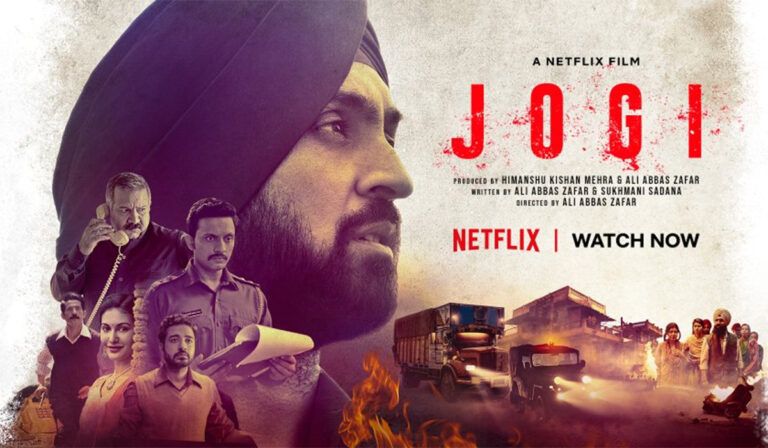
Netflix original film ‘Jogi‘ is set in the backdrop of the carnage against the Sikh community that unleashed in Delhi in 1984, in the wake of then PM Indira Gandhi’s assassination.
Joginder Singh (Diljit Dosanjh), aka Jogi, is a caring son and a responsible citizen of his North Delhi Trilokpuri neighbourhood. When his community is besieged in the 1984 Delhi violence, Jogi takes upon himself the perilous task of evacuating to safety his friends, family and neighbours from Trilokpuri, Lane Number 6. He receives unrelenting support from his buddies, Delhi police’s Rawinder (Mohammad Zeeshan Ayyub) and Kaleem (Paresh Pahuja).
Performances?
Diljit Dosanjh is superb as Joginder Singh, especially in the emotional and sensitive scenes. His shell-shocked expression in the wake of the terrifying happenings around him is so realistic and heart-rending that your heart goes out to his Jogi.
Mohammad Zeeshan Ayyub delivers yet another commendable performance. Paresh Pahuja and Hiten Tejwani lend gravitas to their respective roles. Kumud Mishra comes across as a caricature, perhaps for the first time in his recent career. His is an uninteresting character, saddled further with done-to-death tropes. Amyra Dastur grabs attention in the short time she’s on screen.
Analysis
Jogi is a film with its heart in the right place. The story rekindles the pain of long-festering wounds inflicted on the heart and soul of the country back in 1984; wounds that haven’t perhaps healed even after almost four decades.
Abbas Ali Zafar has depicted the brutality of the blood-curdling events of that time with nuanced sensitivity. The screenplay efficiently conveys the bafflement of ordinary Sikhs at the violent alienation of an entire community for the deeds of a barbaric few.
The evacuation drama that follows engages the viewer to a certain degree. Several scenes, fraught with palpable danger, manage to keep you at the edge of your seat. The story, at this point, alternates between heartrending emotion and suspenseful thrill. However, the half of Jogi is the only part of the film that really touches the core of your heart and chills you to the bone. The troika of Jogi, Ravinder and Kaleem keeps you engaged and invested in the story.
The second half of Jogi paves the way for the entry of new character, Lali (Hiten Tejwani), with an old axe to grind with Jogi. This is when the narrative hits a false note so shrill that it takes away all the good work of the first half of the story. That a story as sensitive as this could swiftly degenerate into a clichéd tale of personal vendetta is laughable. The twist in the story trivialises one of the darkest and most painful chapters of India’s history post independence. Jogi’s second half is a cryptic lesson for filmmakers to handle fragile subjects with utmost care.
Diljit Dosanjh’s earnestness papers over the glaring dissonance of the latter half of the film to some extent. To sum it up, Jogi is a well-made film that needed a better narrative in the second half.
Music and Other Departments?
Songs are as good as redundancies in a film such as Jogi. Yet, the couple of songs that it does have are pleasing to listen to. The background music lends the right touch of horror and terror to the story. Cinematographer Marcin Laskawiec’s camerawork is the mainstay of Jogi. Edgy in moments of thrill, indulgent in the emotional bits, it captures the sensitiveness of the story with flawless perfection.
Highlights?
Diljit Dosanjh’s performance
The emotional bits
The first half
Drawbacks?
Stilted second half
Kumud Mishra’s caricaturish character
Unimpactful twist in the tale
Did I Enjoy It?
I found it Average
Will You Recommend It?
Yes, As a One-Time Watch
Jogi Movie Review by Binged Bureau
We’re hiring!
We are hiring two full-time junior to mid-level writers with the option to work remotely. You need to work a 5-hour shift and be available to write. Interested candidates should email their sample articles to [email protected]. Applications without a sample article will not be considered.
