
































































What Is the Story About?
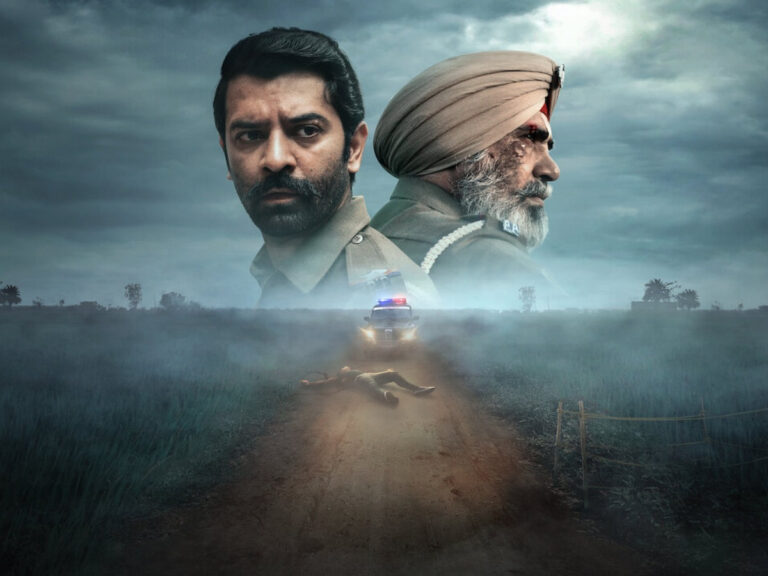
Netflix’s latest Indian original series ‘Kohrra’ is set in the backdrop of rural Punjab. A young NRI, Paul Dhillon (Vishal Handa), returns to his ancestral village, Jagrana in Punjab, for an arranged marriage. Just days before his wedding, he’s found butchered to death in the fields, and his best friend Liam (Ivantiy Novak) missing. When two world-weary cops, the veteran Balbir Singh (Suvinder Vicky) and his young subordinate Amarpal Garundi (Barun Sobti), dig deeper into the murder, it opens up a stink-hole of conspiracies and secrets.
‘Kohrra’ is written and created by Gunjit Chopra and Diggi Sisodia, co-created by Sudip Sharma, directed by Randeep Jha, and produced by Clean Slate Films.
Performances?
Suvinder Vicky, as the stoic, flawed Balbir Singh, is a masterclass in acting. It’s a terrific turn that is right up there with the best performances of recent times. Barun Sobti is a scene-stealer as Garundi. He delivers a flawless performance, bringing conviction and persuasiveness to his character.
Manish Chaudhari is grave and compelling as Satwinder ‘Steve’ Dhillon. He makes you squirm and gets under your skin with his barely contained temper, proof of his excellent acting skills. Varun Badola is a tad underused as Maninder ‘Manna’ Dhillon, but as impressive as ever. Rachel Shelley is superb as Clare Murphy.
Ekavali Khanna, as Indiraji, Amaninder Singh as Happy, overbearing father, Veerpal Kaur Gill as female constable Satnam, Jagga Singh as the junkie Kulli, and the rest of the supporting cast are equally good.
Analysis
‘Kohrra‘ is cut from the same cloth as Netflix’s own ‘CAT’, released last year on the platform. The similarities are endless – the rural milieu, the grim and gritty narrative, the affecting human drama, the predominantly Punjabi cast — even the lead actor, for that matter. Both shows have the excellent Suvinder Vicky playing a Sikh cop with grey shades. There’s one major difference between the two, however. While CAT is darker and grimmer, Kohrra is more nuanced, with stunningly complex characters, in uniquely complicated situations.
The story of Kohrra begins like a regular murder mystery and whodunit. But by the end of the first episode itself, one realises that the murder is just a peripheral element of the narrative. As one delves deeper into the story, a whole gamut of compelling issues pop out of its depths, each enthralling in its own way. Deep-seated patriarchy, parental pressure, toxic masculinity of Indian males, homophobia, the apathetic police system in the country — which only wants to close cases, not solve them — and so much more.
Looming large over the storyline is the many-splendored human emotion of love, its many facets, and the things people do for the sake of it. Love forms the beating heart of the story; it also plays villain in surprising ways. Like several characters re-iterate in the series “love badi g*ndu cheez hai”, leaving it seared on the mind of the viewer.
In its relatively short runtime, Kohrra manages to explore more issues, and in an infinitely nuanced manner, than most other shows that don’t even skim the surface of, in multiple seasons. The layered narrative, despite the brevity, is a testament to the stellar storytelling skills of the writers and the director.
Short, sharp bursts of organic humour lighten up the grim tale. From Satnam’s love for expensive smart watches, iPhones and frappes, to Saakar’s eccentric rap to the delightful nod to Rachel Shelley’s (she played Elizabeth in Lagaan) return to Indian screens when she takes a ‘Capt Russel Cabs’ taxi, the humour is unforced, organic and on-point.
Interestingly, Kohrra is perhaps the first time that an Indian show has featured a legit ménage à trois as part of the primary plot. For the unversed, a ménage à trois is when three people share a domestic arrangement, complete with sexual relations with each other – typically a traditional marriage between a man and woman, along with another individual – in Kohrra’s case, the younger brother of the husband. The most intriguing part of the threesome relationship in Kohrra is that it comes across as a totally natural and organic plot device, instead of forced, contrived or added with the sole purpose of titillation.
The characters that populate the fascinating universe created by Sudip Sharma, Gunjit Chopra and Diggi Sisodia are riveting too. Essentially flawed, all of them, they exist in shades of grey, instead of pristine-white, purity-drenched characters or black-as-night, evil-personified ones. The latter kind of people don’t exist in real life, and it’s about time storytellers show us some real people, for heaven’s sake! Kohrra sets an excellent, emulation-worthy benchmark in that aspect.
Suvinder Vicky’s Balbir Singh and Barun Sobti’s Garundi are especially fascinating. Neither is higher up on the police pecking order, and both are weary cogs in the systemic wheel. Both are also as different as chalk from cheese – Balbir is a softie at work, but a raging bull outside. His daughter (Harleen Sethi) bears the brunt of his overbearing patriarchy. Garundi is just the opposite, with a penchant for shooting first, asking later. But he’s mild and mellow with his loved ones. Both characters offer a fascinating study of human fallacies in their own ways.
Not just the two leads, every characterisation in Kohrra is equally terrific. Each character is etched out with careful detailing, and the actors do them complete justice – be it the female constable, Satnamji; the widowed Indiraji; Garundi’s sister-in-law Rajji; the long-haired rapper Saakar; the truck-driver; and even characters with blink-and-miss appearances – for instance, Shenda’s unnamed wife. Each is outstanding in his or her part. Even though the viewer is never introduced to their back stories, one immediately understands where each one is coming from.
The best part of Kohrra is its style of storytelling. It is that rare Indian show that indulges in the “show, don’t tell” style of filmmaking, placing trust in the intelligence of the viewer, rather than spoon-feeding us every bit and piece of the narrative in expository fashion.
Finally, the best part of the story is that, despite its inherent bleakness, the series ends on a heart-warming redemption arc for each character – Balbir, Indira, Garundi, Manna Dhillon, Saakar, among others.
To sum it up, Kohrra is a a finely-written and directed piece of work, which tells a nuanced story set in rustic Punjab environs. The stellar storytelling, propped by a predominantly Punjabi cast, works majorly to its advantage. Kohrra is definitely a mustwatch.
Music and Other Departments?
Benedict Taylor and Naren Chandavarkar’s background score brings out the piercing throbbing tragedy at the heart of the story. The urgent, evocative, haunting notes are poignant and moving, apt for the story they want to tell. Saurabh Monga’s cinematography is superb, bringing out the starkness of the bleak, dusty hinterlands of Punjab in stunning ways. Sanyukta Kaza’s editing is crisp and flawless.
Highlights?
Excellent performances
Superb characterisations
Terrific writing
Flawless technical aspects
Exceptional casting
Drawbacks?
Nothing worth mentioning
Did I Enjoy It?
Yes
Will You Recommend It?
Yes
Kohrra Series Review by Binged Bureau
We’re hiring!
We are hiring two full-time junior to mid-level writers with the option to work remotely. You need to work a 5-hour shift and be available to write. Interested candidates should email their sample articles to [email protected]. Applications without a sample article will not be considered.
