
































































What Is the Story About?
Maamla Legal Hai Season 2 continues inside the busy and chaotic world of the Patparganj district court in Delhi. The story picks up from where the first season ended, but the biggest change is that VD Tyagi is no longer a lawyer. He has now become a judge.
At first, this feels like a step up for him. He enjoys the respect and authority that comes with the role. But very soon, the reality of the job begins to weigh on him. Being a judge is not just about power. It is about making decisions that can change people’s lives forever. Tyagi starts missing the freedom he had as a lawyer, where he could argue, hustle, and stay close to people.
Around him, life in the court keeps moving in its usual unpredictable way. Different cases come in, some strange, some serious, many inspired by real-life incidents. There are disputes between families, conflicts between couples, and odd situations that reflect everyday life. These cases are often funny on the surface, but they also show how messy and complicated people’s lives can be.
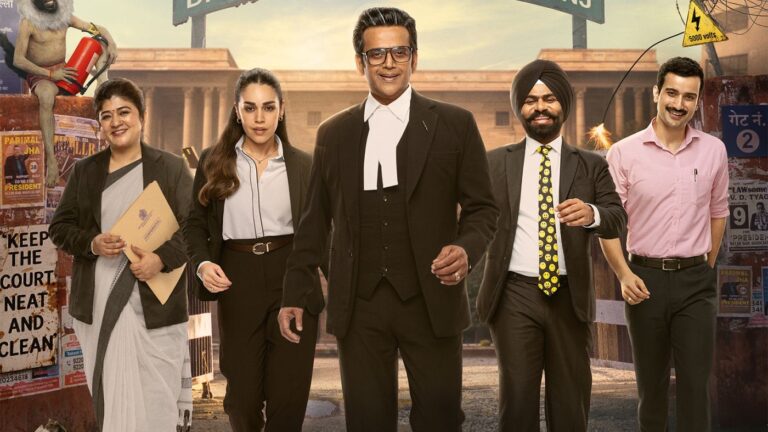
At the same time, the lawyers and staff in the court deal with their own personal struggles. Sujata and Mintu compete for control and recognition while also dealing with their changing relationship. Ananya, who comes from a more polished background, tries to understand how to work in a system that is far from ideal. Vishwas balances his work life with his personal emotions.
The season slowly builds a picture of a system that is flawed but real. People try to do their best, even when the system around them makes things difficult. It is less about big victories and more about everyday chaos.
Performances?
The performances this season work best when they reflect how uncomfortable these characters are in their own roles.
Ravi Kishan’s Tyagi is the clearest example. As a judge, he is not at ease. You can see it in small moments. The way he hesitates before speaking. In one of the difficult moments, when he has to deal with a death penalty decision, he looks less like a man in control and more like someone quietly overwhelmed. The performance is not loud, but it shows a man realising that power also comes with isolation.
Nidhi Bisht and Anjum Batra bring a different kind of tension. Their scenes are built on irritation, ego, and familiarity. When they circle around each other in Tyagi’s old chamber, it feels like two people trying to claim space without openly admitting it. Their arguments are not dramatic. They feel like everyday workplace friction that slowly turns personal.
Anant V Joshi gives Vishwas a restless energy. He moves through the court like someone who is always juggling something. Work, relationships, expectations. There is a lightness to him, but also a sense that he does not have the same control over his life as others pretend to have.
Naila Grewal plays Ananya with a certain awkwardness that fits. She comes in with her polished background, but the court keeps pushing her into situations she cannot fully control.
Across the board, the actors are most effective when they let the awkwardness, confusion, and small insecurities show. That is what makes these people feel real.
Analysis
Maamla Legal Hai Season 2 stays inside the same Patparganj court, but the tone shifts in a significant way. The first season felt like it was still figuring itself out. This one is more settled. It knows the kind of world it wants to show. A place where serious work is constantly interrupted by messy human behaviour and sometimes in an unintentionally funny way.
At the centre of it is Tyagi’s journey from lawyer to judge. This is not treated like a victory. It feels more like a trade-off. As a lawyer, he was active. He could argue, negotiate, and stay close to people. As a judge, he is forced to sit still and decide. That shift changes how he exists in the space. His ideas about making big changes quickly run into the reality of paperwork, rules, and constant scrutiny. Even something as small as smiling at a colleague becomes complicated. The show uses this to quietly question what power actually looks like in a system like this.
The cases continue to come in episode by episode, and they range widely. Some are light and almost absurd, like the one involving rats supposedly eating confiscated cannabis, or a man dealing with the consequences of using too much deodorant. Others are actually difficult, like family disputes or situations that touch on crime and punishment. The show tries to balance both tones. Sometimes it works well, especially when it allows humour to come from behaviour rather than forcing jokes. But there are moments where the writing struggles. A few serious cases feel simplified, almost like they are reduced to punchlines or easy commentary. That is where the show feels unsure of itself.
What the season does well is capture the everyday rhythm of this world. The best scenes are often not about the cases at all. They are about what happens in between. Judges competing over small things like invitations or status. Lawyers trying to hold on to relevance. Staff members navigating through the same. These moments build a sense of place. You start to understand that the system runs not just on rules, but on personalities.
There is also a take about bureaucracy. Decisions move slowly. Responsibility is passed around. Everyone is involved, but no one is fully accountable. The show does not push this too hard, but it is always there in the background. In one of the more affecting moments, a simple act involving a street vendor cuts through all the noise and reminds you what justice should mean at a basic level. The show does not stay on it for long, but it leaves an impression.
Performance-wise, the cast understands this tone. Ravi Kishan plays Tyagi with visible experience. He often looks like a man holding himself back, which fits the role of a judge who cannot behave freely. Nidhi Bisht and Anjum Batra bring a steady, believable tension to their equation, built on ego and familiarity. Anant V Joshi adds movement and energy, making his character feel like someone still trying to find stability. Naila Grewal’s Ananya reflects the discomfort of someone stepping into a system that does not match her expectations. Dibyendu Bhattacharya, even with limited screen time, brings weight and quiet control.
But there is a lack of a coherent solid story. The series moves, but there is no one big reason behind it. There is just everyday chaos which binds the story. If the writers had focused on that part, then it would have come out far better.
Overall, the season works in parts because it stays close to people rather than trying to become a grand statement. It observes more than it declares. At the same time, it does not always trust its own tone, especially when dealing with heavier themes. But when it slows down and lets its characters just exist, it becomes sharp, honest, and quietly engaging.
Other Artists?
The direction stays grounded and does not try to make the court look larger than life. The setting feels like a real lower court which is always crowded, a bit worn out, and always busy. Thankfully, nothing feels staged for effect. This helps the show feel believable. At the same time, the background music sometimes tries too hard to tell you how to feel. In a few scenes, especially emotional ones, silence would have worked better. The editing is mostly steady, but some episodes feel uneven, with certain moments stretching longer than needed while others end too quickly.
Highlights?
Performances
Setting
Drawbacks?
Lack of a coherent screenplay
Did I Enjoy It?
In parts
Will You Recommend It?
Only if you have nothing better to watch.
Maamla Legal Hai Season 2 Series Review by Binged Bureau
We’re hiring!
We are hiring two full-time junior to mid-level writers with the option to work remotely. You need to work a 5-hour shift and be available to write. Interested candidates should email their sample articles to [email protected]. Applications without a sample article will not be considered.
