
































































What Is the Story About?
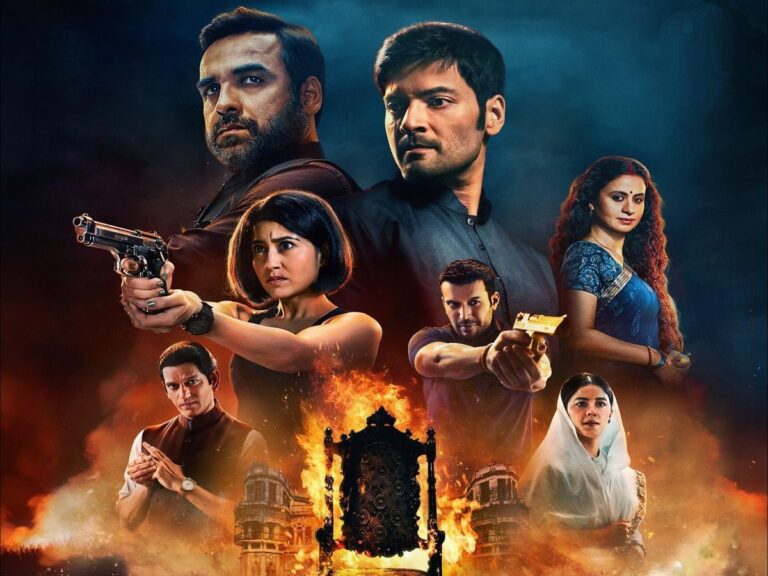
The Tripathis no longer hold the fort at Purvanchal. Guddu and Golu pay a heavy price for their choices and need to confront a new contender for the throne – Sharad Shukla. Meanwhile, Kaleen Bhaiya’s whereabouts are yet to be traced, Ramakant Pandit’s perspective towards the system changes behind bars and CM Madhuri Yadav employs every trick in the book to hold onto power.
Performances?
Ali Fazal, rightly nicknamed ‘Bhasmasur’ in the show, is a dream to watch as Guddu, mirroring the psychological downfall of a character who loses the plot in the pursuit of redemption and power. Shweta Tripathi is ‘shackled’ for a major part of the show but effortlessly portrays the resilience of a wronged woman who isn’t afraid of taking tough calls.
Harshita Gaur is impressive as the show’s emotional anchor – it’s through her character that you try to decode the essence of the story. Though Rasika Dugal’s Beena Tripathi takes a backseat this season, the actress is superb in capturing the spirit of a shrewd, manipulative woman who has terrific survival tactics. However, the two major surprises of this season are Isha Talwar and Anjum Sharma.
There’s a quiet grace and dignity to Isha’s performance as a politician stuck in a male bastion, doing what it takes to stick to her tall ideals. Anjum – as the modern-day Shakuni – is a picture of poise as the power-hungry prince. Pankaj Tripathi lends an appealing philosophical touch to Kaleen Bhaiya through the character’s road to recovery.
Rajesh Tailang, Sheeba Chaddha pack a punch in brief yet impactful episodes while Vijay Varma doesn’t get as much scope to reinvent himself or sparkle. Several solid supporting acts, cameos contribute to the show’s holistic appeal – be it Priyanshu Painyuli or Anil George or Meghna Malik, Anangsha Biswas or Pramod Pathak.
Analysis
Mirzapur season 2’s tantalising, Godfather-ish finale left the viewer with scores of questions. Will Kaleen Bhaiya relieve himself from the clutches of death? Who’ll take over Mirzapur in his absence? Will the widowed Madhuri Yadav prove her mettle in the political arena? Are the Tyagis on the redemption path? What’s in store for Guddu and Golu?
Mirzapur’s latest instalment is a big bore for a major part and has the appeal of a reference manual in a film school – dull, overburdened by expectations, too conscious of its presence, aiming to do justice to every character arc, packing in heavy detailing and bringing all the pieces of the puzzle together for a dramatic ending. However, the show forgets its primary purpose – entertainment.
The new season meanders so much, stretches needlessly and even when it stages a late recovery in the later episodes, you’re too exhausted to appreciate its craft. The elasticity of a possibly taut 150-minute feature film is forcibly expanded across ten episodes (which have a 50-minute runtime on average). The overwrought treatment results in a joyless experience for the viewer.
It wastes much time in establishing its conflicts. The creators are undone by the complexity of their setting. Mirzapur tries to do many things – portray the power hierarchy in the crime world, hopelessness within the system, uncover the drama in the political field, and showcase the trauma of characters raised in dysfunctional families but the storytelling is too impersonal and indifferent.
While focusing specifically on its pivotal characters and the endless subplots, the story progression takes a backseat (now, please don’t give it a ‘slow-burn’ label) and heavy detailing is mistaken for drama. Amidst the many messy situations that its flawed characters find themselves in, it’s hard to decode the larger point that the show is trying to make (it needed more streamlining).
The efforts that have gone into the execution are there for everyone to see – the subtle reveals, the effective visual motifs, the solid dialogue baazi (especially with Raheem’s character in the prison), the karmic approach to the destinies of the characters. The show fails to liberate itself from its sophisticated exterior and the whole isn’t greater than the sum of its parts.
Mirzapur Season 3, directed by Gurmeet Singh and Anand Iyer, is like a student who over-prepares himself for an exam, you want to give a pat on his shoulder but end up saying ‘mazaa nahi aaya.’ If you need a few reasons to catch it, it has to be for the impressive performances, technical finesse, brutal exploration of the nexus between politicians and goons and the strangely compelling yet complex cobweb of interpersonal relationships.
Music and Other Departments?
John Stewart Eduri’s frenetic score, building on the show’s tense, grim ambience, is an asset to the result and so is Sanjay Kapoor’s cinematography, bringing a new dimension to the written material with the visuals. Apurva Dhar Badgaiyann’s writing is dense but the makers could’ve done a better job of translating it into the visual medium. It gets too verbose and dialogue-driven at times and the storytelling needed more precision (it’s not certainly a show that merits over 500 minutes).
Highlights?
The effort to capture various dimensions of the system
Impressive performances
Technically brilliant
Drawbacks?
Lack of focus in storytelling
Pointlessly convoluted
Absence of precision
Did I Enjoy It?
Only in parts
Will You Recommend It?
Only if you’re a hardcore fan of the franchise
Mirzapur: Season 3 Series Review by Binged Bureau
We’re hiring!
We are hiring two full-time junior to mid-level writers with the option to work remotely. You need to work a 5-hour shift and be available to write. Interested candidates should email their sample articles to [email protected]. Applications without a sample article will not be considered.
