































































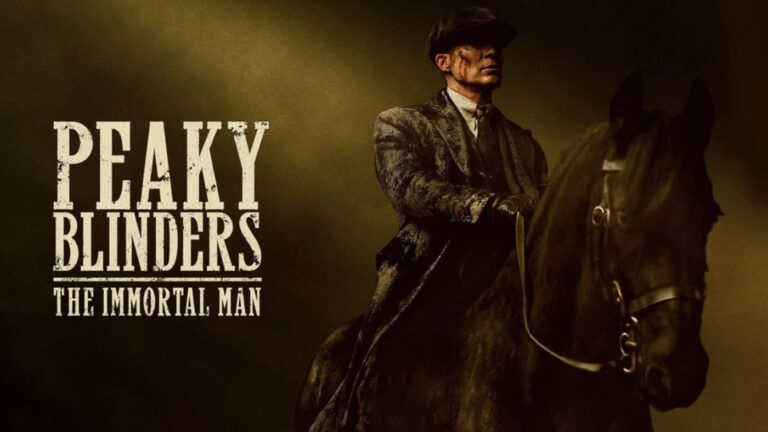

What Is the Story About?
Taking place after the events of the original series, Peaky Blinders: The Immortal Man, revolves around Tommy Shelby (played by Cillian Murphy), as he gets pulled back into the fray to save his son, Duke Shelby (Barry Keoghan). Despite his efforts to remain a “ghost” and move toward legitimacy, the rising tide of World War II and the resurgence of fascist elements in Britain force his hand.
Tommy must navigate a treacherous landscape of shifting political alliances and old vendettas that threaten the Shelby empire’s survival. The narrative centres on his struggle to reconcile his weary and numb soul with the ruthless violence required to protect his family. As the stakes reach a fever pitch, the film explores the weight of his legacy, ultimately questioning if Thomas Shelby can ever truly escape the life he built or if he is destined to remain a soldier of the underworld forever.
Performances?
Cillian Murphy delivers his final performance as Tommy Shelby, and he closes the chapter on the iconic character on a highly satisfying note. Compared to his portrayal in the original TV series, this time his take on Tommy feels more internal, as we see him dealing with the tragic loss of his daughter and his brother Arthur.
We see more heavy silences and a weary stillness from Murphy this time. He portrays Tommy not as a man looking for a fight, but as a man who is haunted by the fact that he is the only one capable of winning it. The “immortality” referenced in the title is played less as a superpower and more as a curse of endurance.
Rebecca Ferguson also stands out as the twin sisters, Zelda and Kaulo Chiriklo. First, we see Kaulo as a total force of nature, the one who claims to channel Zelda’s spirit via her psychic abilities. Ferguson’s portrayal of Kaulo appears calm, cool, but also calculated.
Through haunting flashbacks, we get to see Zelda, the Romani woman Tommy fell for back in 1914. Ferguson plays her with a raw, earthy charm that explains exactly why Tommy never truly got over her.
Analysis
SPOILER ALERT!
Peaky Blinders: The Immortal Man (directed by Tom Harper) feels like an epilogue to the original TV series. It is the high-octane, soul-crushing finale fans have been waiting for, and it officially takes the Shelby saga from the small screen to a massive, war-torn cinematic stage.
The film does retain the slow-burn tension of the OG series to some extent, but it also uses the “movie” format brilliantly. The film discards Birmingham’s blitz and glitz from the early 1920s and opts for more of a “mud and blood” mode.
The film finds Tommy Shelby in self-imposed exile, haunted by the “ghosts” of his past, specifically his brother Arthur and daughter Ruby, while attempting to write his memoirs. The core conflict is sparked by his son, Duke (Barry Keoghan), who has taken over the Peaky Blinders but finds himself entangled in a treacherous Nazi plot involving counterfeit currency designed to collapse the British economy.
One of the biggest positives to come out of the film is the multigenerational conflict between Tommy and his Gypsy son, Duke. The latter finds an opportunity to re-establish the “Peaky Blinders” and run Birmingham as he sees fit after his father retires and chooses exile.
Seeing Tommy forced out of retirement to clean up his son’s mess provides some of the film’s most electric moments, particularly a gritty brawl in the mud that reminds viewers of the show’s rawest roots.
The film’s biggest strength is its ambition; moving from the small-time gang wars of Birmingham to a Nazi-thwarting mission in the 1940s feels like a natural, epic progression for Tommy Shelby. The father-son dynamic between Tommy and the recast Duke (Barry Keoghan) provides the film’s emotional anchor.
However, there are times when the plot seems a bit overstuffed, as the makers try to cram an entire season’s worth of development, including the shocking and controversial deaths of legacy characters like Arthur and Ada, into a two-hour runtime. Both Arthur and Ada are important characters from the OG series, and the manner in which their demises are handled in the latest film feels a bit rushed.
Also, the first 45 minutes are a methodical, atmospheric stretch with some “ghost” and “spirit” elements that perfectly capture Tommy’s internal struggles and decay. However, this portion may test the patience of some viewers, as it feels a bit slow.
But once the action shifts to the Nazi conspiracy, the pace accelerates into a frantic heist-style drama. While this makes for an entertaining second half, it leaves little room for the emotional “breathing space” the series was famous for. Major character deaths and massive political shifts happen so quickly that they often lack the gut-punch impact they would have earned over a six-episode arc.
Tom Harper’s direction successfully upscales the Peaky aesthetic for the big screen. Harper uses stylish tracking shots and the series’ signature slow-motion “power walks” to maintain visual continuity, but he also leans into a more sombre, muted colour palette that reflects Tommy’s weary state of mind.
As for the dialogue, this department has Steven Knight written all over it. It is sharp and heavy with foreshadowing, key traits of the show. However, it occasionally falls into the trap of being overly expository. Because the film has so much ground to cover, characters often spend their time explaining the plot or their motivations rather than letting the subtext do the work.
Thanks to Cillian Murphy, the moment he appears on screen, he elevates every line and does most of the heavy lifting. Moreover, the first half of the film introduces Duke Shelby as another “big gun” from the Shelby family, but the moment he crosses paths with his legendary father, his character arc and development take a back seat.
Another big highlight of The Immortal Man is the mud fight between Tommy and Duke, as it allows both characters to express frustrations and emotions that have remained suppressed for a long time.
Peaky Blinders: The Immortal Man ultimately serves as a victory lap that honours the myth of Thomas Shelby, even if it leaves some of the show’s intricate character work feeling a bit rushed.
Music and Other Departments?
Peaky Blinders: The Immortal Man benefits immensely from a pretty solid score and soundtrack. Composers Antony Genn and Martin Slattery return with a score that perfectly blends the show’s “post-punk” DNA with a more orchestral, cinematic weight. We also listen to some covers of the hits like Massive Attack by Grian Chatten (Fontaines D.C.) and Amy Taylor (Amyl and the Sniffers).
We see a colder, more wintery, and apocalyptic palette from cinematographer George Steel. The lighting is used amazingly to reflect Tommy’s mental state. The iconic “power walks” are still there, but they are framed with a newfound sense of finality.
The editing is where the film’s pacing issues are most visible. While the action sequences, particularly the “mud fight” and the warehouse shootout, are edited more tightly and effectively, the transitions between the “memoir” sub-plot and the Nazi conspiracy can feel jarring.
On the flip side, the production design is flawless. The attention to detail in the 1940s munitions factories and the decaying Shelby manor creates a vibe that is both nostalgic and fresh. The costume design also deserves a shoutout, seeing the transition from 1920s dandyism to the practical, rugged look of Tommy in the 1940s brings the character’s journey full circle.
Other Artists?
Taking over the role from Conrad Khan, Keoghan brings a feral and angsty energy to Duke. He plays the illegitimate heir as a man with all of Tommy’s ambition but none of his restraint. Yes, Keoghan’s portrayal of the character does lack the “calculated coldness” of the original actor, but his chemistry with the cast, particularly with Murphy, makes him a believable, if volatile, successor.
As the Nazi double agent, Tim Roth looks relaxed yet menacing. He plays the villain with an unapologetic, Indiana Jones-style villainy. But his character also feels a bit one-note.
Sophie Rundle doesn’t miss a beat as Ada from the OG series, as she steps up as the family’s moral compass and a powerful MP. While it was great to see her in the film, her sudden death feels rushed, as it feels like she was added only so that Tommy could go on another rampage.
Stephen Graham returns as Hayden Stagg, but he remains criminally underused. In addition, the manner in which Arthur has been handled in the movie doesn’t sit right. Due to real-world issues (health issues and illegal drug possession) with actor Paul Anderson, Arthur is essentially written out through a shocking off-screen death or brief, haunting visions.
But this overall arc will surely not sit well with a large section of the show’s fanbase. Steven Knight does explain the reason behind Arthur’s death, but the manner in which we get to know about his demise also feels rushed.
Highlights?
Cillian Murphy’s Final Bow
Rebecca Ferguson’s Dual Role
Cinematic Ambition
Action Set Pieces
Music and Cinematography
Production and Costume Design
Keoghan’s performance
Drawbacks?
Overstuffed Plot
Pacing Issues
Handling of Arthur and Ada
Underused Stephen Graham
Did I Enjoy It?
Liked the haunting, cinematic scale and Cillian Murphy’s weary, “immortal” performance, which felt like the perfect poetic end for Tommy. While the rushed deaths of Arthur and Ada were a tough pill to swallow, the “mud-and-blood” atmosphere and that electric father-son dynamic keep us hooked until the final frame.
Will You Recommend It?
Yes, particularly to die-hard fans who want closure, especially for the top-tier music and the stunning transition into the 1940s Blitz. However, beware of the pacing issues, as it switches from a slow-burning “ghost story” to a frantic Nazi heist almost too quickly.
Peaky Blinders: The Immortal Man Movie Review by Binged Bureau
We’re hiring!
We are hiring two full-time junior to mid-level writers with the option to work remotely. You need to work a 5-hour shift and be available to write. Interested candidates should email their sample articles to [email protected]. Applications without a sample article will not be considered.
