
































































What Is the Story About?
Raakh is a crime drama set in Delhi in 1978 and is inspired by one of the most shocking criminal cases in India’s history. The murder case of Geeta Chopra and Sanjay Chopra.
In this case the two siblings are named Suman and Sahil Arora, who leave home to participate in a radio programme. On their way back, they accept a lift from two strangers during a rainy evening. And that is when the hunt begins. The horrifying case of Ranga Billa, who in this series are Rajjo and Babu.
It is important to note that Suman and Sahil Arora form one fraction of the story. The writers have taken liberty and made the show about two monsters who also happen to kill Suman and Sahil. The entire show is not based on that particular case.
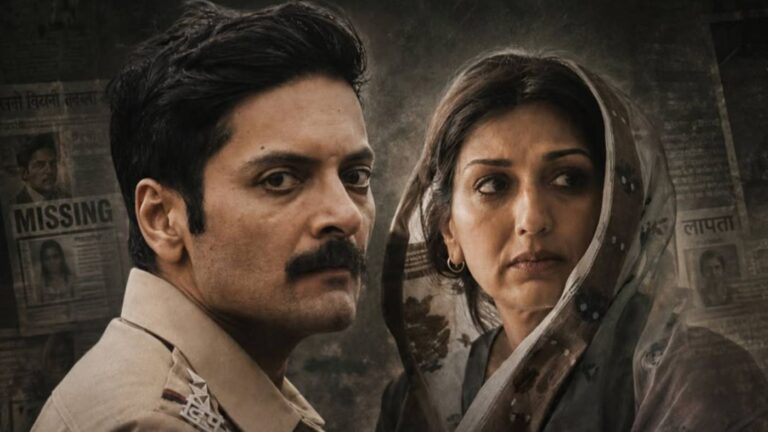
As panic spreads through the family, their parents, Lt. Colonel Ashok Arora and Mona Arora, launch a desperate search for their children. The case lands on the desk of Sub-Inspector Jayprakash Jatav, a young and ambitious police officer trying to prove himself. What initially appears to be a missing persons case soon evolves into a horrifying murder investigation that shocks the entire nation.
Running parallel to the investigation is the story of Babu and Rajjo, two petty criminals drifting across cities while surviving through theft, kidnapping and violence. Through flashbacks and parallel timelines, the series gradually pieces together their journey and reveals how their lives intersect with the fate of the Arora siblings.
As Jayprakash and his team pursue every lead, the investigation expands beyond Delhi and becomes a manhunt that originates in Mumbai and then expands to Sonipat and Agra. The series also explores the early days of forensic investigation in India, highlighting the challenges faced by law enforcement in an era without modern technology. Alongside the procedural elements, Raakh the psychological scars left behind by violent crime.
More than a conventional thriller, Raakh is a haunting portrait of a city confronting an act of unimaginable brutality. It explores not only the hunt for the perpetrators but also the devastating impact of the crime on the victims’ family and on a society forced to confront the darkness lurking beneath everyday life. This series is more about two murderers than it is about the kidnapping and murder of the two kids.
Performances?
The performances are among Raakh’s strongest assets and play a crucial role in grounding a story that could easily have slipped into sensationalism.
Ali Fazal delivers one of the finest performances of his career as Sub-Inspector Jayprakash Jatav. Instead of turning the character into a larger-than-life cop, Fazal plays him as a man carrying the emotional burden of a horrific case. His frustration with bureaucracy, his determination to prove himself, and his growing obsession with finding the killers are conveyed through subtle expressions rather than dramatic outbursts. The actor is particularly effective in scenes where Jayprakash struggles to maintain composure while confronting the brutality of the crime.
Sonali Bendre is heartbreaking as Mona Arora, the mother of the missing children. She portrays grief with remarkable control. Some of her most powerful moments come in silence, as she clings to hope long after reality has become impossible to ignore.
Aamir Bashir is equally impressive as Lt. Colonel Ashok Arora. He captures the conflict between military discipline and parental anguish with tremendous sensitivity. Bashir excels in moments where his character desperately searches for answers while trying to remain emotionally functional. He pays a private investigator and finds out what exactly his children went through. That particular scene when he chooses to keep the information only to himself is absolutely horrifying.
Analysis
Raakh arrives at a time when Indian streaming platforms are past their obsession with crime dramas, serial killers, and investigations. Loosely inspired by the infamous Ranga-Billa case, the series uses a familiar procedural framework but attempts to tell a larger story about a city losing its innocence, institutions struggling to cope with unprecedented brutality, and families left permanently shattered by violence.
The series has done a wonderful job at recreating the late-1970s Delhi. The production design is exceptional without ever drawing attention to itself. The streets, government offices, police stations, vehicles, clothing, and homes create a convincing world. The period setting serves a dramatic purpose beyond aesthetics. The absence of modern surveillance, mobile phones, and digital tracking forces the investigation to rely on witness statements, poor sketches, paperwork, radio alerts, and instinct. This old-fashioned investigative process generates genuine tension because every breakthrough feels hard-earned.
The writing is at its strongest when it focuses on grief. The series understands that the real tragedy is not the crime itself but the void it leaves behind. The scenes involving the Arora family carry tremendous emotional weight. Rather than reducing the parents to symbols of suffering, the show allows them to process loss in different ways. Mona’s refusal to fully accept reality and Ashok’s desperate search for answers feel painfully authentic. The series repeatedly reminds viewers that while justice may eventually arrive, what has happened can never be undone.
Coming to that, there is one concern with this series. How ethical is it to take a real-life crime incident and make a series out of it?
Well, there is not much of a problem. And there are n number of films/series based on real crimes. But Raakh is different.
It takes on the formula of Dhurandhar. Yes, there are references to real crime but most of the series is fictional. This happens to an extent that you may never be able to differentiate the two. There is a popular term called “hero worshiping”, well, this series is entirely opposite of that. It is “monster vilification” if I may say. The show focuses more on Rajjo and Babu instead of a particular crime.
Ali Fazal is remarkable in this series. Away from the trope of Munna Bhaiya, he is very vulnerable in this series, even though he is playing a sub-inspector. When he is introduced on the screen, he is talking about Ambedkar and you occasionally see iconographies of Ambedkar. After all, he is Jayaprakash Jatav who is also preparing to be an inspector.
The father-son dynamic is among the show’s most interesting subplots. Rakesh Bedi’s Ghanshyam represents a generation that has been subject to caste-based discrimination, while Jayprakash represents someone determined to challenge it. Their ideological conflict gives the series a personal dimension that prevents it from becoming a purely investigative drama.
The series is also commendable for refusing to romanticise its criminals. Akash Makhija and Ramandeep Yadav are genuinely disturbing as Babu and Rajjo. The performances avoid theatrical villainy and instead portray violence as something frighteningly casual. The show attempts to explore their backgrounds and the circumstances that shaped them without excusing their actions. For instance, Babu is clearly a psychopath in the show. He is much more bloodthirsty than Rajjo. But yet again, he has a trigger. He labels Rajjo emasculated because Rajjo was vasectomised during the Emergency. Babu doesn’t think of Rajjo as a man and he acknowledges Rajjo’s masculinity only when Rajjo does what Babu asks him to do. This involves rape, murder and just about anything.
Very subtly, the show also talks about sexuality, gender norms and, of course, caste.
However, the series is not without flaws. The biggest issue is pacing. While the measured approach works for much of the narrative, eight episodes feel excessive for the story being told. Several stretches linger longer than necessary, particularly during the criminals’ journey across different cities. The repetition sometimes dilutes the urgency that the central investigation requires.
Coming to the character of Nissar played by Anshul Chauhan. She is sort of a love interest of Jayaprakash and her character is totally unnecessary. She keeps on appearing in the show and even if you skip the scenes, then it won’t really matter. The only problem of Raakh is the pacing. It could very well be shortened to 7 or even 6 episodes. But Prosit Roy is too involved in his world to even consider that.
At various points, the show evokes memories of superior works. The police procedural elements inevitably invite comparisons to Delhi Crime. The exploration of criminal psychology recalls Paatal Lok and Black Warrant.
Another weakness lies in the occasional tendency to over-explain. Some themes that are already evident through performances and visual storytelling are unnecessarily verbalised. For instance the phone call between Jayaprakash and Nissar when the former is in Mumbai.
The symbolism surrounding Delhi’s transformation and the nature of human evil is sometimes spelt out through dialogue when the imagery is already doing the job effectively. The series would have benefited from greater confidence in its own merit.
Coming to the confidence part. No OTT platform now dares to do what they did back in 2018 or 2019. So many times the story needed stronger language but there is hardly anything. Even Babu and Rajjo talk more politely than an average passenger in the Delhi Metro. That is a turn-off because even when the story is too aggressive, the storytelling is failing to catch up.
The depiction of violence may also divide viewers. While the brutality serves an important narrative purpose, certain sequences feel designed to shock rather than deepen understanding. For instance, the whole case of Deena. She is one of the victims of Babu but from a narrative point of view, she does not matter much. The line between confronting horror and exploiting it becomes slightly blurred in places.
Despite these shortcomings, Raakh remains a powerful and emotionally affecting crime drama. Its strongest achievement is that it never forgets the victims. Even as the investigation expands and the manhunt intensifies, the series continually returns to the children whose lives were stolen and the family left behind. In a genre often fascinated by killers, that focus keeps us clicking on the next episode button. Raakh may not redefine the crime-drama genre, but it is a mature, thoughtful, and deeply unsettling work that lingers long after its final episode.
Other Artists?
Divya Sharma and Vivaan Sharma play the siblings Suman and Sahil. They are kids and they show innocence, courage and the terror that the actual siblings went through. They look remarkable in their roles and they are perfectly cast.
Akash Makhija as Babu and Ramandeep Yadav as Rajjo leave a terrifying impression. Rather than playing them as exaggerated villains, both actors make the criminals disturbingly believable. Makhija brings an unnerving unpredictability to Babu, while Yadav effectively charts Rajjo’s transformation from a petty criminal into a far more dangerous figure. Their performances create genuine discomfort without relying on theatrics.
Rakesh Bedi provides warmth and humanity as Jayprakash’s father. His battles were very different from his son and that causes mild discomfort between them. The supporting cast, including Dibyendu Bhattacharya and Anshul Chauhan, are okay in their respective roles. Although we will come to the character of Nissar, played by Anshul Chauhan, later.
Music and Other Departments?
The technical departments play a major role in making Raakh as immersive as it is. The production design is outstanding as it convincingly recreates late-1970s Delhi and Bombay through meticulous attention to locations, costumes, vehicles, offices, and household spaces. Cinematography embraces muted colours and atmospheric lighting, creating a constant sense of unease without becoming visually oppressive. The background score enhances tension and grief rather than overwhelming scenes. Editing is largely sharp, especially during the investigation sequences, though a few episodes are a bit too long. Suman is a singer and thus the timing and choice of songs are made with a lot of sensibility.
Sound design is particularly strong, using silence, ambient city noises, and sparse effects to deepen the show’s unsettling mood. Overall, the craft departments work in harmony to create a haunting and authentic period crime drama.
Highlights?
Performances
Screenplay
Setting
Drawbacks?
Too long and slow
Did I Enjoy It?
I was horrified but it is what the makers would have wanted.
Will You Recommend It?
Absolutely
Raakh Amazon Prime Webseries Review by Binged Bureau
We’re hiring!
We are hiring two full-time junior to mid-level writers with the option to work remotely. You need to work a 5-hour shift and be available to write. Interested candidates should email their sample articles to [email protected]. Applications without a sample article will not be considered.
