
































































What Is the Story About?
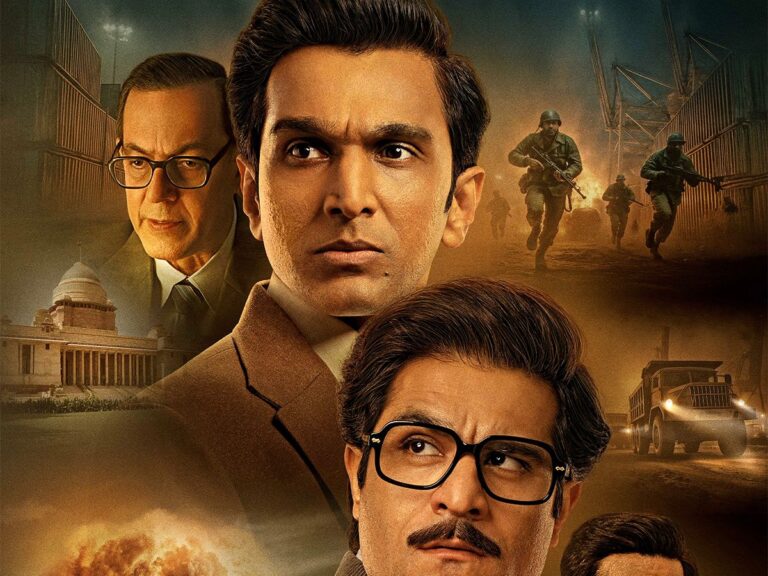
Saare Jahan Se Accha is about the high-stakes journey of Vishnu Shankar, a top-tier Indian spy operating in the tense political landscape of the 1970s. His story is one of profound national duty, born from the personal guilt of failing to protect the country’s leading nuclear scientist, Homi J. Bhabha, years earlier. This defining failure becomes the driving force behind his career in the newly formed intelligence agency, RAW.
The central plot starts when Vishnu is tasked with a mission that could alter world history. He must travel to Pakistan and sabotage their clandestine efforts to build a nuclear bomb. To operate effectively, he assumes the identity of a mild-mannered embassy diplomat, bringing along his new wife, Mohini, as an essential part of his cover. She, however, remains completely unaware of the dangerous double life her husband leads.
Once on enemy soil, the series transforms into a gripping cat-and-mouse game. Vishnu finds his match in Murtaza Malik, the sharp and relentless head of Pakistan’s ISI, who is equally devoted to his nation. The narrative is less about action and more about the intricate, morally grey world of spycraft. It explores the heavy personal toll of such a life, focusing on how Vishnu’s secretive and dangerous work erodes his marriage and forces him to question the very nature of right and wrong in the service of his country.
Performances?
The show is packed with talented actors, but the results are a real mixed bag. Pratik Gandhi leads the series as the spy Vishnu. He plays the part with a quiet, heavy seriousness. While some will appreciate his subtle performance, others might find him a bit too stiff and boring, making it hard to connect with his character.
The real stars of the show are the antagonists. Sunny Hinduja is absolutely brilliant as the ruthless Pakistani ISI chief, Murtaza. He has a powerful screen presence and brings a captivating energy that often steals the spotlight. Suhail Nayyar is just as impressive as another undercover agent, perfectly capturing the struggle of a man torn between his mission and his heart. These two are so good, you might find yourself more interested in their stories than the hero’s.
The supporting cast is full of familiar faces. The great Rajat Kapoor plays the R&AW boss, but the role feels a bit too simple for him; he handles it easily but is never truly challenged. Despite that, he is an absolute marvel to look at. He has a certain authority in his personality that looks absolutely amazing and he does the job with a lot of finesse.
Anup Soni also does a solid job as a high-ranking Pakistani officer.
Unfortunately, the show completely lets down its female actors. The incredibly talented Tillotama Shome is wasted in the cliché role of the suspicious wife, with very little to do. Kritika Kamra’s character as a journalist shows a spark of potential but is ultimately forgettable. It’s a shame to see so much talent given such underdeveloped parts to play.
Analysis
To truly understand Saare Jahan Se Accha, you have to see it not as one show but as two. The first is a brilliant, quiet, and thoughtful spy drama that respects its audience’s intelligence. The second is a more predictable, flag-waving thriller that feels like it has been tweaked by a nervous studio executive. These two shows are constantly at war with each other, and while the battle is fascinating to watch, it ultimately prevents the series from becoming the masterpiece it so clearly wants to be.
Let’s start with the brilliant show, because it deserves our attention. For its first few episodes, Saare Jahan Se Accha operates on a level we rarely see. It rejects the loud explosions and car chases of its genre cousins for something far more compelling: psychological tension. The story understands that the most dangerous part of being a spy isn’t the gunfight, but the quiet lie you have to tell your wife every morning. It focuses on the immense human cost of espionage. We see how living a double life eats away at a person’s soul, how patriotism can become a problem, and how the line between hero and villain is often just a matter of which side of the border you were born on. This version of the show gives us complex characters, especially on the Pakistani side. The ISI chief Murtaza is not a cackling villain; he is a dedicated, intelligent man doing his job, a dark mirror to our own hero. This nuance is what makes the early episodes so gripping.
But then, the second, more generic show starts to take over. You can almost feel the shift happen. The careful, deliberate pacing begins to feel like a slow, aimless drift. The complex characters start to shed their interesting layers and harden into familiar clichés. Vishnu, our guilt-ridden and conflicted hero, slowly morphs into a more standard, slick patriot by the finale. Murtaza, his fascinating adversary, loses his depth and becomes a more straightforward, ruthless bad guy. It feels as if the writers lost their nerve. They set up a complex moral chess match but, in the end, decided to just flip the board over and declare a simple winner. This inconsistency is the show’s fatal flaw. It promises a thoughtful meal but serves you fast food for the final course.
Nowhere is this failure of imagination more obvious than in its treatment of women. It is genuinely baffling. The show wants to be seen as a serious, character-driven drama, yet it reduces every single female character to a tired stereotype. The most criminal example is what it does to Tillotama Shome, one of the finest actors working today. She is cast as the spy’s wife and given nothing to do but be suspicious, serve tea, and look worried. It is a thankless, one-dimensional role that feels like it was written in the 1970s, not just set there. Other female characters are either used as honey traps or exist as forgettable plot devices. For a show that tries so hard to be smart, this is a shockingly unintelligent and lazy aspect of its writing.
Ultimately, Saare Jahan Se Accha is a fascinating and frustrating case of what could have been. It asks profound questions about duty, identity, and the nature of truth. It tries to show that in the world of espionage, nobody truly wins. But it doesn’t have the courage to stick with its own bleak, intelligent conclusions. The result is a show that feels compromised, as if it’s constantly trying to soften its own sharp edges. It’s a good show, and certainly better than many of its peers. But it will always be haunted by the ghost of the truly great show it almost was.
Music and Other Departments?
One of the best things about the show is how it looks and feels. The team did a fantastic job of taking us back to the 1970s. Everything from the rotary phones and vintage cars to the clothes and office buildings feels authentic. You can tell a lot of care went into building this world, and it successfully pulls you into the past.
The cinematography, however, is a strange mix of good and bad. The camera work itself is often slick and professional, with well-composed shots that build a sense of tension. But this is undermined by some truly baffling lighting choices. Many important scenes are so poorly lit and murky that you will find yourself squinting at the screen, which completely breaks the mood. On top of that, the few action sequences in the show feel slow and uninspired, lacking the urgency you would expect from a spy story.
The background music does its job well, nicely adding to the drama without being too distracting. But the show is let down by a lack of polish in other areas.
Highlights?
Rajat Kapoor
Setting
Concept
Drawbacks?
Screenplay
Characterization
Did I Enjoy It?
No
Will You Recommend It?
No
Saare Jahan Se Achcha Series Review by Binged Bureau
We’re hiring!
We are hiring two full-time junior to mid-level writers with the option to work remotely. You need to work a 5-hour shift and be available to write. Interested candidates should email their sample articles to [email protected]. Applications without a sample article will not be considered.
