
































































What Is the Story About?
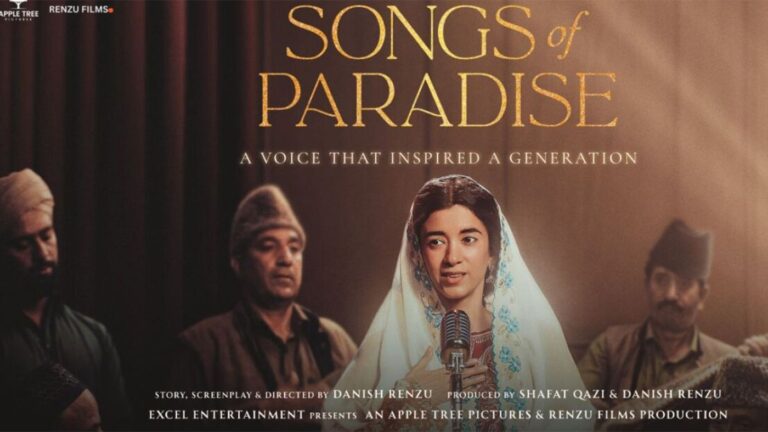
Songs of Paradise is inspired by the life of Raj Begum, Kashmir’s first female playback singer. The film tells the story of Zeba Akhtar, a young woman growing up in Srinagar in the 1950s. Zeba has a natural gift for singing, but she lives in a society where women are expected to stay at home and limit themselves to marriage and household work. Her father is supportive of her talent, while her mother believes that a girl should never sing in public.
Zeba’s life changes when a respected music teacher, Ustad Nabi, hears her sing at a wedding. Impressed by her voice, he offers to train her. With his guidance, Zeba improves and eventually wins a singing competition that earns her a place at Radio Kashmir. To protect herself from criticism, she begins performing under a new name, Noor Begum.
At Radio Kashmir, Zeba finds herself in a world dominated by men. There are no basic facilities for women, and she often feels out of place. Yet her voice soon captures the attention of listeners across the Valley. Along the way, she is supported by Azaad, a progressive poet who becomes her mentor and later her husband. Together they help shape her identity as a singer.
The film also shows the older Noor Begum, played by Soni Razdan, living a quiet life in Srinagar. When Rumi, a young music student from Berkeley, visits her, she is reluctant to speak at first. Slowly, she begins to recall her journey, reflecting on her struggles and achievements.
At its heart, the story is about a woman who refused to be silenced. Despite opposition from her family and society, Zeba chose music as her path and became a voice that represented both freedom and resilience in Kashmir.
Performances?
The film lives and dies with its performances, and unfortunately, this is where Songs of Paradise struggles the most. Saba Azad, who plays the young Zeba, has a natural screen presence and is a trained singer in real life. One would expect her to carry the musical sequences with ease, but her performance feels a bit flat. She never quite embodies the fire of a young woman who is defying the norms of her time. In scenes where Zeba is supposed to be full of passion, whether practicing music or standing up to her mother, Saba appears too restrained, almost expressionless. The emotional depth required for the role is missing, and this weakens the film’s central arc. The thing which stands out the most is the accent. Saba employs a very heavy and made-up Kashmiri accent and that is not very pleasant on the screen.
Soni Razdan, as the older Noor Begum, brings dignity to her role but struggles with consistency. Her portrayal is good, but her accent and mannerisms feel disconnected from the younger version played by Saba. It becomes difficult for the audience to believe that these two women are the same person. This lack of continuity hurts the storytelling.
Analysis
Songs of Paradise is a film that begins with immense promise but loses its way in execution. On paper, the story is deeply powerful. It is based on the life and struggles of Raj Begum, the first recorded female singer of Kashmir. Her contribution to Kashmiri music was historic, and her story deserved a moving, layered, and unforgettable film. Unfortunately, what we get is a diluted version of that struggle, presented with sincerity but lacking bite.
The script is the biggest culprit. Danish Renzu sets the stage beautifully in the opening. The narration of an aged Noor Begum instantly pulls the audience into the world of Kashmir, its lush valleys, and its cultural history. We are told we will see the rise of a girl who challenged her society and became the voice of a generation. But once the story gets going, the conflicts feel shallow. For a film built on the idea of “struggle,” the hurdles Zeba faces are almost laughably soft. Her strict mother is portrayed as the biggest obstacle, while the patriarchal society around her barely resists. Men who should have opposed her suddenly agree, sometimes in a single scene. This makes the journey feel unearned. The struggles of a Kashmiri woman in the 1950s could have been heart-wrenching, but here they are watered down into convenient storytelling.
The pacing of the film adds to the problem. At 1 hour and 47 minutes, the runtime is crisp, but the storytelling feels flat. Every scene moves at the same energy level. The highs never soar, and the lows never hit hard. You expect to feel goosebumps when Zeba first sings in defiance of society, but the direction plays it safe. Even the moments of revelation, like when Zeba becomes Noor Begum, are handled without intensity. It feels like a film that is afraid of its own subject matter.
Where the film does succeed is in its intentions. Danish Renzu treats the subject with respect. The idea of celebrating Kashmiri culture and honouring Raj Begum’s forgotten legacy is noble. The cinematography captures the valley with elegance, avoiding tourist-like shots and instead framing Kashmir as lived-in and real. The dialogue, too, occasionally sparkles with poetry, giving glimpses of what the film could have been.
But intention alone cannot save a film. Songs of Paradise wants to be a stirring tribute, but its lack of dramatic weight makes it feel more like a polite television film than a powerful cinematic experience. By sanding down the rough edges of Noor Begum’s life, the film denies her the epic treatment she deserves. Instead of making the audience feel the fire of rebellion, it leaves them mildly appreciative at best.
In the end, Songs of Paradise is important because of what it attempts, not because of what it achieves. It opens a window into Kashmiri history and introduces a new generation to the idea of Noor Begum. But as cinema, it falls short. This is a film that should have shaken us with its music, moved us with its performances, and haunted us with its conflicts. Instead, it leaves us asking: where was the real struggle?
Music and Other Departments?
Music, ironically, is another missed opportunity. For a film celebrating a singer’s legacy, you expect the soundtrack to linger in your memory. While the Kashmiri melodies are soothing, they feel repetitive and fail to create a distinct identity. There are no standout songs that one can feel like singing. Here, I remember Qala. A film that made music its biggest strength. The songs do the talking and even bring audiences. Here nothing of that sort works.
Beyond the big elements of story, music, and performances, a few minute details stand out. The production design, for instance, deserves some credit for recreating the Kashmir of the 1950s without resorting to glossy exaggeration. The costumes feel authentic, especially the pherans and traditional jewellery. The dialect work is surprisingly consistent, with most actors maintaining an exaggerated Kashmiri accent that roots the film in its setting.
Other Artists?
On the other hand, Taaruk Raina as Rumi, the music student from Berkeley, adds some freshness to the screen. His role is not very demanding, but he plays the part with sincerity. Zain Khan Durrani, as Azaad the poet, is another bright spot. He brings intensity and conviction to his lines, and his chemistry with Saba feels natural. His character could have been written with more depth, but his performance still stands out among the cast.
The supporting actors, including Sheeba Chaddha and Lilette Dubey and fellow musicians, are competent but not memorable. Too much focus seems to have been placed on getting the Kashmiri accent right, which results in several characters sounding forced rather than authentic.
Overall, the performances do not rise to the occasion. In a film that celebrates the voice of a revolutionary singer, the acting often feels muted. A stronger cast could have elevated the story and added the emotional weight it deserved.
Highlights?
Soni Razdan
Setting
Attempt
Drawbacks?
Performances
Script
Execution
Did I Enjoy It?
In parts
Will You Recommend It?
If you have nothing else to watch.
Songs Of Paradise Review by Binged Bureau
We’re hiring!
We are hiring two full-time junior to mid-level writers with the option to work remotely. You need to work a 5-hour shift and be available to write. Interested candidates should email their sample articles to [email protected]. Applications without a sample article will not be considered.
