
































































What Is the Story About?
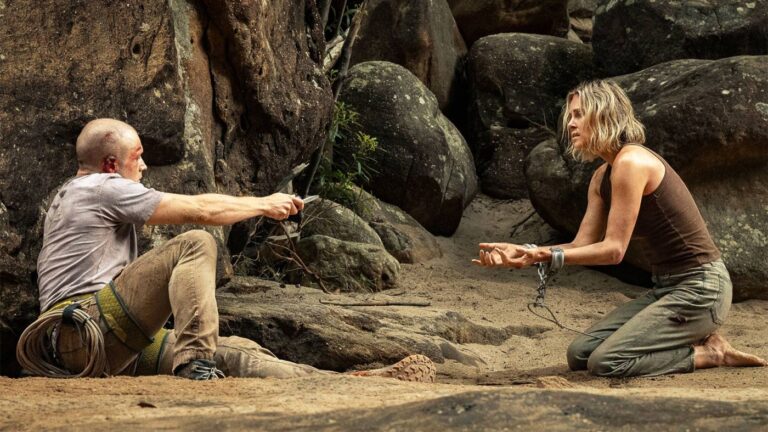
Sasha (Charlize Theron), a professional rock climber, is haunted by a tragic accident that claimed her partner’s life during a climb in Norway. In an attempt to find peace and process her grief, she travels alone to the rugged wilderness of the Australian Outback to hike and kayak through the remote Wandarra National Park.
However, her quest for solitude turns into a fight for survival when she crosses paths with Ben (Taron Egerton), a local man who initially seems helpful but is revealed to be a cold-blooded killer.
Ben treats the wilderness as his private hunting ground and decides that Sasha (who remains with limited supplies) is his next prize. He gives her a brief head start before beginning a relentless, high-stakes game of cat and mouse across the dangerous terrain.
Performances?
The acting in Apex is undoubtedly the movie’s strongest aspect. Charlize Theron delivers a stoic and physically demanding performance.
Dealing with a painful trauma of losing her husband, Theron plays Sasha with silence, hollowness, and bruised yet determined persona. She doesn’t lose her calm or shout at anyone easily. Instead, she displays her grief through her expessions and the manner in which she relentlessly pushes her body to the limit.
Theron’s restrained emotions work well as they show how detached and depressed she has become after losing the love of her life. As usual, Theron is excellent in the action scenes, performing many of her own stunts and making Sasha’s survival instincts feel very believable.
Also, we see a new layer of vulnerability this time from Theron. It’s been a while since she has portrayed a character like this, and she nailed it. Her transition from a grieving wanderer to a resourceful survivor is seamless, making every scrap and climb feel incredibly grounded and earned.
Analysis
Apex is a lean, mean survival machine that doesn’t reinvent the wheel but certainly knows how to spin it. Directed by Baltasar Kormákur, the film feels like a spiritual successor to classic outdoor thrillers, stripping away the noise to focus on a high-stakes hunt.
The narrative is straightforward: it’s a pure “man vs. wild vs. maniac” setup that trades complex subplots for a steady build-up of dread. While the story might feel a bit thin for those seeking deep lore, its simplicity is its strength, allowing the pacing to stay tight and the stakes to remain crystal clear.
The direction and atmosphere are where the movie truly shines. Kormákur utilizes the vast, sun-drenched landscapes of the Australian Outback to create a feeling of a blend of openness and claustrophobia.
The cinematography makes the wilderness look both breathtaking and hostile, with the camera often lingering on the jagged rocks and rushing water that Sasha must navigate.
The atmosphere shifts beautifully from the somber, quiet grief of the opening act to a frantic, heartbeat-skipping tension once the hunt begins.
On the downside, some of the dialogue feels a bit cliched and straightforward. We don’t get any memorable dialogue in this one. But the conversations we get between Sasha and Ben and particularly, Sasha and Tommy (in the beginning) are intriguing to watch and they play an important role in adding plenty of depth to the movie’s story, even if the story feels a bit thin.
When it comes to the action and set pieces, Apex goes for grit and realism over gloss. The stunts feel heavy and dangerous, focusing on the grueling reality of rock climbing and navigating rough terrain under pressure. The kayak sequence and the final vertical face-off are standout moments that use the environment as a weapon.
These aren’t your typical “superhero” action beats. They are desperate, messy, and physical. However, some viewers might find the middle act a bit repetitive, as it settles into a loop of “hide, run, climb” that occasionally slows the momentum.
The characterization in Apex is built on sharp contrasts. Sasha is defined by her “quiet strength,” evolving from a woman paralyzed by grief into a primal survivor who regains her will to live through sheer physical grit.
In contrast, Ben is a menacing and deranged figure, a villain who hides his predatory nature behind a mask of local hospitality. While the supporting roles remain thin, this central tug-of-war between Sasha’s resilience and Ben’s calculated cruelty keeps the stakes personal.
Ultimately, Apex succeeds by knowing exactly what it wants to be. The pros are stunning visuals, intense physical action, and a terrifyingly grounded and creepy villain, far outweigh the cons of a predictable script and occasional clunky dialogue.
It’s a stylish, atmospheric thriller that reminds us that sometimes the most effective stories are the ones where the only goal is to make it to the next sunrise.
Music and Other Departments?
The music is a clever mix of high-energy needle drops and a haunting original score. Composer Högni Egilsson creates a sense of awe and terror using orchestral swells that make the mountains feel alive.
The sound design is arguably the film’s secret weapon. In a movie where the hero is often silent, the environment speaks for her. The crunch of gravel, the whistle of the wind through canyons, and the distant, rhythmic splashing of a kayak are all amplified to make the isolation feel heavy.
Cinematographer Lawrence Sher gives the film a high-end, cinematic look. He uses sweeping aerial shots to show how small Sasha is compared to the vast wilderness, contrasted with shaky, tight close-ups during the chases to make you feel her panic.
The use of fluid, one-shot tracking sequences during the scrambles and falls adds a layer of realism that keeps you glued to the screen. However, the movie does suffer from poor VFX quality, particularly during the underwater scenes. Also, there are some glossy moments where the CGI looks a bit too perfect, occasionally distracting us.
Since director Baltasar Kormákur (helmed Everest) loves “extreme” filmmaking, there was a huge emphasis on practical stunts. Theron performed many of her own climbing sequences, which adds a layer of authenticity that digital doubles just can’t match.
Other Artists?
Taron Egerton is clearly having the time of his life playing Ben, the local predator. He brings a smiling, yet creepy and deranged vibe to the role. He genuinely looks unsettling throughout the movie. One moment he’s offering a friendly tip, and the next, he’s hunting with a cold, psychotic, and calculated glee.
While Charlize Theron keeps us glued to the screens, Egerton keeps us on the edge of our toes. His character helps in maintaining tension throughout the film. He uses a mix of manic energy and sudden silences to keep the audience (and Sasha) on edge.
His charisma and menacing presence make him one of the most memorable Netflix villains we’ve seen in a while.
Eric Bana doesn’t get much screentime in Apex. He plays Tommy, Sasha’s partner. But he does get a memorable, and deeply emotional cameo in the prologue. As Tommy, Bana brings a much-needed emotional warmth. His brief presence provides the “ghost” that haunts Theron for the rest of the film.
Highlights?
Gripping lead performances
Grounded and impactful action sequences
Immersive atmosphere
Good cinematography and sound design
Drawbacks?
Predictable story
Clunky dialogue
Improper use of Bana
Some scenes involving poor VFX
Did I Enjoy It?
Liked the visceral, high-stakes energy of the film and was particularly gripped by the intense physical performances from Theron and Egerton. While the script felt a bit predictable at times, the stunning cinematography and the “man vs. wild” atmosphere keep us engaged from start to finish.
Will You Recommend It?
Yes, especially to those who are looking for a stylish, gritty survival thriller that prioritises tension and realism over complex plotting. It’s a must-watch for fans of Charlize Theron’s action work, even if you have to overlook some of the clunky dialogue and occasional VFX slips.
Apex Netflix Movie Review by Binged Bureau
We’re hiring!
We are hiring two full-time junior to mid-level writers with the option to work remotely. You need to work a 5-hour shift and be available to write. Interested candidates should email their sample articles to [email protected]. Applications without a sample article will not be considered.
