
































































What Is the Story About?
Glory begins with a violent incident that pulls a broken family back together. A young boxer, Nihal, is killed while trying to elope with Gudiya, the daughter of his coach Raghubir Singh. Gudiya survives the attack but is left in critical condition. This brings her two brothers, Dev and Ravi, back to their hometown in Haryana, a place deeply tied to boxing.
The brothers have a strained relationship with their father. Raghubir is a respected coach but a harsh parent whose obsession with success has already damaged the family. Dev carries anger while Ravi is still trying to find his place after walking away from boxing in the past. The attack forces them to work together, even though old wounds remain.
As they begin to search for answers, the story opens up into a larger world. There are multiple suspects, including rival boxing figures, local power players, and community leaders who oppose the relationship between Nihal and Gudiya. The investigation is also driven by anger and revenge.
At the same time, Ravi returns to boxing as part of the plan to get closer to the truth. This creates a parallel track where sport and violence begin to overlap. The boxing ring is no longer just about competition. It becomes a space tied to personal loss and unfinished conflict.
The story moves between these two threads. One follows the search for the attackers. The other explores how the family deals with its past and its expectations. As the layers unfold, the show tries to connect personal trauma with a larger system.
Performances?
The performances in Glory are uneven, but they keep the show from falling apart completely.
Divyenndu stands out the most. As Dev, he brings an anger that feels like something that has been building up for years. He does not overplay the bitterness. In scenes with his father, you can see the resentment sitting just under the surface. Even when he is still, there is tension in the way he looks and listens. It adds weight to a character that could have easily become annoying.
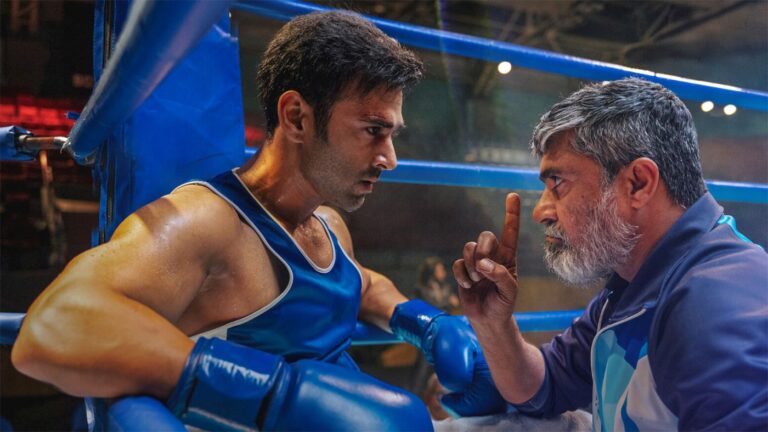
Pulkit Samrat approaches Ravi very differently. He is more open, more expressive, and physically convincing as a boxer. The training sequences and fight moments look natural to him. But emotionally, his performance does not always hold the same depth. In key dramatic scenes, his sincerity sometimes feels too neat, as if the character’s struggle is being simplified.
Suvinder Vicky brings authority to Raghubir. He does not need long speeches to establish control. A glance is often enough. At the same time, the role limits him. The writing keeps him within familiar territory of the strict, regretful father, and the performance cannot fully move beyond that.
Kashmira Pardeshi leaves an impression in a smaller role. But the writing pushes her into exaggerated territory later, which weakens the impact.
Sayani Gupta’s character is more functional than fully formed. Ashutosh Rana and Sikandar Kher have presence, but they are not given enough space to build anything memorable.
Overall, the actors try to ground the material, but the writing does not always support them enough.
Analysis
Glory sets up an interesting mix of genres. It begins as a violent crime story but slowly opens into something larger. It looks at a family shaped by expectation and tries to connect that world with themes of honour and ambition. On paper, this is a strong idea. A sports drama that uses a murder investigation to explore what drives people inside and outside the ring. At its best, the show comes close to achieving that.
The opening episodes work well because they are focused. The attack on Nihal and Gudiya creates immediate tension, and the return of the two brothers brings emotional weight. The fractured relationship between the father and his sons is established clearly. You understand the history without it being explained too much. There is anger, guilt, and unfinished business, and that gives the story a strong base.
The world of boxing is also presented with some authenticity. You see the discipline, the pressure, and the constant push to perform. There is also a clear attempt to show how sport becomes a way out for many, especially in a place where success is tied to family pride.
However, the show begins to lose its grip as it tries to handle too many things at once. The crime investigation, the sports journey, and the social commentary start to pull in different directions. Instead of building on each other, they often feel like separate tracks. The mystery becomes less engaging because it is stretched out, and at the same time, the emotional arcs do not get enough space to deepen.
One of the biggest issues is the predictability of the central reveal. The show tries to build suspense, but the answer becomes clear much earlier than intended. As a result, the later episodes rely more on shock value and violent moments to maintain interest. These scenes create impact in the moment, but they do not add much to the overall story.
The writing also struggles with balance. It introduces strong ideas like caste pressure, toxic masculinity, and the cost of ambition, but does not explore them fully. These themes appear in parts, but they do not come together in a meaningful way. At times, the show leans towards realism, and at other times, it shifts into a more dramatic, almost exaggerated tone. This inconsistency makes it harder to stay fully invested.
That said, there are moments where the show feels grounded and effective. The dynamic between the brothers and their father carries emotional weight, even when the narrative around them becomes uneven. Some supporting characters add texture to the world, even if they are not fully developed.
In the end, Glory feels like a series that had strong intentions but struggled with execution. It offers enough to stay engaging, especially in its performances and initial setup, but it does not fully deliver on the depth it promises.
Music and Other Departments?
The background score adds energy to the boxing scenes and helps build tension, but it can feel loud in dramatic moments. The music itself is not very memorable. Visually, the gyms and small-town settings feel grounded, though some scenes look staged. The action is raw and sometimes excessive. Editing keeps the pace steady early on, but later episodes feel stretched and uneven.
Highlights?
Divyenndu
Setting
Drawbacks?
Screenplay
Too many things happening at once
Did I Enjoy It?
In parts
Will You Recommend It?
Only if you love sports drama
Glory Netflix Series Review by Binged Bureau
We’re hiring!
We are hiring two full-time junior to mid-level writers with the option to work remotely. You need to work a 5-hour shift and be available to write. Interested candidates should email their sample articles to [email protected]. Applications without a sample article will not be considered.
