































































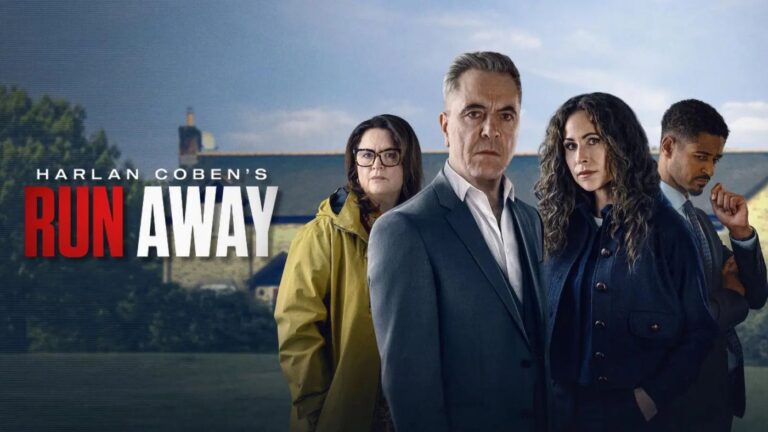

What Is the Story About?
In Harlan Coben’s Run Away, Simon Greene is a financial advisor desperate to find his drug-addicted daughter, Paige, who fled home to live with her abusive boyfriend, Aaron. When Simon tracks her to Central Park, she flees again, and Aaron is later found brutally murdered.
As Simon and his wife, Ingrid, search for the truth, they are drawn into a dark conspiracy involving a shadowy cult and a series of professional hits targeting people linked by a hidden past. The mystery deepens when a private investigator and a pair of cold-blooded killers cross paths with Simon.
Ultimately, the story uncovers a shocking family secret involving DNA, long-held lies, and the lengths a parent will go to protect their child. Simon must navigate a web of violence and betrayal to bring Paige home and face the truth about his own family’s history.
Performances?
James Nesbitt (Simon Greene) looks great as the desperate father doing whatever he can to bring his daughter back safely. His character maintains professional composure alongside the raw, intense, and frantic energy of a parent slowly losing his grasp on his family. He delivers a truly dedicated performance and helps us digest plenty of plot twists, despite them appearing far-fetched or a bit ridiculous.
However, his occasional colourful and fun banter with other characters, particularly with Elena Ravenscroft (played by Ruth Jones), sucks a large portion of the seriousness and emotional connection with Simon and other characters out of the show, as many of these well-intentioned but poorly placed jokes and exchanges don’t land well at all and feel off, considering the show’s themes and plot points.
Ellie de Lange, as Paige Greene, the daughter whose addiction and disappearance drive the plot, bestows a broken, realistic, and vulnerable performance. In fact, her character is one of the rare ones that remains realistic and natural by the time the season ends.
Ruth Jones’s turn as a private investigator feels like a refreshing change. Her chemistry with her mother-in-law and with Nesbitt is one of the few things that actually hold the series together, although some of her banter with Nesbitt fails to land well.
Still, she gives a very layered performance here. She comes across as sly and smart in front of Simon, while bringing out a more emotionally vulnerable and genuine side in front of her mother-in-law, who also happens to be a techie. Yes, it doesn’t make much sense, but it is Harlan Coben’s world, after all.
Minnie Driver as Ingrid Greene appears quite the opposite of Simon, and notably colder, in this series. She gives a nuanced portrayal of a woman who is both grieving and pragmatically trying to protect the rest of her family from Simon’s obsession. However, she deserved more screen time. A performer of Driver’s calibre certainly warrants it. The makers of Emily in Paris Season 5 made the same mistake with her, as she was undoubtedly one of the biggest positives to come out of that otherwise largely forgettable season.
Analysis
Harlan Coben’s Run Away (developed by Danny Brocklehurst) is a mess. A shiny, glossy, but still hot, steaming mess. Despite a few noticeable positives, the list of what’s wrong with the show is too big to ignore. While the production values are high, the series often struggles under the weight of its own complex mechanics.
One of the biggest issues with this latest Netflix title is the lack of seriousness and grimness required, given the crime-thriller genre it attempts to explore and the nature of its plot elements.
For those who enjoy crime thrillers with committed performances and grim or dark atmospheres, Run Away is definitely not for you. In fact, we’re not quite sure why this sort of series was greenlit in the first place. One solid reason would be Harlan Coben’s popularity. As for other reasons, well, we’re still looking for them.
Run Away’s soaring popularity and its high position on global rankings, as well as the Top 10 charts in India, are solid proof of how badly Netflix has deteriorated audience viewing habits. As long as a crime thriller contains plenty of blood, a sufficient amount of gore, and passable performances, it seems to work, at least on Netflix, even if it is stylish, glossy, and colourful.
Considering its themes and plot elements, one might expect the series to be a gripping and hard-hitting watch. But nope, that’s simply not the case here. No matter how grim or twisty the storyline gets, the show never sheds its polished, vibrant, and stylish aesthetic.
To make matters worse, the series doesn’t shy away from being over-theatrical. The dramatic, tense, soap-opera-style sound effects used during many intense confrontations between characters diminish the seriousness and emotional connection required to stay invested, bit by bit.
It’s fine to add a pinch of humour to a dark crime thriller, but the amount of humour in Run Away is excessive, so much so that it stops making sense after the first two or three episodes. The series is also brimmed with plot twists, and by the time it nears its conclusion, it comes terrifyingly close to tripping over its own narrative devices.
Like many eight-episode Netflix series, Run Away suffers from the infamous mid-season drag. Episodes four and five focus heavily on the side investigation involving the private investigators, slowing the momentum of Simon’s search. That said, the remaining episodes are relatively tightly paced, allowing viewers to finish the series quickly.
For the plot to function, Simon repeatedly happens to be in the right place at the right time. The transition from a missing-person story to a DNA conspiracy feels disjointed and may leave viewers feeling as though they’re watching two different shows awkwardly stitched together.
The direction, one of the show’s biggest weaknesses, leans far too heavily into prestige-TV tropes. Frequent slow-motion shots (mainly in the flashbacks) and brooding silences attempt to inject gravitas into what is ultimately a pulpy thriller.
Moreover, the mid-season action choreography is poor, suffering from lazy staging, weak VFX, and excessive blood spillage. Most importantly, one has to ask: was this sequence needed at all? Nope.
Dialogue is another department in which Run Away fails spectacularly. Because the plot is so intricate, characters often spend entire scenes explaining the story to one another.
Music and Other Departments?
The score by Luke Richards and David Buckley largely remains atmospheric and propulsive, using a mix of electronic pulses and sombre strings to mirror Simon’s internal panic. However, it can sometimes become overly intrusive. In moments of quiet tension, the music occasionally swells to a melodramatic level, telling the audience exactly how to feel rather than allowing the silence to build naturally.
As mentioned above, the cinematography is another significant flaw in Run Away. How can one expect viewers to remain serious while watching a crime thriller when the screen appears so bright, colourful, and glossy?
Furthermore, the dreamy haze filters used in flashbacks are a tired cliché, making certain pivotal memories feel more like scenes from a soap opera than moments in a gritty thriller.
The production team does an excellent job of making the Marinduque Estate feel like a living, breathing character, a maze of concrete and shadows that feels genuinely dangerous. Conversely, the cult setup looks far too much like a movie set, appearing overly polished and architectural.
Other Artists?
The professional assassin duo, Jon Pointing (Ash) and Maeve Courtier-Lilley (Dee Dee), take some inspiration from the Pumpkin–Honey Bunny arc in Quentin Tarantino’s classic Pulp Fiction and put a decent twist on it.
Pointing looks a bit flat in the series’ first half, while Courtier-Lilley doesn’t add anything especially new or exciting to her character, though she looks well-suited to the role. She plays Dee Dee with a cold, calculated stillness, which is occasionally fun to watch.
Pointing, meanwhile, starts to grow on us after the first three episodes, as Ash begins to question the motives of Dee Dee’s secretive cult. However, after a certain point, their quirks and eccentricities become slightly jarring to watch.
Alfred Enoch (Isaac Fagbenle) is a capable actor (How to Get Away with Murder, Foundation), but here he remains restrained and boxed into a procedural corner. His romantic connection with his workforce partner, Ruby Todd (played by Amy Gledhill, who is also largely one-dimensional), fails to connect emotionally. Yes, their chemistry is pleasant to watch, but the romance arc itself feels forced.
In addition, the actors playing the younger members of the shadowy cult-like organisation, The Truthers, come across as either flat or overly theatrical. There is little middle ground, with most leaning heavily into the familiar “brainwashed” trope.
In a series filled with eccentric assassins and high-society drama, Lucian Msamati delivers a performance that feels compelling, gritty, and natural. In fact, his character stands out the most. He portrays a man who has lost his way but found a new purpose in protecting others. His backstory, losing his wife to cancer and his son to addiction, adds a layer of grief that Msamati conveys through subtle, weary expressions rather than grand monologues.
The other Greene children, portrayed by Adrian Greensmith and Ellie Henry, remain underutilised, particularly Henry, though both do solid work with the material they are given. The rest of the cast is serviceable at best.
Highlights?
Strong lead performances, particularly from Nesbitt, de Lange, and Msamati.
High production value
Well-designed sets
Tight pacing
Drawbacks?
Poorly placed humor
Script and dialogue issues
Direction and technical flaws
Character underutilisation
Not-so-great antagonists
Way too many twists
Did I Enjoy It?
Not that much. Run Away was a “guilty pleasure” watch rather than a masterpiece.
Will You Recommend It?
With a few heavy “ifs.” Yes, if you are a “Coben-verse” fan and are looking for a one-time binge-worthy watch, but no, if you want a gritty, realistic crime thriller.
Harlan Coben’s Run Away Netflix Web Series Review by Binged Bureau
We’re hiring!
We are hiring two full-time junior to mid-level writers with the option to work remotely. You need to work a 5-hour shift and be available to write. Interested candidates should email their sample articles to [email protected]. Applications without a sample article will not be considered.
