































































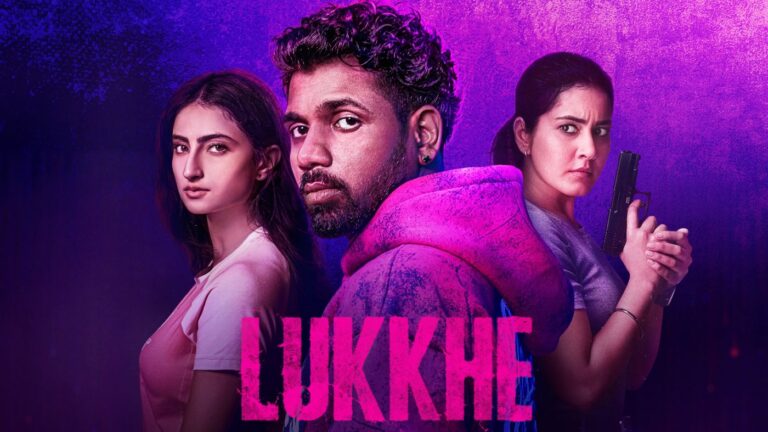

What Is the Story About?
Lukkhe is set in the world of Chandigarh’s underground rap scene, where music, drugs and crime go hand in hand. At the centre of the story is Lucky, a young hockey player struggling with drug addiction after a tragic incident changes his life. During rehab, he meets Sannober, and the two slowly grow close while trying to recover from their own emotional wounds.
But Lucky’s life becomes more complicated once he discovers that Sannober’s brother is MC Badnaam, a famous rapper secretly involved in drug trafficking. Badnaam is already locked in a bitter rivalry with another rapper, OG. It looks like a professional clash but slowly turns personal and violent, pulling everyone around them into danger.
At the same time, police officer Gurbaani is trying to dismantle the drug network spreading across Chandigarh. She sees Lucky as an opportunity to get closer to Badnaam and pressures him into becoming an informant. This places Lucky in a difficult position. He wants to protect Sannober and move on from his past, but he also knows the damage drugs are causing around him.
As the story moves forward, the worlds of rap music, crime, addiction, and revenge begin to collide. Friendships break down, loyalties crumble and characters are forced to choose between survival and morality. The series also explores how fame and power can slowly corrupt people who once had simpler dreams.
While the show uses rap battles and crime drama to create tension, the emotional centre remains with people trying to escape their past while constantly getting pulled back into it. Underneath the violence and music, Lukkhe is really about young people struggling to find identity, control, and belonging in a chaotic environment.
Performances?
The performances in Lukkhe are uneven, but a few actors manage to hold the show together.
Lakshvir Singh Saran is easily the strongest presence in the series. As Lucky, he brings sincerity to a character constantly struggling with guilt, survival, and emotional confusion. He does not overplay the trauma. Even in quieter scenes, especially with his mother or Sannober, there is a visible heaviness in the way he carries himself. His performance gives the show some emotional grounding that the screenplay itself often lacks.
King makes a confident acting debut as MC Badnaam. He does not have the range of a seasoned actor yet, but his screen presence works naturally within this world. The arrogance, emotional instability, and dead-eyed intensity suit the character well. In confrontation scenes and rap performances, he looks completely believable. However, in emotionally vulnerable moments, the limitations in his acting become more visible.
Raashii Khanna brings some sort of maturity to Gurbaani. She avoids making the cop character overly dramatic and gives her enough emotional restraint to feel believable. Some of her scenes are repetitive because of the writing, but she manages to keep the character steady throughout.
Analysis
Lukkhe is one of those shows that constantly feel torn between strong atmosphere and weak execution. It has energy, confidence, and a clear understanding of the world it wants to portray, but it struggles to decide what kind of story it truly wants to tell. At different points, it becomes a rap drama, a crime thriller, a love story, an addiction narrative, and a revenge saga. Some of these tracks work well on their own. Together, they often pull the series in too many directions.
What immediately works in the show’s favour is the setting. Chandigarh’s rap scene is not treated like background decoration. The music, performances, rivalries, and public image of the rappers all feel connected to the emotional lives of the characters. The rap battles are not only about ego or fame. They become spaces where insecurity and power struggles are on the display openly. The series understands that performance itself can become a mask for damaged people trying to survive emotionally.
This is most visible in MC Badnaam. The character works because the show never fully presents him as either hero or villain. He is dangerous, manipulative, emotionally unstable, and still capable of loyalty and affection. King’s casting helps here because his real-world presence naturally fits the role. There is an ease in the performance during musical or confrontational scenes that makes the character believable.
The other strong element is Lucky’s journey. His guilt, addiction, and emotional confusion give the series a more human centre. The scenes involving recovery and his attempts to rebuild his life are among the few moments where the show slows down and allows emotion to settle naturally. His relationship with his mother also gives the story some much-needed emotional texture.
However, the series begins to weaken once it expands beyond its strongest threads. Instead of deepening existing conflicts, the writing keeps introducing more subplots, more backstories, and more characters. Hitmen, gang wars, corrupt officials, revenge arcs, secret operations. The narrative keeps growing outward without strengthening its emotional core. By the second half, the show often feels busy rather than engaging.
One major issue is how addiction is handled. The series wants to speak about rehabilitation and emotional trauma, but it rarely explores either with enough seriousness. Recovery becomes more of a plot device than a lived process. Characters move in and out of dangerous environments too easily, and the emotional consequences of relapse or dependency are simplified.
The love story between Lucky and Sannober is another weak point. The show clearly wants their relationship to feel tragic and emotionally consuming, but the chemistry never becomes strong enough to support that ambition. Too much of the romance relies on music montages and emotional declarations instead of believable intimacy between the characters.
The tonal inconsistency also hurts the series. Some scenes aim for emotional realism, while others lean into exaggerations. The transitions between these moods are not always smooth, especially in the final episodes where the story starts collapsing under its own weight.
Still, Lukkhe remains watchable because it has sincerity underneath the mess. It genuinely tries to connect music, loneliness, and self-destruction within one world. It does not fully succeed, but there are enough strong performances, interesting ideas, and emotionally honest moments to keep it from feeling empty.
Music and Other Departments?
Music is easily the strongest technical aspect of Lukkhe. The rap tracks are not inserted as random crowd-pleasers but woven directly into the storytelling. Diss tracks function like emotional confrontations, while stage performances often reveal the insecurities and frustrations the characters hide in regular conversations. The soundtrack also captures the contrast within Punjab’s music culture, moving between aggressive hip-hop beats, softer romantic tracks, and mood-driven background pieces without feeling completely disconnected.
Visually, the series leans heavily into neon lighting, nightclub spaces, and stylised colour palettes. Blues, purples, and reds dominate scenes involving intoxication, emotional breakdown, or violence, creating a slightly dreamlike atmosphere. Some action sequences, especially the bike chase and concert portions, are staged with energy and rhythm. However, the editing becomes uneven in later episodes as the growing number of subplots begins to crowd the narrative and slow the pacing.
Other Artists?
Palak Tiwari struggles the most among the lead cast. She looks slightly disconnected from the world around her, and the emotional chemistry with Lakshvir Singh Saran never fully develops. Part of the problem is the writing, which treats Sannober more like an idea than a person, but the performance also lacks the emotional depth needed to make the relationship convincing.
Shivankit Parihar brings energy as OG, though he occasionally pushes the aggression too hard. Kritika Bharadwaj and Nakul Roshan Sahdev leave stronger impressions in supporting parts because their performances feel more lived-in and natural.
Highlights?
Music
Performances
Drawbacks?
Too many subplots
Execution of screenplay
Did I Enjoy It?
In parts
Will You Recommend It?
Only if you have nothing better to watch.
Lukkhe Webseries Review by Binged Bureau
We’re hiring!
We are hiring two full-time junior to mid-level writers with the option to work remotely. You need to work a 5-hour shift and be available to write. Interested candidates should email their sample articles to [email protected]. Applications without a sample article will not be considered.
