
































































What Is the Story About?
Starting just after the cliffhanger ending of the first season, Devil May Cry Season 2 takes us back to Dante, who awakens from cryostasis, and Mary (nicknamed Lady by Dante). While the government organisation DARKCOM launches “Operation Inferno” to colonise the underworld, Dante’s long-lost twin brother, Vergil, resurfaces as a formidable champion of the demon king Mundus.
As the brothers’ clashing ideologies spark a violent reunion, Lady navigates the political treachery of the human world. The season explores the tragic Sparda family legacy, culminating in an epic three-way war between humanity, Mundus, and the rival demon lord Argosax.
Performances?
Johnny Young Bosch undoubtedly adds more heart and soul to his voice performance as Dante this season. Did you guys know that he voiced Dante’s cousin, Nero, in the games? Well, it’s cool to see how much he has improved as an artist. And he certainly brings more badassery and emotional vulnerability to the character.
Bosch’s voice work shines brightest when the series takes some deep breaths here and there and adopts a quieter approach. The moments in which we witness Dante confronting his tragic past, the decisions he made, and coming to terms with the fact that what happened cannot be changed, bring out the actor’s best voice work.
Amidst all this, he never loses his cockiness and style. In other words, Dante layers his cockiness with a subtle, fraying edge of trauma. And Bosch does a great job of portraying all these emotions.
Opposite Dante, we get Robbie Daymond’s Vergil. And first of all, allow us to acknowledge Daymond’s work here, because his voice performance is phenomenal. Over the season, we see him shedding his humanity bit by bit under Mundus’ guidance in flashbacks, while ultimately realising by the time we reach the finale that, despite all his frustration, rage, and the pain and hardship he endured under Mundus’ training, he never stopped loving their mother, Eva.
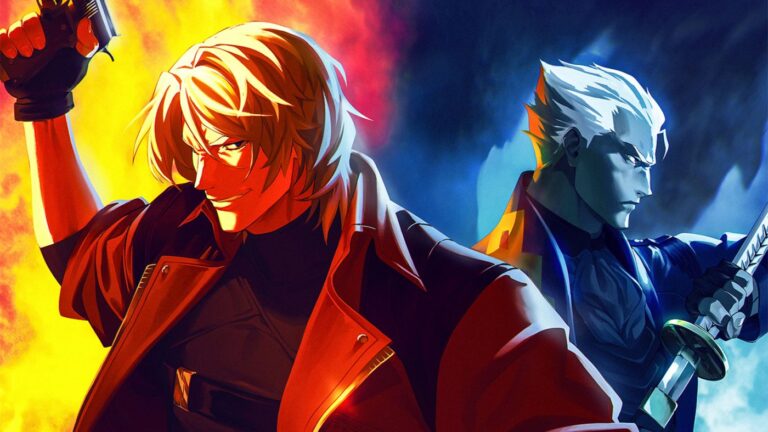
Where Bosch is fire and chaos, Daymond is ice and lethal intent. His Vergil is someone who has been broken down many times (both from the inside and outside), yet he continues to resist and never stops. He uses his rage and pain to mould himself, allowing him to flesh out all his human emotions. Yet, he could never rid himself of his love for his mother, even if he shows very little of it. And the chemistry between Dante and Vergil is electric.
Analysis
Created by Adi Shankar, Devil May Cry Season 2 doubles down on the Sparda family tragedy, blood, action, emotions, and explosive set-pieces, all leading towards a multi-front war that feels significantly more ambitious, even if it occasionally trips over its own shoelaces.
The narrative structure is much tighter and more ambitious this time around. Season 2 wastes no time in accelerating the stakes to the highest of levels by picking up right where Season 1 ended. The story also feels more layered and occasionally takes some big risks, but its greatest strength is its unwavering focus on the conflict between Dante and Vergil.
Still, we see signs of the makers slightly losing their grasp on the script, as the newest season becomes a bit too crowded in the second half.
The show tries to juggle the demon king Mundus, the corporate sorcery of Arius and the havoc caused by his female clone army, the militaristic propaganda of DARKCOM, the political angles impacting the struggle, the bond between Dante and Lady, the lingering fear of Argosax’s chaotic powers, and much more.
Most of these subplots make sense, but all eight episodes (each nearly 32–38 minutes long) don’t provide enough runtime to develop some of them properly.
On top of this, we have the action. This time, the action feels a bit overwhelming. By the time we reach the finale, it starts to feel like Adi Shankar’s team left the “action” button on autopilot mode. We are not criticising the quality of the action, because it is genuinely amazing. The quality of animation in these scenes has massively improved compared to Season 1.
The hand-drawn choreography is fluid, and the creative use of Dante’s arsenal (Ebony & Ivory feel like characters themselves) is a love letter to the games. The integration of 3D CGI for the larger demons is also vastly improved, finally feeling like part of the world rather than an eyesore.
But when you have an anime series of only eight episodes with barely enough runtime and too many subplots, the action definitely starts to feel heavy. Also, the plot, despite appearing better and more layered than Season 1, simply doesn’t have enough meat to stop us from feeling a bit exhausted after watching so much action.
Devil May Cry Season 2 tries its hardest to evoke nostalgia for the 2000s with its rap-metal and punk rock-infused soundtrack. We get an electronically charged guitar-based opening theme from Power Glove (though it doesn’t hit quite the same way as “Rollin’” by Limp Bizkit did), “Let the Bodies Hit the Floor” by Drowning Pool, “Sk8er Boi” by Avril Lavigne, and many other hit tracks in the first five episodes.
These tracks help elevate several important scenes. However, they also end up overshadowing Power Glove’s score for the series, which itself appears heavily inspired by the emo and punk rock era of the 2000s.
One major issue that emerges as an obstacle to the second season’s growth is its tonal inconsistency. The moment we begin emotionally investing in the characters and their respective tragedies, an oddly light-hearted comedic element suddenly pops up out of nowhere and disrupts the tone.
There is one episode where Dante and Lady try to stop Arius from awakening Argosax, and they seek help from one of Dante’s former clients, who happens to wield Makai’s powers. Within seconds, we see them trying hard to keep the client’s granddaughter occupied through cartoonish antics (yes, we hear Avril Lavigne’s “Sk8er Boi” during this sequence). The final three episodes, however, feel far more consistent in terms of both storyline and tone.
Character-wise, Season 2 is a massive step up. Dante feels less like a passenger in his own story compared to Season 1. He’s more vulnerable, grizzled, and carries a palpable sense of exhaustion. Vergil, meanwhile, is the season’s MVP. He isn’t just a stoic villain. He’s a “tone-shifting” presence whose arrival redefines the series’ power scale.
Lady (Mary) occasionally feels sidelined as the brotherly drama takes centre stage, which might frustrate fans of her prominent role in the debut season. However, her romantic angle with Dante works well.
The dialogue remains a “love it or hate it” affair. It’s unashamedly campy, filled with one-liners and “Jackpot!” moments that fit the franchise’s DNA but might make prestige-TV fans roll their eyes. Yet, there’s a newfound sincerity in the way the brothers speak to each other that helps ground the silliness.
Ultimately, Devil May Cry Season 2 is a messy, beautiful, and hyper-violent evolution. It trades the simplicity of the first season for a complex, lore-heavy epic. It’s not perfect, but when the swords clash and the soundtrack kicks in, it becomes one of the best game-to-anime adaptations currently streaming.
Other Artists?
Scout Taylor-Compton delivers a performance as Lady (Mary) that is miles better than her work in Season 1. She excels at capturing Mary’s professional friction with Dante. Her voice carries a weary, “I’m too old for this” energy. Yet, she manages to make Mary feel like a formidable threat to demons despite her lack of supernatural powers. And some of her lines hit hard.
There is a bittersweet weight to every line delivered by the late Kevin Conroy as William Baines. Known for voicing the ultimate hero, Conroy leans into a very different kind of authority here, one that is cold, pragmatic, and dangerously self-righteous. And the great voice of “Batman” does a flawless job here, too.
Fans of Netflix’s Castlevania will immediately recognise Graham McTavish’s voice as Arius. McTavish brings a sophisticated, “theatrical” villainy to the supremely powerful and cunning CEO of Uroboros. Unlike the chaotic demons Dante usually fights, McTavish’s Arius sounds like a man who has already won. His delivery is oily and arrogant, making him genuinely threatening.
Ray Chase voices the series’s most ancient evil, Mundus, and he pulls it off by going big. He successfully makes you feel the immense power gap between the demon king and everyone else, ensuring that even when Mundus isn’t on screen, his presence looms over the narrative like a shadow.
Music and Other Departments?
Studio Mir has always been a powerhouse, but in Season 2, they’ve managed to fix the most glaring issue from the debut: the jarring 3D CGI.
The problems with Season 1 often involved clunky-looking 3D demon fodder that didn’t match the hand-drawn backgrounds. In Season 2, the blend is significantly smoother. The larger-than-life bosses, particularly the more abstract forms of Mundus, feel like they occupy the same physical space as Dante.
The score and the soundtrack are love letters to the era of punk rock and rap-metal from the early 2000s. Following the tradition of using Evanescence’s “Afterlife” in Season 1, the new episodes feature tracks like “My Immortal” and a Power Glove remix of “Meet Me in the Afterlife.” However, at least a couple of the licensed tracks used this season don’t fit well.
We witness a more deliberate colour tone this season. Dante’s scenes are often washed in warm, chaotic oranges and reds, while Vergil’s presence brings a chilling, clinical blue to the screen.
The contrast between the sleek, high-tech DARKCOM facilities and the rotting, organic architecture of the Underworld (Makai) is visually striking. The technical team has done an excellent job using lighting to heighten the horror elements, making the demons feel genuinely grotesque rather than just cool targets.
Highlights?
Better emotional focus
Dante-Vergil conflict
Vergil’s layered characterisation and emotional complexity
Ambitious and layered narrative
Improved integration of 3D CGI in animation
Nostalgic punk rock and rap-metal soundtrack
Strong supporting cast
Drawbacks?
Some underdeveloped subplots
Action feels a bit overwhelming
Tonal inconsistency
Some licensed songs feel misplaced
Lady (Mary) is somewhat sidelined
Narrative looks a bit overcrowded in the second half
Did I Enjoy It?
Yes, enjoyed Devil May Cry Season 2 despite its flaws. The emotional conflict between Dante and Vergil, the improved animation, and the brutal action sequences keep us invested throughout.
Will You Recommend It?
Yup. We know it’s messy and occasionally overcrowded, but the emotional core and spectacle make it worth watching.
Devil May Cry Season 2 Series Review by Binged Bureau
We’re hiring!
We are hiring two full-time junior to mid-level writers with the option to work remotely. You need to work a 5-hour shift and be available to write. Interested candidates should email their sample articles to [email protected]. Applications without a sample article will not be considered.
