
































































What Is the Story About?
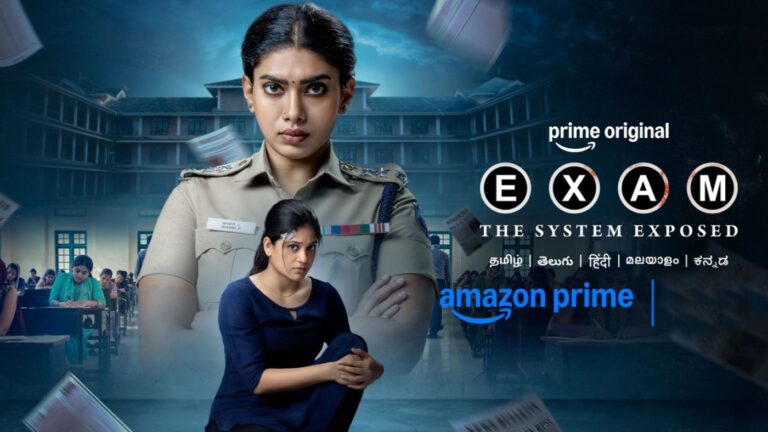
Exam begins with a woman named Jhansi kidnapping Maramalli, a newly appointed Deputy Superintendent of Police, just before she takes charge in a hill town in the Nilgiris. Jhansi then assumes her identity and starts living as the new DSP while the real Maramalli is secretly held captive.
At first, the reason behind this risky impersonation doesn’t quite make sense. But slowly, the series reveals that Jhansi is trying to expose a large entrance exam scam connected to government jobs and civil services recruitment. Along with former jailor Jayachandran and a small team of people who have themselves suffered because of corruption in the system, she enters the police department to investigate the network from inside.
The scam involves leaked question papers, dummy candidates, coaching centres working with middlemen, and wealthy aspirants paying huge amounts of money to secure ranks. The series shows how deserving students are pushed aside while influential people manipulate the process for profit.
Running parallel to Jhansi’s mission is the story of Kumaresan, a bright student whose education and future are damaged because of poverty and systemic failure. His track gives the larger scam a human face and reminds the viewer what is actually at stake behind all the investigations and conspiracies.
As Jhansi gets deeper into the operation, maintaining her false identity becomes increasingly difficult. Police officers, locals, and even Maramalli’s own parents begin to grow suspicious. At the same time, the people running the scam start sensing that someone is getting dangerously close to exposing them.
While Exam is structured like a thriller, the story is really about how corruption inside competitive exams destroys trust, opportunity, and the belief that merit alone can change lives.
Performances?
Dushara Vijayan carries most of Exam on her shoulders, and for the most part, she succeeds in holding the series together. As Jhansi, she has to constantly balance fear, intelligence, and desperation while pretending to be someone else. In the early episodes especially, she creates believable tension in ordinary scenes where Jhansi is simply trying not to get exposed. However, the performance becomes uneven in later portions where the writing turns more dramatic. Some emotional scenes feel rushed, and her reactions occasionally become too loud for a character who is supposed to survive by impersonating someone else.
Aditi Balan leaves a strong impression despite limited screen time. She brings authority and discipline to Maramalli without overplaying the toughness. The scenes where the character’s personal history slowly emerges are among the more emotionally grounded moments in the series. The problem is that the script sidelines her for long stretches.
Analysis
Exam arrives at a time when conversations around competitive exams in India are troubling governments. The recent NEET UG paper leak controversy once again exposed how deeply broken and unequal the system can become. Lakhs of students prepared for years, only to watch the credibility of the entire process collapse because of corruption and negligence that had nothing to do with them. That frustration, helplessness, and distrust form the emotional space from which Exam begins. The series clearly understands the sensitivity of this subject. The problem is that it never fully translates that urgency into gripping drama.
The ambition behind the show is genuinely admirable. Instead of turning exam corruption into a simple social message, the series attempts to build a thriller around it. A woman impersonating a police officer to expose a large-scale entrance exam scam is a strong setup. There is paranoia, danger, identity deception, and institutional corruption built into the premise. For the first few episodes, the show almost convinces you that it might become something truly sharp and unsettling.
The early portions work because they focus on process and tension rather than melodrama. Jhansi learning to survive as Maramalli, avoiding suspicion inside the police station, handling unexpected questions, and navigating a hostile environment create genuine intrigue. The series is at its best when it quietly observes how difficult it is to maintain a lie under constant scrutiny.
The portions explaining the mechanics of the scam are also effective. The use of leaked papers, dummy candidates, corrupt coaching networks, and middlemen reflects a system where merit slowly becomes meaningless for ordinary students. The parallel story involving a talented student losing his future because of poverty and systemic corruption adds emotional weight to the larger issue.
But somewhere around the midpoint, the series begins to lose control of its own material. Instead of deepening the investigation or exploring the emotional cost of such corruption, the writing starts leaning into familiar thriller shortcuts. CCTV cameras, phone tracking, hidden masterminds, and convenient escapes slowly replace the grounded tension established earlier.
The biggest problem is that the show never generates the intensity the subject deserves. This is a story about ruined futures, institutional betrayal, and a system that destroys trust in education itself. Yet the emotional impact remains strangely muted. The series keeps telling us the scam is enormous, but it rarely makes us feel the devastation behind it.
The antagonists are another major weakness. For a scam operating at such a large scale, the villains feel surprisingly underwritten and small. The show hints at powerful figures controlling everything from the shadows, but instead of exploring the political and bureaucratic machinery behind these crimes, it reduces the conflict into a more conventional thriller setup. It feels safer than it should.
Dushara Vijayan works hard to hold the centre together, and some supporting performances help maintain engagement, but the writing keeps undercutting them with rushed developments and repetitive scenes. Even the relationship between Jhansi and Maramalli, which could have added emotional complexity, remains underexplored.
What makes the disappointment sharper is the timing. A series like this could have truly connected with audiences right now because the anger around exam corruption is real and widespread. Now the makers couldn’t have guessed that the paper would be cancelled. However, this is a gigantic failure by Prime Video. The material had the potential to become an emotionally charged and politically relevant thriller. Instead, Exam settles for being moderately engaging when it could have been genuinely powerful.
Other Artists?
Abbas gives one of the more balanced performances in the show. His role as Jayachandran needed calmness rather than theatrics, and he understands that well. But the character itself almost disappears midway, reducing his impact.
Among the supporting cast, the actors playing the police officers and local characters fit naturally into the world of the series. None of them feel distracting or overly dramatic.
The weak link is the antagonist side of the story. The villains are written too thinly, and the performances never fully create the threat or intelligence the series needs. As a result, the central conflict often feels easier than it should.
Music and Other Departments?
Sam CS’s background score does its job without becoming memorable. It helps maintain tension during investigation scenes but rarely adds emotional depth. Visually, the Nilgiris setting gives the series a grounded atmosphere and prevents it from looking generic. However, the editing becomes choppy in crucial stretches, especially during action and reveal sequences. The direction also lacks consistency, with some scenes feeling carefully staged while others appear rushed and underdeveloped.
Highlights?
Concept
Drawbacks?
Weak Screenplay
No intensity
Did I Enjoy It?
Not much
Will You Recommend It?
Not really
Exam: The System Exposed Webseries Review by Binged Bureau
We’re hiring!
We are hiring two full-time junior to mid-level writers with the option to work remotely. You need to work a 5-hour shift and be available to write. Interested candidates should email their sample articles to [email protected]. Applications without a sample article will not be considered.
